General Atomics

Engineering the swarm: how software is powering autonomous defence systems

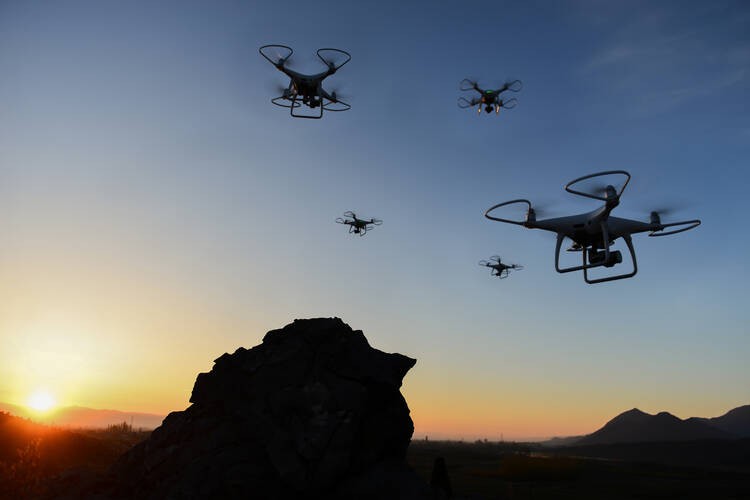
Across skies, seas and battlefields, a new kind of formation is emerging: one made not of pilots and platoons but of intelligent machines acting in perfect coordination. Autonomous swarms are redefining how nations project power, defend assets and respond to threats in real time, creating urgency to develop autonomous systems that can think, communicate and act as one.


Image courtesy PTC


Defence organisations across the globe are investing heavily in swarming autonomy. DARPA’s OFFensive Swarm-Enabled Tactics (OFFSET) programme has demonstrated swarms of hundreds of unmanned air and ground vehicles working together to complete reconnaissance and strike missions.

The Royal Navy is advancing its own autonomous initiatives, deploying AI-coordinated surface and underwater vessels for mine countermeasures through programmes like RNMB Ariadne and Thales’ autonomous minehunting system. Meanwhile, NATO and the European Defence Fund are investing heavily in software-defined swarming capabilities designed to adapt dynamically to emerging threats.

These programmes all point toward the same conclusion: defence superiority is being defined by software. As systems become more autonomous and connected, the real competitive advantage will come from the code that governs system behaviour and the data that drives decision making.

Engineering complexity at scale
Swarming autonomy changes everything about how defence systems are engineered. In a swarm, dozens of autonomous air, land, or maritime vehicles collaborate to achieve shared objectives. Each autonomous platform must meet multiple layers of requirements, from communications and cybersecurity to mission logic and human-machine interaction.

A single change in mission logic or communication architecture can produce cascading effects across the entire swarm, creating emergent behaviours that only surface once systems are tested or fielded. Layer in safety constraints and the need to continuously adapt to an environment and the engineering challenge only becomes more difficult.

Defining system behaviour before the build
Model-based systems engineering (MBSE) helps aerospace and defence organisations mitigate these risks by enabling a system-wide view of how autonomous systems are supposed to interact with each other. Teams can model communication flows, decision logic and mission behaviours in a connected SysML environment to analyse swarm dynamics and expose dependencies before physical testing.

Connecting the digital thread
A system’s behavioural insights only deliver value when they align with programme requirements and system baselines. To turn behavioural insights into a reliable, certifiable capability, systems models must stay connected to requirements, verification data and the broader product context.

Codebeamer enables this connected approach by unifying requirements, risk and verification evidence in a single controlled environment. 

When connected to PTC Modeler, teams can trace each behavioural model back to its originating requirement to understand how system changes affect safety, compliance, or mission objectives. Windchill completes the digital thread by managing configurations, change histories and system context across hardware and software domains to ensure that every update remains tied to the correct configuration and version of the system.

Validating multi-agent behaviour
Bringing behavioural models into simulation tools like MATLAB/Simulink, Ansys, or STK enables engineering teams to test mission scenarios and evaluate swarm performance under realistic conditions. When using these tools with PTC Modeler, systems engineers can validate collective behaviours earlier, refine system logic based on simulation results and maintain end-to-end traceability back to system requirements in Codebeamer and Windchill.

Supporting continuous innovation
Swarming technology is evolving quickly. Defence organisations are continuously refining algorithms, changing mission rules and upgrading platforms. PTC’s collaborative MBSE environment supports this agility through modular, open, reusable systems architecture that lets engineers update mission logic or add new capabilities without rebuilding the entire model.

Engineering the swarm
The capacity to design and coordinate autonomous systems with speed, security and accountability is shaping the next generation of defence. By integrating digital engineering tools that connect design intent, test data and operational insights, engineering teams can deliver adaptable systems while maintaining the highest levels of safety and compliance.

Related

South East leads UK manufacturing SME performance
Airbus manufacturing UK
South East leads UK manufacturing SME performance
UK manufacturing SMEs are seeing sharply different performance across the country, as new Unleashed research reveals.
Aerospace Insights

19 Aug 2026

Virgin Atlantic faces UK Watchdog ‘price dripping’ probe
A Virgin Atlantic Airbus A350-1000XWB is on final approach to JFK Airport.
Virgin Atlantic faces UK Watchdog ‘price dripping’ probe
How Virgin Atlantic is under investigation for potentially misleading customers by hiding mandatory fees from headline prices.
Aerospace

19 Aug 2026

UK Government partners with Google in world-first contrail trial
Airplane leaves contrails in the sky with clouds on black background.
UK Government partners with Google in world-first contrail trial
The UK Government, Google and aviation partners have launched Operation Blue Skies, a £5 million trial testing AI-driven contrail avoidance over the North Atlantic.
Aerospace

18 Aug 2026

Babcock engineering supplier network takes shape as Assystem and Amentum join
Type 31 Frigate rollout in Rosyth
Babcock engineering supplier network takes shape as Assystem and Amentum join
The two engineering specialists join AtkinsRéalis among 10 strategic suppliers selected to provide expertise across Babcock’s global portfolio.
ODU to reveal extended range of military connectors at DVD2026
Military comms
ODU to reveal extended range of military connectors at DVD2026
At next month's DVD2026 - taking place at the UTAC Millbrook Proving Ground in Bedfordshire - ODU Connectors will be presenting new additions to its Advanced Military Connector (AMC) range.
Defence Events Member News

19 Aug 2026

From a washing machine to an SAS rifle: All the MoD items reported lost, missing or stolen
Police scotland drone trial for safer motorbike riding
From a washing machine to an SAS rifle: All the MoD items reported lost, missing or stolen
According to newly released FOI data, more than 5,000 weapons, ammunition items and electronic devices were reported lost, stolen or missing by the MoD and police forces in the last five years.
Defence

18 Aug 2026

UK satellite funding targets connectivity ‘not-spots’ for farmers and remote railways
Young farmer works with a digital tablet in a wheat field, smart farm and quality control
UK satellite funding targets connectivity ‘not-spots’ for farmers and remote railways
British farmers and passengers travelling through remote parts of Scotland could gain better connectivity through a new £13 million package backing 16 UK satellite communications projects.
Space

18 Aug 2026

SatVu’s space-based thermal intelligence reveals status of Texan LNG terminal
Golden Pass LNG terminal in Texas
SatVu’s space-based thermal intelligence reveals status of Texan LNG terminal
By using HotSat-2's MWIR sensor, SatVu has captured thermal data over the Golden Pass LNG terminal in Texas, with AllSource Analysis attributing thermal activity to the individual units and equipment within.
Member News Space

14 Aug 2026

MDA Space opens CHORUS Control Centre
Chorus: generated image.
MDA Space opens CHORUS Control Centre
With the opening of its new control centre, MDA Space has moved closer to operational readiness ahead of the launch of its CHORUS satellite constellation later this year.
Member News Space

13 Aug 2026

AI to reduce 101 wait times and free up police time
Dorset Police 101 emergency service operator
AI to reduce 101 wait times and free up police time
A new AI call-routing system for 101 will get callers to the right service faster, whilst freeing up police to focus on tackling crime.
Security

19 Aug 2026

Babcock engineering supplier network takes shape as Assystem and Amentum join
Type 31 Frigate rollout in Rosyth
Babcock engineering supplier network takes shape as Assystem and Amentum join
The two engineering specialists join AtkinsRéalis among 10 strategic suppliers selected to provide expertise across Babcock’s global portfolio.
PM’s texts with fake White House aide raises questions over ministerial security
Computer hacker with mobile phone smartphone stealing data
PM’s texts with fake White House aide raises questions over ministerial security
The Prime Minister ended the exchange after becoming suspicious, but the incident has put government communications security firmly in focus.
Security

19 Aug 2026