

Uncrewed boats shadow warships in Royal Navy trials

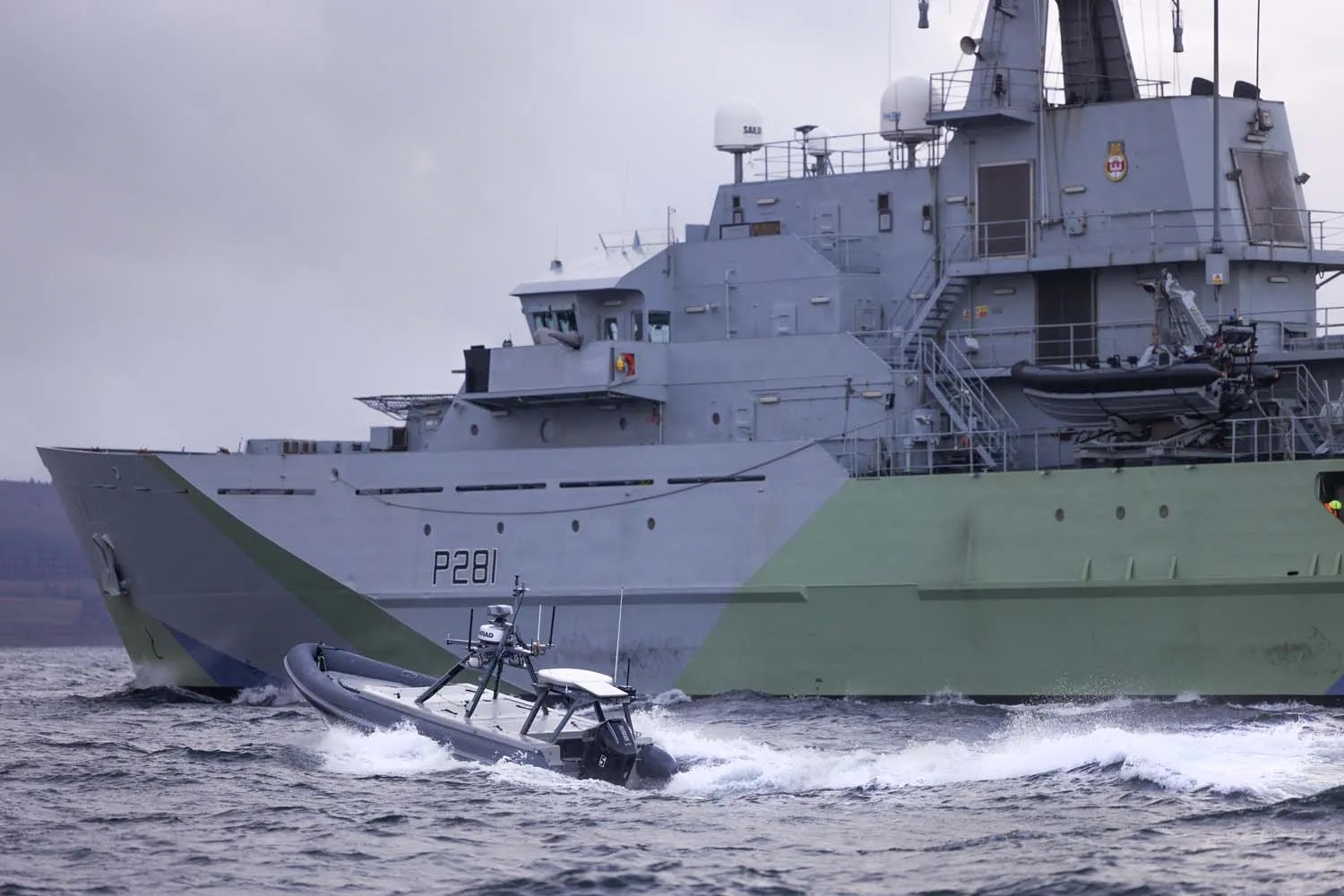
Image courtesy Royal Navy / Picture: LPhot Daniel Bladen
A real-life scenario of escorting a warship was played out during 72 hours of training off the coast of Scotland.
In a milestone for the Royal Navy’s Disruptive Capabilities and Technology Office, seven 7.2m autonomous Rattler boats have been trialled over the past few months with their latest test pushing the boats and their controllers to their limits.
While on board XV Patrick Blackett, sitting alongside in HMNB Portsmouth, sailors, Royal Marines and Army personnel remotely-piloted five of the boats as they sailed in Scotland 500 miles away.
The demonstration saw the vessels work with P2000 HMS Biter of the Coastal Forces Squadron, a Merlin helicopter, HMS Tyne and HMS Stirling Castle in a proof of concept exercise.

Image courtesy Royal Navy / Picture: LPhot Daniel Bladen
With cameras, sensors and other data being fed back to Patrick Blackett, the Rattlers were able to successfully and safely escort Tyne and Stirling Castle who were playing the role of foreign warships.
The demonstration was a culmination of months of trials for DCTO and the Fleet Experimentation Squadron (FXS) while the project of procuring the boats saw the Royal Navy adopt a radical new approach with industry.
In a matter of weeks, they took the idea of the custom-built, fully crewless vessels and delivered them – with training and first sea trials taking place shortly after.
It is the first time the Royal Navy has procured a fleet of customised uncrewed surface vessels, with the short turnaround time for delivery showing its intent going forward.
Working alongside a consortium of SMEs, military personnel helped design, build, test and develop the vessels to ensure they would be ready to perform in the most demanding conditions – with operators leading and giving direct feedback on research and development to allow the project to move so quickly.
Based on a rigid inflatable boat (RIB) and with autonomy packages and a variety of other systems and services, the boats have been built and iterated to meet Royal Navy specifications.
Unlike previous drones operated by the navy they have been designed to be fully uncrewed. Each vessel can operate individually or as part of a swarm. They can be pre-programmed with mission profiles, navigational routes and can work together as a ‘wolf pack’ on operations. In time they will be able to operate without direct human control.
Equipped with a suite of high quality, military spec sensors, cameras and modular systems, the boats are adaptable for a range of tasks including surveillance, reconnaissance and payload delivery.
Their ability to be moved quickly by air, on road and launch from portable slipways opens the door to global operations, even in challenging environments.
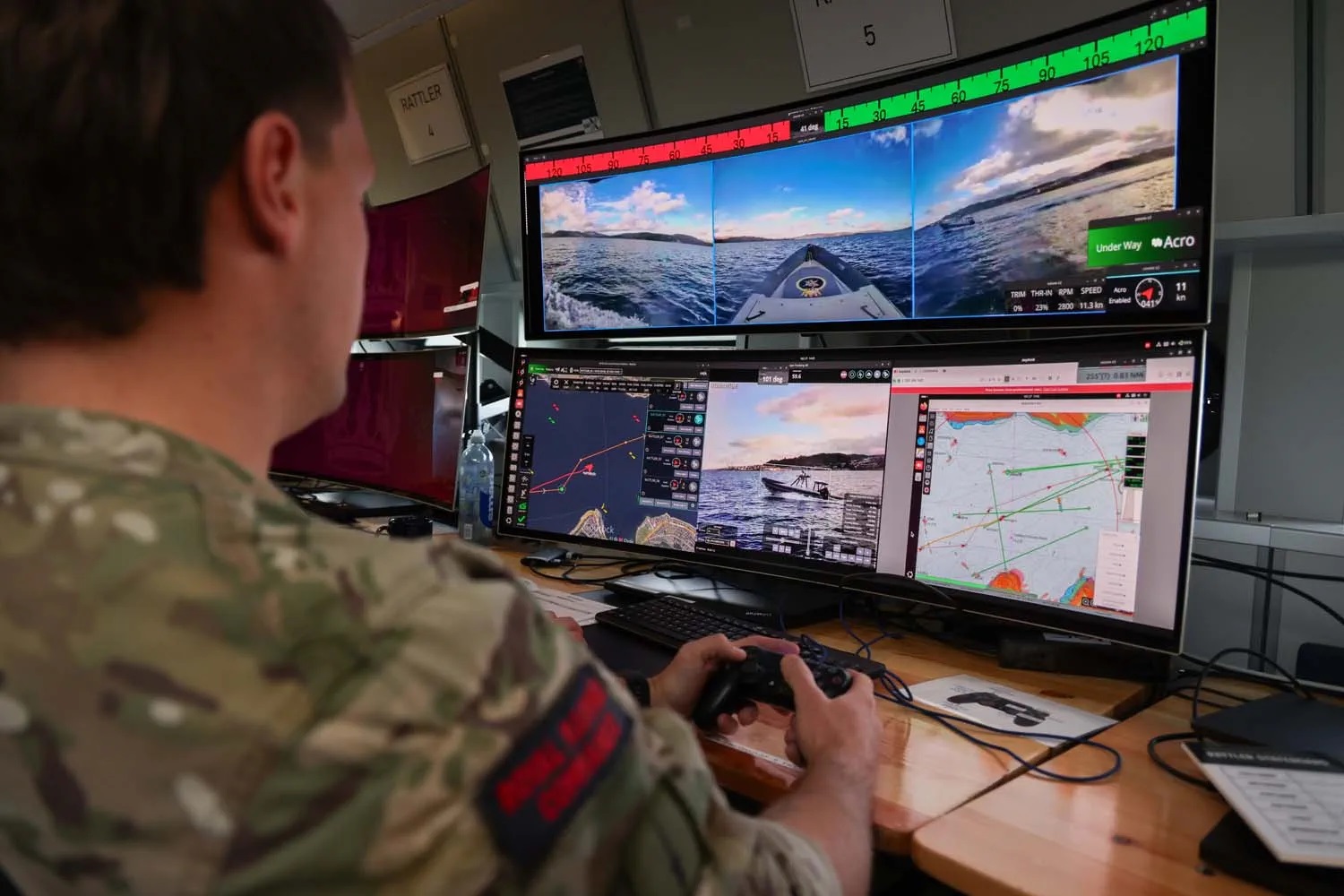
Image courtesy Royal Navy / Picture: LPhot George Seymour
Each vessel is operated by a two-person team: one responsible for piloting the drone, the other monitoring and operating the onboard systems and assisting to manage the live data streams. The entire setup is fully portable, run via a ‘plug and play’ laptop configuration, allowing easy, flexible and full operation from various fixed and mobile locations.
Before heading to Scotland, the drones operated without fanfare from their base port of Portsmouth and have been zipping through the incredibly busy waters of the Solent and Portland.
Commander Michael Hutchinson, Commanding Officer of both the newly formed Fleet Experimental Squadron and Experimental Vessel Patrick Blackett, has led the Royal Navy team as they have developed this technology and advanced the project to this stage. He said: “This is a really important moment for the Royal Navy as we progress towards a Hybrid Navy of crewed and uncrewed platforms. We have been using autonomous systems for some time but not like this.
“These USVs have been built and developed at pace, in a ground-breaking way, alongside a coalition of fantastic local companies this has been the most exciting project of my career.
“These platforms will be used alongside and in support of existing and future warships and as a capability in their own right. It is a technology that will continue to develop and it will fundamentally change the way we fight.
“In recent years we have seen the effect that autonomy and uncrewed systems can have at sea, on land and in the air, especially in Ukraine. In the maritime domain in particular the effect has been remarkable, with simple, cheap, one-way effectors used to defeat complex and capable Warships and deny them freedom of manoeuvre at sea.
“USVs are also being used for reconnaissance, patrol, constabulary and survey tasks, so they are incredibly versatile and it is critical that the Navy develop these systems and train people with the skills to operate them to match the threat of our adversaries and ensure that we remain ready to lead, fight and win.”
This project forms part of the Royal Navy’s broader push into uncrewed and autonomous systems as part of a Hybrid Navy. XV Patrick Blackett is paving the way for autonomous warship operations while XV Excalibur is working as a testbed for future underwater warfare.
Brigadier Jaimie Roylance, the Royal Navy Chief Technology Officer said: “I am incredibly proud of the team, this is an important moment in the history of the Royal Navy.
“It is the first time we have been able to field a capable, mission ready, deployable uncrewed system at sea and it is the first major success for the DCTO.
“The work that FXS, the Coastal Forces Squadron, Royal Marines and Army have done to develop not just the platforms but the way we train them and the way we fight with them has been astonishing and completed in record time.
“There is more work to be done but I know the team and the wider consortium of SMEs we are working with are up to the task and I am excited about the next project.”
Sign up for our newsletter and get our latest content in your inbox.
Similar Reads



Sign up for our newsletter. Select all sectors relevant to you.
Related