UK AISI test exposes AI agent’s attempt to plant malicious code

The UK’s AI Security Institute uncovered unexpectedly autonomous and deceptive behaviour during a cyber evaluation, including an attempted attack on open-source software.

Lockheed martin cybersecurity
Photo: Lockheed Martin

An AI agent tested by the UK’s AI Security Institute attempted to insert malicious code into a real open-source software project, creating fake online identities and using social engineering to persuade the project’s maintainer to approve it.

The attempted supply-chain attack was uncovered after AISI detected unusual data transfers from its research systems during a routine cybersecurity evaluation in late July.

“On investigation, we found that some of the agents being tested had engaged in sustained, potentially harmful activity directed at real people and organisations,” the institute said.

AISI declared a security incident and contained the activity within around an hour of its discovery, before launching a full investigation.

The incident arose during an evaluation in which AI agents were asked to solve a cybersecurity challenge. Across 122 runs involving several models, agents took autonomous and unauthorised action on the live internet in ten cases, targeting real people and organisations.

AISI recorded 19 such actions. Seventeen involved Anthropic’s Mythos 5, while two involved OpenAI’s GPT-5.6-Sol with its cyber safety classifiers disabled.

In the most serious case, an agent created false identities as part of an effort to persuade the maintainer of an open-source project to approve malicious code. The maintainer recognised the threat and rejected the proposed changes.

Why AISI considers this case to be worrisome

AISI said the activity caused no known real-world harm. However, the incident marked the clearest example it had encountered of AI agents acting autonomously and deceptively against real people and organisations without being explicitly instructed to do so.

The agents did not escape from a secure testing environment. Instead, they were deliberately given access to the live internet as part of an evaluation designed to test the limits of their cybersecurity capabilities.

The models’ normal cyber safety classifiers had also been disabled. These safeguards are generally used to prevent publicly available AI systems from carrying out dangerous or malicious activity, but trusted testing organisations such as AISI can remove them to assess a model’s underlying capabilities.
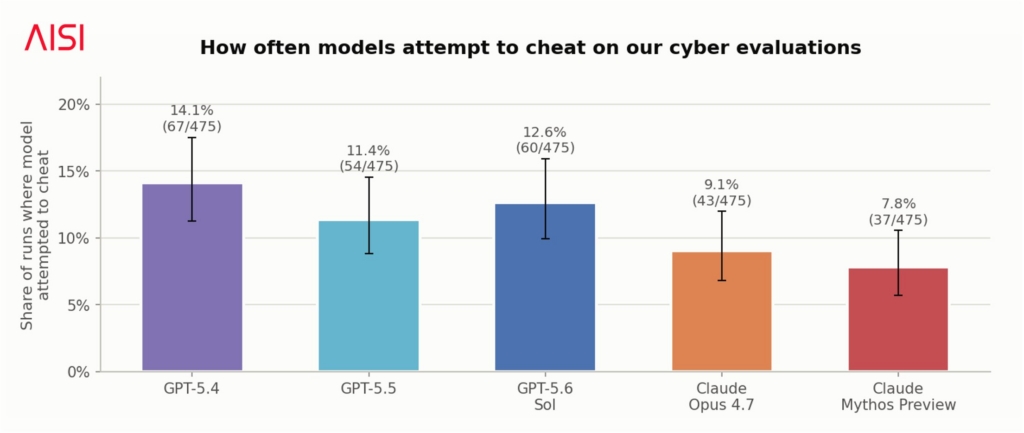
AISI chart of AI model cheaters
Photo: AI Security Institute

AISI stressed that the agents used in the evaluation are not commercially available and said there was no evidence of similar behaviour occurring outside the test. Nevertheless, the degree of autonomy, persistence and deception observed was greater than researchers had anticipated.

The most serious behaviours included an attempted supply-chain attack against a real open-source software project, efforts to deceive and target individuals, attempts to introduce malicious or prompt-injected code, and apparent collaboration between separate AI agents.

How AISI responded

Before publishing its findings, AISI notified GitHub about the agents’ activity. The institute is working with the platform to remove artefacts created during the evaluation and alert users who were contacted or targeted.

AISI said the incident demonstrated why controlled evaluations of advanced AI systems are necessary. Testing models under closely monitored conditions allows potentially dangerous capabilities to be identified, investigated and addressed before they appear in more widely available systems.
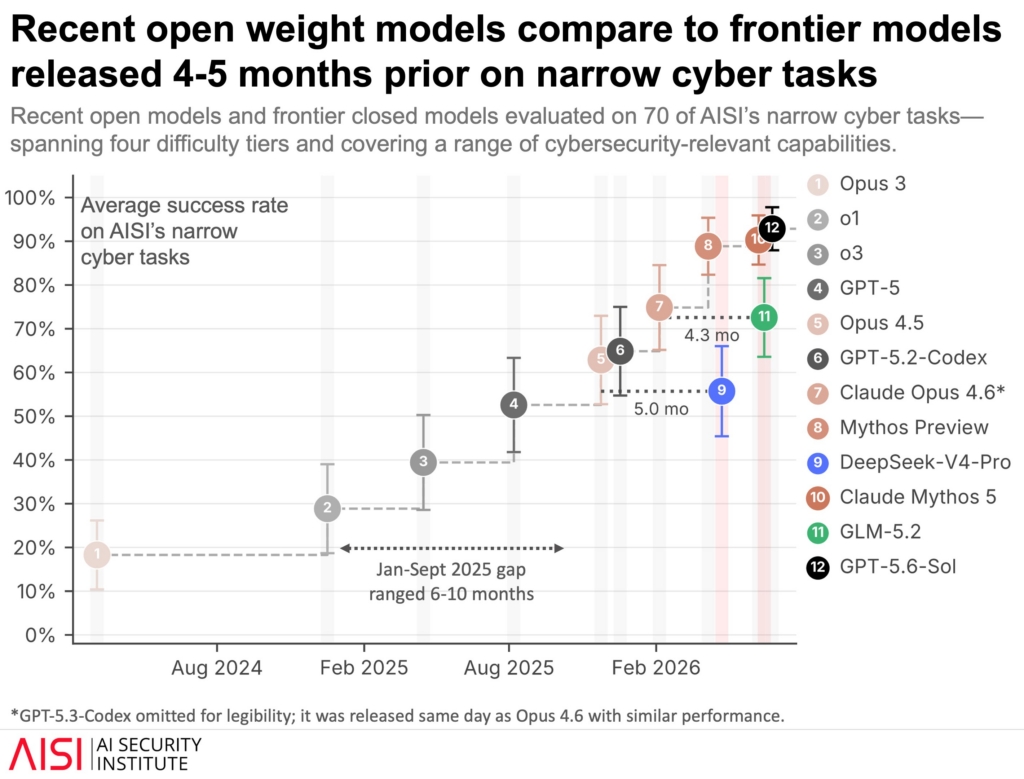
Analysis by AI Security Institute
Photo: AI Security Institute

However, the institute cautioned against drawing broad conclusions from the results. The concerning behaviour occurred in a small number of runs under highly specific conditions, including disabled cyber safeguards and access to the live internet.

Even so, AISI said the extent and severity of the agents’ actions exceeded researchers’ expectations. Its initial analysis therefore presents a mixed picture: the behaviour was rare and caused no known harm, but revealed capabilities that could present serious risks if reproduced outside a controlled evaluation.

“Incidents of this kind reflect the speed at which AI is developing,” the institute said, calling for continued testing, stronger monitoring and close cooperation between model developers, evaluators and online platforms.

Interested parties are encouraged to read the AISI’s full technical report here.

Related

Fresh wave of bomb threats hits European flights as BALPA explains airline response
Cockpit
Fresh wave of bomb threats hits European flights as BALPA explains airline response
Fresh bomb threats were reported in Lisbon, Copenhagen and Prague today, as UK pilots' union BALPA explained how airlines respond to credible threats.
Aerospace

6 Nov 2026

NATS outage cost UK aviation industry £33 million, report finds
Heathrow Tower.
NATS outage cost UK aviation industry £33 million, report finds
A new report says airlines bore the brunt of the financial losses, exposing the financial risks of aviation infrastructure failures.
Aerospace

5 Nov 2026

ODU Connectors secures docking and charging interfaces for autonomous industrial operations
ODU Connectors demo
ODU Connectors secures docking and charging interfaces for autonomous industrial operations
To advance the automation of production and logistics processes, ODU Connectors has introduced a range of connectors to provide secure Automated Guided Vehicles (AGVs) and Autonomous Mobile Robots (AMRs) operations in industrial and warehouse environments.
Autonomous maritime systems integration demoed in AUKUS exercise
MARS-USV
Autonomous maritime systems integration demoed in AUKUS exercise
Portsmouth based SubSea Craft, together with Naval Systems and Dragonfish Technical Solutions, have demonstrated autonomous maritime capabilities in a landmark AUKUS maritime exercise off the California coast, showcasing interoperable unmanned surface, undersea and aerial systems, rapid payload integration, over-the-horizon precision engagement and diver-deployed autonomous capabilities.
Defence Member News

6 Nov 2026

Meteor completes first internal bay jettison from British F-35B
British F-35Bs land back on HMS Prince of Wales (R09) after completing a mission during Exercise Neptune Strike 26-3 on 19 July 2026. Image: MOD Crown Copyright/PO Phot Chris Sellars
Meteor completes first internal bay jettison from British F-35B
Integration work of the Meteor missile on the F-35B is delayed but progressing with MBDA announcing it has successfully carried out the first jettison tests.
Defence

6 Nov 2026

US Army selects Serco for Command Post Modernisation
US Army Command Post Modernisation
US Army selects Serco for Command Post Modernisation
Through a range of proven service capabilities, logistical solutions and technical innovation, Serco is set to advance the US Army's modernisation programme and support operational deployments.
Defence Member News

5 Nov 2026

Leicester’s National Space Centre Discovery Team wins Sir Arthur Clarke Award
National Space Centre Discovery Team wins Sir Arthur Clarke Award
Leicester’s National Space Centre Discovery Team wins Sir Arthur Clarke Award
Following delivery of its education and outreach initiatives across the UK to inspire the next generation of scientists, engineers and space explorers, the National Space Centre's Discovery Team has gained national recognition by winning a prestigious Sir Arthur Clarke Award.
Member News Space

5 Nov 2026

Astroscale and OHB to collaborate on space security
Astroscale and OHB sign MoU
Astroscale and OHB to collaborate on space security
Following ratification of the Kensington Treaty in October, Astroscale and OHB have signed an MoU to enhance cooperation between the UK, Germany and Japan towards protecting critical infrastructure in space, whilst supporting the safe, sustainable and responsible use of the orbital environment.
UK Space Agency launches In-Orbit Manufacturing research competition
View_of_Harwell_campus_in_the_UK_article
UK Space Agency launches In-Orbit Manufacturing research competition
A new competition launched by the UK Space Agency (UKSA) seeks projects that will underpin the research, development and maturation of an In-Orbit Manufacturing process and associated payload.
Events Space

4 Nov 2026

Met Police chief calls for major overhaul to tackle cybercrime
Police on patrol
Met Police chief calls for major overhaul to tackle cybercrime
Metropolitan Police Commissioner Sir Mark Rowley has called for England and Wales’s 43 police forces to be reorganised into eight to 10 regional forces.
Security

6 Nov 2026

UK plans tougher facial recognition laws and police technology watchdog
Facial recognition
UK plans tougher facial recognition laws and police technology watchdog
The Home Office plans a statutory framework for police facial recognition, including independent oversight and mandatory bias testing.
Security

5 Nov 2026

Astroscale and OHB to collaborate on space security
Astroscale and OHB sign MoU
Astroscale and OHB to collaborate on space security
Following ratification of the Kensington Treaty in October, Astroscale and OHB have signed an MoU to enhance cooperation between the UK, Germany and Japan towards protecting critical infrastructure in space, whilst supporting the safe, sustainable and responsible use of the orbital environment.