


Royal Navy reveals names of two new support ships for carrier fleet


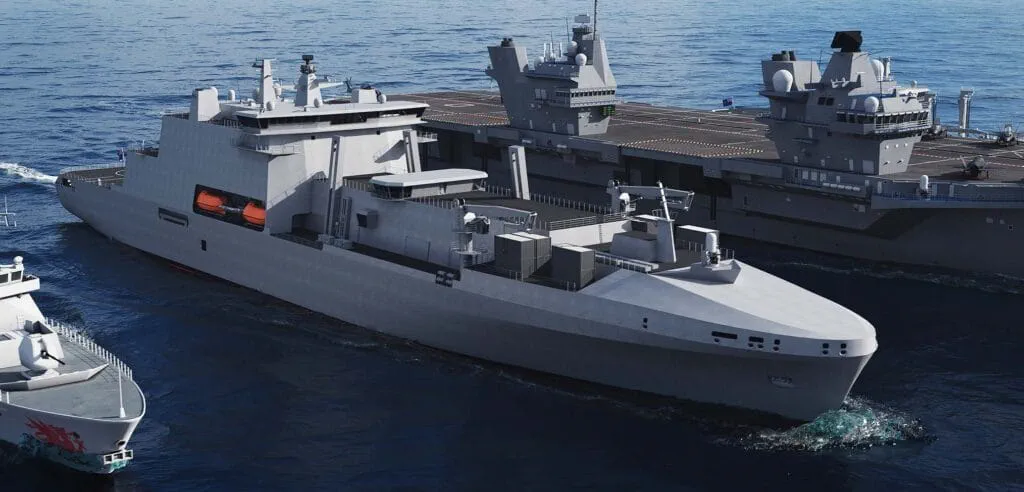
The Royal Navy has revealed the names of two new Fleet Solid Support (FSS) ships that will help keep the UK’s aircraft carriers supplied during long-range deployments.
RFA Reliant and RFA Resourceful will join first-of-class RFA Resurgent in the three-ship programme designed to strengthen the Royal Navy’s ability to sustain operations far from the UK.
Commodore Sam Shattock, head of the Royal Fleet Auxiliary (RFA), announced the names during the keel-laying ceremony for RFA Resurgent at Navantia UK’s Appledore shipyard in Devon on 3 September, coinciding with Merchant Navy Day.
The vessels will support the UK’s two Queen Elizabeth-class aircraft carriers.
RFA Resurgent begins to take shape
The keel laying marks the formal beginning of RFA Resurgent’s assembly, although construction is already underway at several shipyards.
Sections of the three ships are being produced at Appledore, Navantia UK’s Harland & Wolff facility in Belfast and Navantia’s yards in Spain. The modules will be brought together in Belfast for final assembly, integration and trials.
A specially commissioned coin was welded into Resurgent’s structure during the ceremony, continuing a long-established shipbuilding tradition.
“Today represents the moment when vision becomes reality, when plans and drawings come to life, effectively becoming the ship’s birthday,” Shattock said.
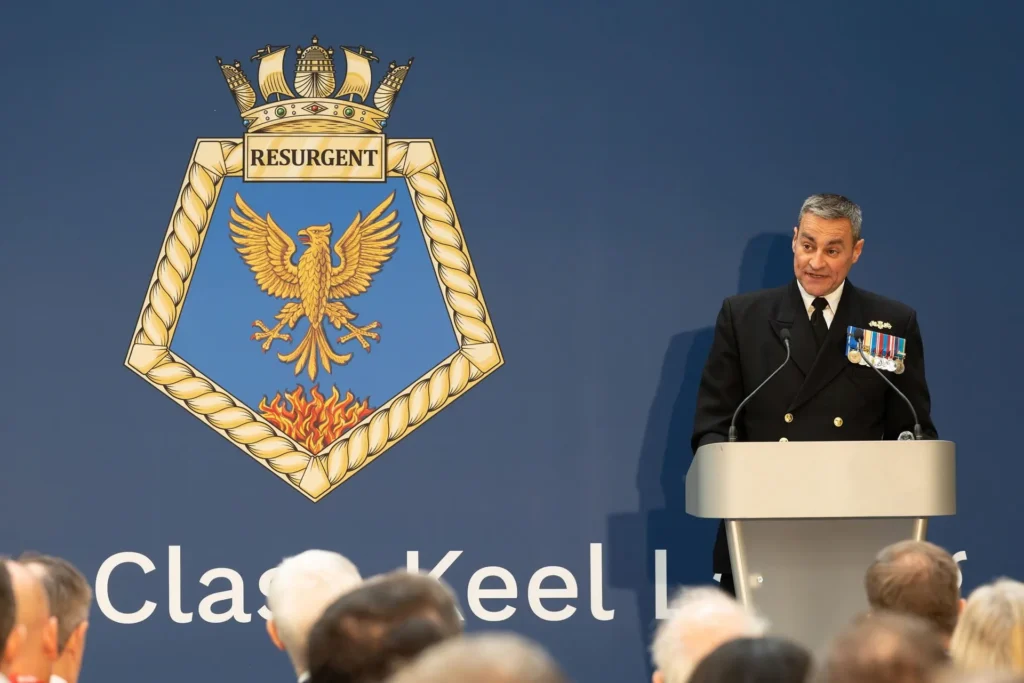
He added that Resurgent represented “renewal, resilience and the ability to recover stronger from challenge,” both for the ship and the “people who will design, build, support and ultimately sail her.”
The MoD expects RFA Resurgent to enter service in the early 2030s. The programme is expected to support around 1,200 UK shipyard jobs and hundreds of apprenticeships, with approximately £100 million being invested in Appledore and Belfast.
Why the Royal Navy needs its new support ships
The FSS vessels will act as floating supply bases, carrying ammunition, spare parts, food and other stores and transferring them to Royal Navy vessels while underway.
This allows warships to remain at sea without repeatedly returning to port, and is particularly important for the aircraft carriers HMS Queen Elizabeth and HMS Prince of Wales, as well as their accompanying carrier strike groups.
The three ships will replace the solid-support capability previously provided by RFA Fort Victoria.
Each vessel will have a core RFA crew of 101 and accommodation for another 80 personnel, including helicopter and boat teams and specialists. They can also support counter-piracy, counter-terrorism and multinational operations.
The ships are designed to reduce energy consumption and accommodate low-carbon fuels and future energy technologies during their planned 30-year service lives.
Why were the ships named Resurgent, Reliant and Resourceful?
Resurgent, Reliant and Resourceful share a common theme: adjectives representing qualities associated with the new support fleet. Two also revive historic RFA names.
The previous RFA Resurgent was a merchant vessel converted into a fleet replenishment ship in 1957 and served until 1979.
Three previous RFA vessels have carried the Reliant name. The most recent was a converted merchant ship brought into service as a helicopter support vessel in 1983. It supported multinational forces during the 1984 Lebanon crisis and participated in evacuation operations before being sold in 1986.
Resourceful is new to the RFA, but has a historical connection. RFA Resource, an armament stores ship that served from 1966 to 1997, earned battle honours for the Falklands and Kuwait.
How does the Royal Navy choose ship names?
Royal Navy and RFA ship names go through a formal selection and approval process involving the Ships’ Names and Badges Committee.
A Ministry of Defence Freedom of Information response explaining the process says the committee considers potential names for new classes when directed by senior Navy leadership.
The Navy can specify a naming theme or ask the committee to suggest one. The committee submits its recommendations to the Navy Board, but does not make the final decision. The board can request alternatives or select different names.
The Secretary of State approves preferred names before they are submitted to the Sovereign for royal approval.
Committee membership can vary depending on the ships being named. An RFA representative would normally participate in the process of selecting names for new RFA vessels.
For the new support ships, the result combines tradition with a clear class identity: two historic RFA names revived for a new generation and one new name designed to fit alongside them.
Together, Resurgent, Reliant and Resourceful will provide the logistical support needed to keep Britain’s carrier fleet operating thousands of miles from home.
Sign up for our newsletter and get our latest content in your inbox.
Similar Reads




Sign up for our newsletter. Select all sectors relevant to you.
Related