General Atomics

Can apprenticeships solve the aerospace skills shortage?

The UK aerospace industry needs a new generation of skilled engineers and technicians. Apprenticeships can help deliver them, but only if businesses can afford to train people, attract candidates and give them reasons to stay.

Employment skills recruitment shoot - Airfield Engineering Shoot with Airfield Duty Engineer & Engineering Apprentices - Heathrow Terminal 5 Photo credit -
Photo: David Poultney - In-Press Photography for Heathrow Airport

The UK aerospace skills shortage needs more than just extra job adverts. Manufacturing aircraft and their components requires years of specialist knowledge across precision engineering, materials science, maintenance, inspection and digital production.

As experienced workers become harder to find, training new people is vital to the industry’s future.

The scale of the challenge is huge. ADS reported in August 2026 that 66% of aerospace employers faced persistent workforce and skills shortages. Across the four sectors, the UK has an average of 10,000 unfilled technical vacancies each year. Separately, Skills England estimates that advanced manufacturing and defence will need another 6,000 aerospace engineers between 2025 and 2035.

These figures cover different groups, but together they really show the pressure on employers to build their future workforce.

Training takes time and investment

Apprenticeships offer a direct way to develop people with the skills manufacturers actually use. An apprentice can learn alongside experienced colleagues, achieve recognised qualifications and become familiar with the equipment, processes and quality standards required in aerospace. The route also opens technical careers to people who may not choose a conventional university degree.

Yet an apprenticeship is not a quick fix. Employers must pay wages, provide supervision and allow time for training, often while trying to meet demanding production schedules. These commitments can be particularly difficult for smaller suppliers, where losing even one experienced employee’s time can affect daily operations.
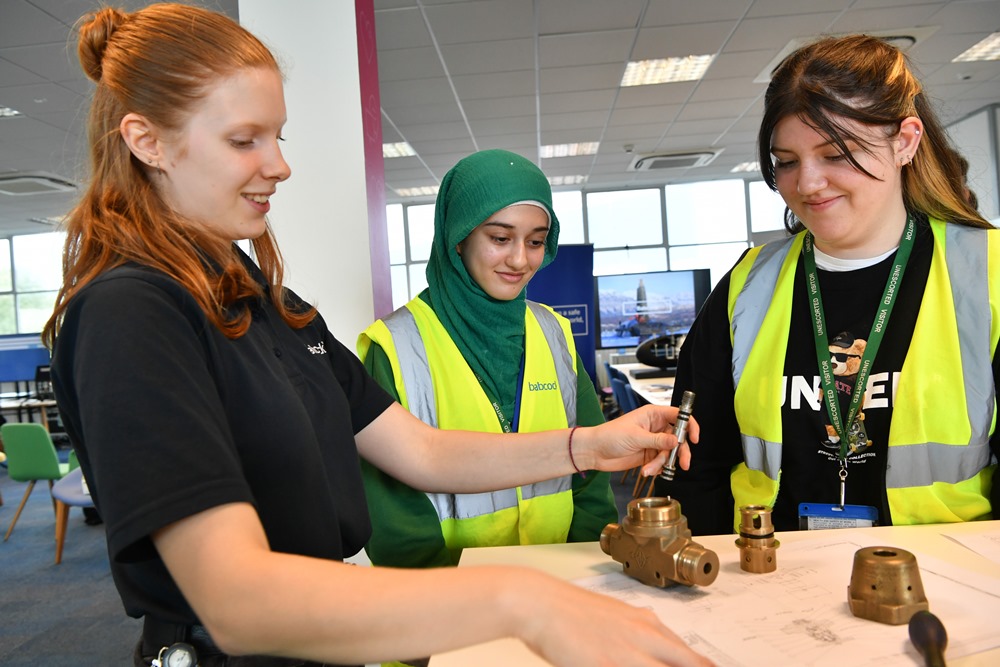
women in manufacturing apprenticeship
Photo: Babcock

Any perception of a gender pay gap in aviation must also urgently be addressed.

Specialist aviation is particularly suffering. When Airbus Helicopters launched its UK training academy at Oxford Airport in July 2026, Richard Atack, managing director of Airbus Helicopters in the UK, highlighted the shortage of qualified personnel and the regulatory challenges facing the sector.

“We are seeing a shortage of technical rotary wing specialists in the UK, further impacted by the added workload to industry and the lack of mutual recognition between CAA and EASA,” Atack said.

He added that the academy formed part of “a long-term vision to ensure critical services to support the UK’s rotary wing fleet” and would help strengthen Britain’s position in specialist helicopter training.

The academy expects more than 400 pilots, engineering technicians and aerospace leaders to pass through each year and offers apprenticeship pathways from Level 3 to Level 6. It is a practical example of an employer investing in the training infrastructure needed to develop specialist expertise. However, not every company has the resources to establish its own academy.

Partnerships between manufacturers, colleges and training providers, alongside shared facilities and accessible funding, could help smaller suppliers offer apprenticeships too. Without that support, businesses under the most pressure to fill vacancies may be the least able to invest in developing new recruits.

Finding the next generation

There is also the question of who applies in the first place. Aerospace competes with other industries for people with engineering, digital and technical skills, while many young people have limited awareness of the range of jobs involved in making and maintaining aircraft.

ADS launched its 2026 There’s Aerospace For You campaign to encourage more young people into the industry. Its research found that 60% of young people would not consider a career in manufacturing, suggesting many may not realise how much technology and advanced engineering the sector now involves.
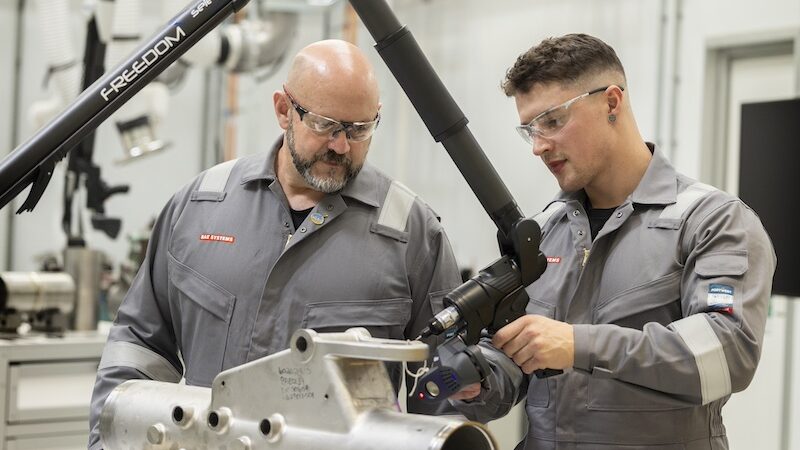
Apprentice working at a UK defence manufacturer
Photo: Rosie Hallam / UK MOD

Employers need to reach young people earlier by working with schools and colleges, offering visits and showing them what the jobs involve. They should also explain the qualifications, working conditions and career opportunities available.

Apprenticeships need to be seen as a valuable route into a skilled career in their own right, rather than simply an alternative to university.

What happens after qualification?

Taking on apprentices is only the first step. If qualified workers leave for better pay or career opportunities, employers lose both skilled people and their investment in training.

Apprenticeships alone will not solve the skills shortage. The industry will still need experienced workers and training that keeps pace with new technology, as well as clear routes to promotion to help retain workers.

Success depends on how many apprentices qualify, build careers and stay in aerospace. Employers, colleges and government need to work together over the coming years to make that happen.

Related

UK Finance Minister signals support for London Heathrow Airport’s £33 billion runway expansion
London Heathrow
UK Finance Minister signals support for London Heathrow Airport’s £33 billion runway expansion
In contrast to the cautious response of the UK Prime Minister, Chancellor John Healey has backed Heathrow's expansion plans.
Aerospace

17 Oct 2026

Marshall Aerospace outlines its next chapter following AURELIUS acquisition
Marshall Aerospace
Marshall Aerospace outlines its next chapter following AURELIUS acquisition
Speaking exclusively to Advance, Marshall Aerospace discusses its military aircraft contracts, manufacturing priorities and search for a new home following the takeover.
Aerospace Insights

17 Oct 2026

17,000 aircraft on order: How does the industry actually clear the backlog?
Boeing 737 factory in Renton
17,000 aircraft on order: How does the industry actually clear the backlog?
Aircraft manufacturers are under pressure to deliver faster, but supply-chain constraints continue to hold production back. What will it take to turn growing orderbooks into aircraft ready to fly?
Aerospace

17 Oct 2026

The need for speed: Why the English Electric Lightning was designed the way it was
English Electric Lightning
The need for speed: Why the English Electric Lightning was designed the way it was
With its unconventional design, the Lightning was designed to climb rapidly, reach great heights and intercept an enemy aircraft before it could approach its target.
Defence

18 Oct 2026

UK defence is moving faster. Can its legal frameworks keep pace?
As UK defence procurement accelerates, legal experts at Crowell & Moring explore how businesses can seize opportunities while managing legal risk.
Defence Insights

17 Oct 2026

From trials to frontline capability: Accelerating AI adoption in UK defence
Jack Maxton headshot
From trials to frontline capability: Accelerating AI adoption in UK defence
Jack Maxton, CEO of DIGI2AL, argues that faster experimentation, closer industry collaboration and a shift in mindset can help the MOD turn AI ambitions into operational advantage.
Viasat orders ALL.​SPACE Hydra MAX Terminals for Ka-band networks
ALL.SPACE Hydra
Viasat orders ALL.​SPACE Hydra MAX Terminals for Ka-band networks
Viasat has placed an order for multiple ALL.​SPACE Hydra MAX terminals approved to operate on Viasat's global NextGen Ka-band network, providing resilient SATCOM connectivity for defence and government users.
Defence Member News Space

15 Oct 2026

Cornwall Space Cluster launches £15k legal support programme for space SMEs
Goonhilly satellite near Cornwall Space Cluster
Cornwall Space Cluster launches £15k legal support programme for space SMEs
Cornwall Space Cluster has partnered with Stephens Scown to offer specialist legal advice to space businesses, helping them protect intellectual property, prepare for investment and support future growth.
Space

15 Oct 2026

ClearSpace selected to deliver UK’s first active debris removal mission
ClearSpace removing space debris
ClearSpace selected to deliver UK’s first active debris removal mission
The UK-led programme will remove two defunct satellites while creating specialist jobs, supporting supply chains and building capability in the growing in-orbit services sector.
Space

15 Oct 2026

Police officers risk accidental AI misconduct, watchdog warns
National Police Chiefs Council photo of police on duty
Police officers risk accidental AI misconduct, watchdog warns
The Independent Office for Police Conduct has warned that officers and staff risk misconduct investigations for inappropriate AI use.
Security

16 Oct 2026

NAD and CDS want accelerated capability as DSEI UK 27 launched
NAD and CDS launch DSEI UK 27
NAD and CDS want accelerated capability as DSEI UK 27 launched
As the National Armaments Director (NAD) and the Chief of the Defence Staff (CDS) launched DSEI UK 2027 yesterday, they said faster capability delivery, greater innovation and improved readiness are required to ensure the UK and its allies are suitably prepared for any future conflict.
Warwickshire Police turns to AI to review the quality of investigations
Chat with AI or Artificial Intelligence technology. Man touching chatting virtual with an intelligent artificial intelligence asks for the answers he wants. Smart assistant futuristic, Chatbot,
Warwickshire Police turns to AI to review the quality of investigations
An eight-agent system checks investigation records against policing standards, with officers retaining responsibility for decisions.
Security

14 Oct 2026