AIM Altitude's ARCA galley system meets new hygiene demands
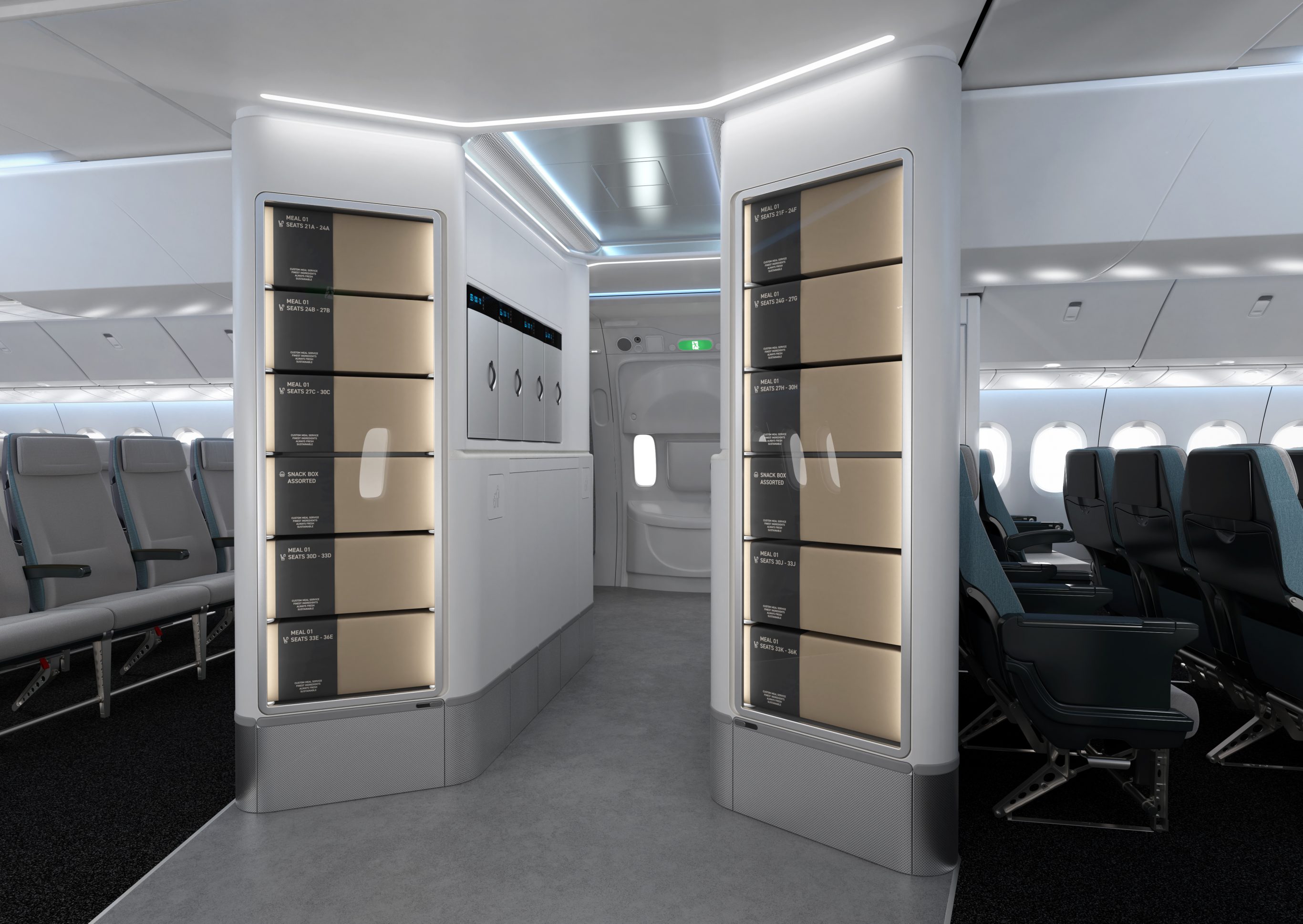
Image courtesy AIM Altitude
ARCA redefines the future of aircraft service with a new boxed meal system. Rather than crew having to handle open meal trays packed with loose components, ARCA consists simply of a hot meal-pack and an accompanying boxed cold meal-pack, which nest securely together. The majority of the contents are safely sealed away in the box. This has significant benefits for hygiene, passenger confidence and minimising the risk of transmitting infection.

The ARCA meal-pack boxes double as closing waste-containers. This was originally intended to aid recycling and divert waste from landfills – still a hugely important element - but since the pandemic, this also has the advantage of reducing crew contact with left-over food and used utensils.
AIM Altitude is part of AVIC Cabin Systems (ACS) a global alliance of cabin interiors specialists. Ross Burns, Head of Industrial Design at AVIC Cabin Systems and co-creator of ARCA said: “We originally developed ARCA before Covid-19. The concept was devised to make aircraft meals more eco-friendly, more easily customised, and to save galley space. All of these positives are still achieved by ARCA but it is also now hugely relevant in enhancing hygiene, helping crew and passengers to maintain social distancing and lessening the risk of infection.”
The ARCA boxed system for in-flight meals was developed by AIM Altitude as a concept to modernise the aircraft galley and is now being hailed as a solution towards increased flight hygiene.
Currently, meal trays are loaded onto the aircraft without hot meals. This creates multiple inefficient voids. The ARCA meal-packs contain all the usual dishes and accessories: side dish, dessert, bun and cutlery, but the pack is stackable and has a much smaller footprint than a tray. With around 300 economy passengers, this space efficiency gives substantial gains to the cabin – enough for another row of seats or more space for social distancing.
Instead of deep meal carts housing half-empty trays, the ARCA system works with densely-packed carrier boxes on the galley ends. The meal packs make it easier for passengers to be able to pre-select custom meals, meeting increasingly varied dietary requirements and hopefully reducing food wastage in terms of unwanted items.
Helena Teichrib, Senior Industrial Designer at AIM Altitude, said: “We originally developed ARCA before even hearing about Covid-19. The concept was devised to make aircraft meals more eco-friendly, more easily customised, and to save galley space. All of these positives are still achieved by ARCA but it is also now hugely relevant in enhancing hygiene, helping crew to maintain social distancing and lessening the risk of infection.”
ARCA can be retrofitted with minimal reconfiguration. Its architecture seamlessly integrates into the existing airframe and central crew areas are easily configured so familiarity and efficiency are not compromised. Common inserts such as ovens, coffee makers and water boilers can still be used.
ARCA is highly customisable, from the galley system itself being adaptable for twin- and single-aisle aircraft, to the meal boxes, which can be uniquely designed with the latest brand graphics.
Its adaptable nature means ARCA is future proof. It can be further configured to allow self-service, snack offerings, or to be used as a dedicated stowage for special meals. The ARCA core principles are translatable to other platforms such as the A320 and B737, to maximise the true potential of this significant design.
Space efficiency
The ARCA pack is stackable and has a much smaller footprint than a tray. Meals are stored in an aesthetically pleasing, refrigerated aisle-stowage unit. Boxed in sets of 16, the meals can be easily moved onto an ARCA-designed, lightweight folding trolley for meal service.
ARCA caters for the same number of passengers within a smaller footprint, thereby enabling airlines to reclaim lost space compared to a traditional configuration, enough to allow for an extra row of seats or a monument feature. The ARCA design also facilitates the replacement of heavy and expensive trolley equipment, which translates into a beneficial weight-saving.
Reduced waste
ARCA reduces waste. It offers compostable and recyclable packaging to enable zero landfill flights. In co-operation with the catering partner, the meal-pack contents can be customised by the passenger. They benefit by receiving the food of their choice, with satisfied passengers and food-waste reduction the likely consequences. After the meal, the carrier boxes are repurposed into waste containers for recycling and separate compacting.
Ross Burns commented: “Air travel has long been criticised for its carbon footprint, but the sustainability debate has now reached a new level of urgency, along with the need for Covid-secure cabins. We have had great feedback from potential customers, reinforcing our belief that ARCA could be a real revolution in meal service in terms of sustainability, space efficiency, and hygiene.”