Aviation operational gains offset by industry growth


Image by Alexander Supertramp / copyright Shutterstock
Despite this, data from IBA’s Net Zero reporting tool also shows that absolute aviation emissions have risen above pre-pandemic levels over the same period, highlighting the continued challenge of aligning industry growth with Net Zero 2050 ambitions – reaching almost 960mtCO2 in 2025, from 925mtCO2 in 2024 and 935mtCO2 in 2019.
IBA highlights that while airlines are transporting passengers and cargo more efficiently than ever before, the growth in overall flight activity is continuing to offset many of these operational gains. The data shows that global CO₂ intensity has followed a gradual downward trend since 2018, while total emissions have steadily recovered and now surpassed pre-pandemic levels.
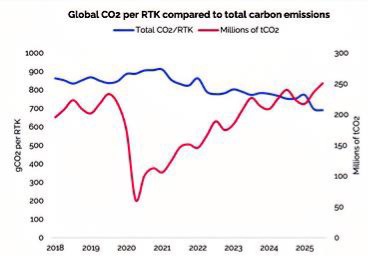
Source: IBA NetZero Reporting – Quarterly Data – Data to September 2025
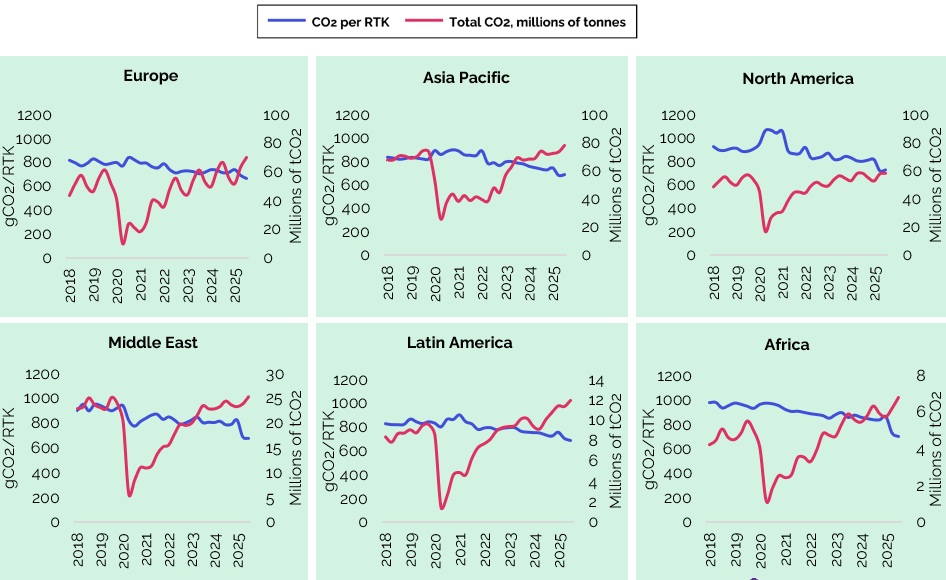
Regional analysis from IBA NetZero also highlights significant divergence across global aviation markets.
Source: IBA NetZero Reporting – Quarterly Data – Data to September 2025
In North America, emissions intensity declined from an average of 920 gCO₂/RTK in 2018 to 760 gCO₂/RTK in 2025, while total emissions rose from around 50 million tonnes to almost 60 million tonnes of CO₂ over the same period. Asia-Pacific recorded a similar trend, with carbon intensity falling from 860 gCO₂/RTK to below 700 gCO₂/RTK, with total emissions climbing to almost 80 million tonnes of CO₂ by 2025.
The Middle East also saw an increase in total emissions following the post-pandemic recovery, rising from approximately 22 million tonnes to nearly 27 million tonnes of CO₂, despite improvements in operational efficiency. Europe experienced comparatively moderate emissions growth alongside gradual reductions in carbon intensity, while Africa and Latin America both recorded improvements in efficiency metrics even as total emissions continued to rise.
IBA notes that these trends reinforce aviation’s central Net Zero challenge: improving operational efficiency alone is no longer sufficient if absolute emissions continue to rise alongside growth in passenger and cargo demand. Future progress towards Net Zero 2050 will increasingly depend on accelerating sustainable aviation fuel (SAF) adoption, fleet renewal and carbon removal strategies, alongside continued efficiency gains.
IBA warns that without faster deployment of these measures, aviation risks delaying emissions reductions, requiring increasingly steeper cuts as we close in on the 2050 deadline.
Sign up for our newsletter and get our latest content in your inbox.
Similar Reads



Sign up for our newsletter. Select all sectors relevant to you.
Related