Advancing UK Aerospace, Defence, Security & Space Solutions Worldwide

Aerospace

BA bids fond farewell to remaining 747s
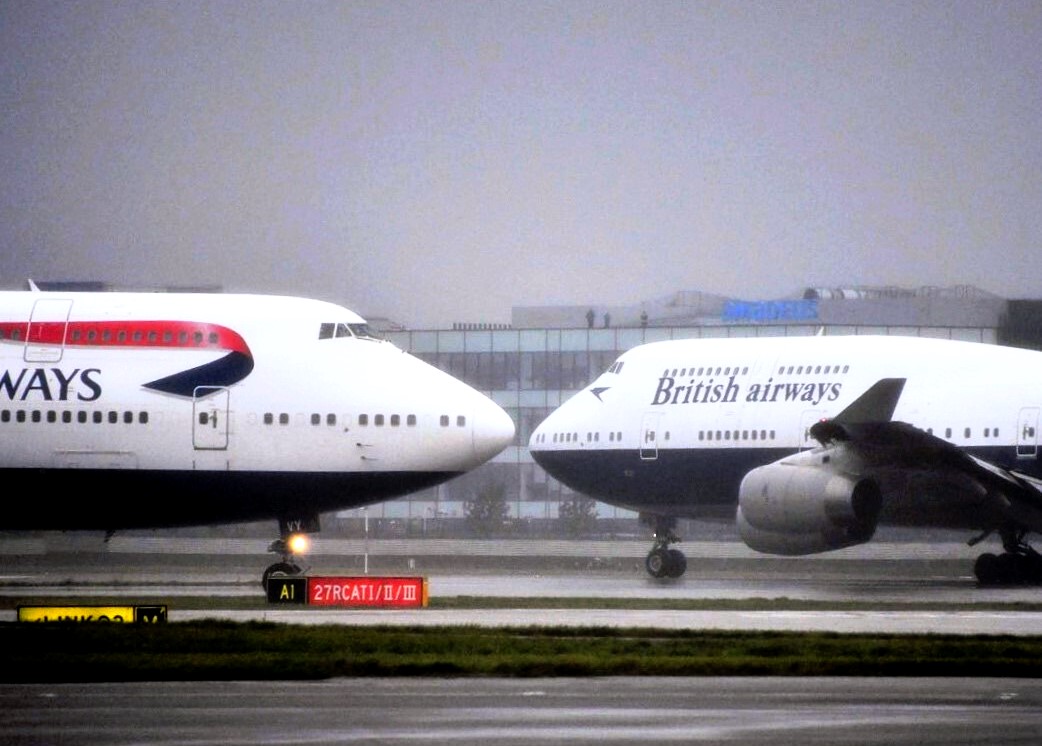
British Airways’ remaining two Boeing 747 aircraft based at Heathrow taxied for take off for the last time today.

Above: Final departure for British Airways' 74 7.

To commemorate the occasion the airline’s two aircraft took to the skies one after the other from runway 27R. Once in the air, G-CIVY circled back over the southerly runway in an emotional farewell to its home before heading to St Athan where the aircraft will be retired.

Advertisement
ODU RT

G-CIVB, painted in the airline's historic Negus livery and G-CIVY, in its current Chatham Dockyard livery, are going to be retiring in the UK at Kemble and St Athan, respectively. Between the two aircraft they have flown an impressive 104 million miles in their 47 years of service and carried millions of British Airways customers.

At 7:47am this morning, hundreds of aviation enthusiasts and customers flooded social media sharing their favourite 747 memories using #BA747farewell.

Alex Cruz, British Airways’ Chairman and CEO said: “Today was an emotional milestone in the retirement of our 747 fleet as it was our last chance to see the Queen of the Skies depart from our home at Heathrow airport. The 747s have played a huge role in our 100-year history, forming the backbone of our fleet for over 50 years. I know I speak for our customers and the many thousands of colleagues who have spent much of their careers alongside them when I say we will miss seeing them grace our skies.”

In July, British Airways announced that its remaining 747s had sadly flown their last commercial services as a result of the impact the Covid-19 pandemic has had on the airline and the aviation sector. The fleet is being replaced by quieter more fuel efficient aircraft as part of the airline’s commitment to achieving net zero carbon emissions by 2050.

Advertisement
PTC rectangle

Facts and stats:
•    Boeing has been manufacturing 747 aircraft for more than 50 years
•    BOAC flew its first 747 flight on 14th April 1971
•    British Airways took delivery of its first 747-400 in July 1989 and its last in April 1999
•    At its height, the airline had a fleet of 57 747-400s
•    British Airways was the world’s biggest operator of 747-400 aircraft
•    The 747-400 has 6ft high winglets on the tips of its wings to improve efficiency
•    It has 16 main wheels and two landing nose wheels
•    The wings of a 747-400 span 213ft and are big enough to accommodate 50 parked cars
•    The tail height of 64ft is equivalent to a six-storey building
•    The 747-400 is 231ft long

Last year to mark its centenary British Airways re-painted three of its jumbo jets in heritage colours donning its historic BOAC, Negus and Landor livery The BOAC jet put in a guest appearance with the Red Arrows much to the delight of spectators at the Royal International Air Tattoo.
 

Advertisement
ECS leaderboard banner
Wales to be UK launchpad for advanced autonomous tech

Aerospace Defence Security

Wales to be UK launchpad for advanced autonomous tech

20 February 2026

Thousands of skilled workers in Wales will be involved in the design, testing and manufacture of advanced autonomous technologies and unmanned systems, as a landmark £50 million Defence Growth Deal positions the nation at the forefront of Britain’s defence future.

NPAS increases aircraft available for deployment

Aerospace Security

NPAS increases aircraft available for deployment

19 February 2026

In January this year, the National Police Air Service (NPAS) was able to increase the number of aircraft that were available for operational deployment.

Alloyed secures ATI Programme funding to develop ABD-1000AM

Aerospace

Alloyed secures ATI Programme funding to develop ABD-1000AM

19 February 2026

Developer and manufacturer of advanced metallic components, Alloyed Ltd, has secured funding from the ATI Programme for an ambitious £1 million project to accelerate the development of ABD-1000AM, a next-generation nickel-based superalloy designed for additive manufacturing.

Birmingham Airport publishes new sustainability strategy

Aerospace

Birmingham Airport publishes new sustainability strategy

19 February 2026

Birmingham Airport (BHX) has published its new sustainability strategy for 2026 to 2030, outlining the next strategic steps on its journey to becoming a more sustainable and socially responsible business.

Advertisement
Security & Policing Rectangle
UK hydrogen airport trial sets out roadmap for further studies

Aerospace

UK hydrogen airport trial sets out roadmap for further studies

18 February 2026

A new report into the UK’s first airside trial of multiple hydrogen-powered ground support equipment (GSE) has confirmed that hydrogen can be safely and effectively integrated into airport ground operations, whilst setting out a series of essential next steps needed to accelerate hydrogen adoption and decarbonisation across the aviation sector.

Kent collaborates on Pre-FEED study for Eq.flight SAF demo plant

Aerospace

Kent collaborates on Pre-FEED study for Eq.flight SAF demo plant

18 February 2026

Integrated energy services partner, Kent, has collaborated with Equilibrion during a successful bid for funding from the UK Department for Transport’s Advanced Fuels Fund (AFF) and with that funding for Equilibrion and its partners, Kent is delivering the Pre-Front-End Engineering Design (Pre-FEED) for Eq.flight, an advanced power-to-liquids ...

Advertisement
ODU RT
Advertisement
ECS leaderboard banner