

Drone swarms central to AWE26

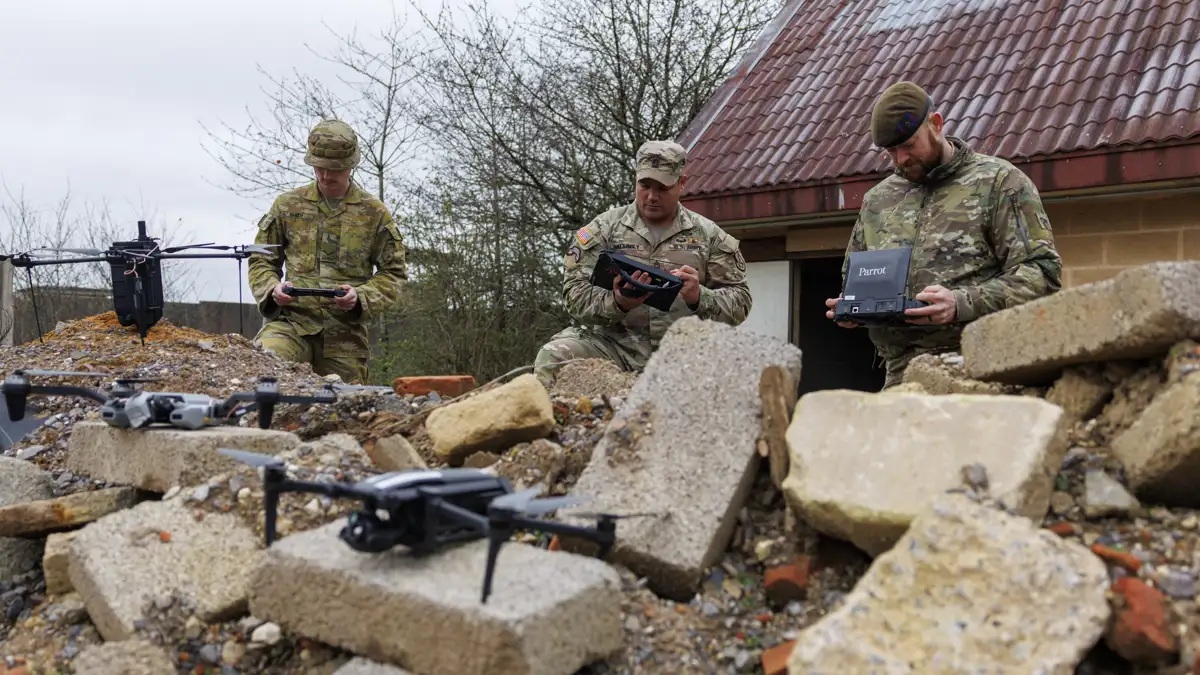
Above: (left to right) Lance Corporal kai Smith, Australian Defence Force, Sergeant Gallogoly, US Army and Lance Sergeant Scott, British Army.
Courtesy British Army
Taking part were troops from the Australian Army, the UK and the US Army. These three countries form AUKUS, the trilateral security partnership that helps advance the development of cutting-edge military technology, together.
Last year, Ukraine carried out a bold military operation. Dozens of Russian warplanes, parked deep inside Russia, were destroyed by drones. It showed just how powerful drone warfare has become.
So, it is no surprise that drones were at the centre of this year’s Army Warfighting Experiment 2026 (AWE26). This year, the big focus was on drone swarms – large groups of drones working together.
Taking part were troops from Australia, the UK and the USA, the three countries that form AUKUS, the trilateral security partnership whose aim is to deliver Australia’s first nuclear powered submarines and to advance the development of cutting-edge military technology together – things like artificial intelligence and advanced computer systems.
Getting machines to speak the same language
The biggest achievement of AWE26 was building a system that let British, American and Australian drone swarms share information and data with each other instantly.
The project lead from the British Army explained it like this: "Just as we speak English to one another, machines need common languages to work together effectively. Finding those languages is vital."
In simple terms: when a British drone swarm collects intelligence, that information gets sent to a British computer server which then shares it with the American and Australian servers straight away. This kind of instant sharing between allies marks a significant breakthrough which could make a huge difference on a future battlefield.
Keeping humans in charge
AWE26 also looked at one of the trickiest problems with using autonomous systems: making sure humans stay in control. Even when robots are making decisions and talking to each other, military rules and ethics require that people remain responsible for what happens.
The team compared it to giving orders to a soldier — before any drone swarm takes action, it needs clear rules about what it is and is not allowed to do. Getting those rules agreed between three different countries was a key part of the experiment.
Teaching AI to spot the difference
The third part of AWE26 was about sharing artificial intelligence (AI) training data. AI needs to be shown thousands of images before it can reliably identify objects on a battlefield and tell the difference between friendly and enemy forces.
One drone pilot from the Irish Guards described the work involved, said: "We’ve inputted a significant number of images of battlefield items so far. It’s a mammoth task, but all the time you’re improving the capability."
The war in Ukraine is proving enemies have become skilled at blocking the signals between drones and their pilots. AI-powered swarms can help get around this problem — the more data that has been fed in, the greater the accuracy and efficiency the swarm will have at identifying objects.
The experiment lasted three weeks near Copehill Down. The first two weeks were spent on preparation and planning. In the third week, the three nations took turns flying real missions to test how well their systems shared data with each other.
What comes next
A lead scientist from the Defence Science and Technology Laboratory (Dstl), said: "It’s been a pleasure to work with these other nations. It’s been so interesting to see the different approaches they are taking. The troops and operators have been so engaged — they are the people who will be called upon to use this in the future, so it’s great to see them so involved."
Next year’s experiment is planned to be much bigger. The aim is to mix real drones with computer-generated virtual ones, to replicate the size of swarm that might actually be used in a real combat situation.
Sign up for our newsletter and get our latest content in your inbox.
Similar Reads