

General Atomics and Saab’s carrier-based MQ-9B AEW capability aligned with Royal Navy priorities


Above: Artist rendering of GA-ASI MQ-9B UAS with Saab AEW sensors.
Courtesy GA-ASI
The new system is aimed squarely at addressing a longstanding requirement: persistent long-range AEW capability launched from carriers that do not have catapults and arrestor wires.
In contrast to conventional fixed-wing AEW platforms, which require launch and recovery systems not present on the Queen Elizabeth-class carriers, the MQ-9B STOL variant has been designed for short-deck operations, taking off and landing without the need for traditional carrier launch systems. It builds upon successful shipboard trials by GA-ASI’s Mojave STOL aboard HMS Prince of Wales in 2023, which demonstrated short takeoff and landing from UK flight decks.
Saab’s contribution — its active electronically scanned array (AESA) radar and electronic surveillance system — is a new development of the company’s Erieye, which is integrated on GlobalEye. In this case, the radar is engineered into lightweight modular pods and optimised for high-altitude, long-endurance unmanned operations. The result is a surveillance capability offering greatly enhanced range and endurance compared to Crowsnest, increased on-station time and flexible tasking — all in an uncrewed package with no aircrew ever at risk.
A Natural Evolution to Persistent, Uncrewed Overwatch
The system will enable continuous airborne surveillance over wide maritime areas, supporting surface fleet protection, early threat detection and improved coordination of air and missile defences. MQ-9B STOL combines long endurance and the ability to fly at significantly higher altitudes than rotary-wing AEW platforms, which extends both the line-of-site and radar horizon for the aircraft. Importantly, it also integrates easily into existing NATO command-and-control networks, making it suitable for manned-unmanned teaming and coalition operations.
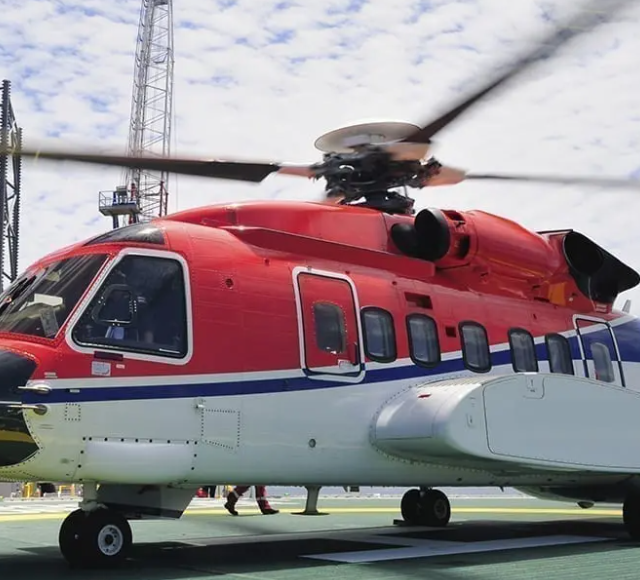
For the Royal Navy, this comes at a timely juncture. The current Crowsnest-equipped Merlin helicopters, while effective in specific roles, face endurance and range constraints that limit their ability to perform persistent AEW in highly contested environments. Crowsnest is also set to retire within the decade, prompting the Ministry of Defence to evaluate alternatives that align with the Integrated Force 2030 vision.
The UK’s emerging need, along with the proliferation of both high- and low-end air threats in Europe and around the world, was the impetus for the partnership between GA-ASI and Saab, said Jamie Walters, Vice President of International Strategic Development for GA-ASI.
“The AEW pod being developed with our partners at Saab leverages their decades of innovation in this mission area,” Walters said. “The configuration is scalable and we see clear potential for integration into Royal Navy operations, particularly where endurance and deck compatibility are critical.”
Leveraging Existing Investments and Infrastructure
In developing an unmanned AEW solution, GA-ASI is prioritising both affordability and flexibility, Walters said.
“The MQ-9B STOL is designed to operate from platforms like the Queen Elizabeth-class carriers without significant modifications,” he noted. “By combining that with Saab’s sensor technology, we’re offering a realistic near-term solution for persistent AEW from the sea on a platform that has significant commonality with the RAF Protectors.”

Above: GA-ASI’s MQ-9B STOL AEW platform transforms airborne sensing in expeditionary environments.
Courtesy GA-ASI
The modularity of the system also supports future capability development. The sensor pod can potentially host additional payloads such as signals intelligence (SIGINT) or electronic warfare (EW) systems and could be networked with UK-operated P-8 Poseidon aircraft, Royal Navy ships and even the Royal Air Force’s Protector unmanned aircraft, all of which use compatible communication protocols and data links.
Cost-effectiveness is a key advantage, Walters added: “Operating uncrewed systems reduces both crew risk and sustainment overhead, enabling more persistent presence at lower cost.
“On top of that, the RAF’s Protector programme, which is based on the MQ-9B platform, creates synergies between the services that can help reduce sustainment and training costs. This won’t be a wholly new system requiring a new training pipeline to be developed from scratch.”
As surface fleets face growing threats from hypersonic weapons, advanced cruise missiles and increasingly from both low-tech and high-end uncrewed aerial systems, early detection is becoming an imperative.
And with the need for AEW increasing during a time of constrained defence budgets, uncrewed AEW platforms that offer persistence, reach and survivability are poised to define the next chapter of warfare at sea.
For the leaders of the Royal Navy whose carrier strike ambitions depend on agility, interoperability and innovation, the GA-ASI-Saab solution presents an opportunity not just to replace a legacy system but to completely reimagine airborne early warning.
Sign up for our newsletter and get our latest content in your inbox.
Similar Reads


Sign up for our newsletter. Select all sectors relevant to you.
Related