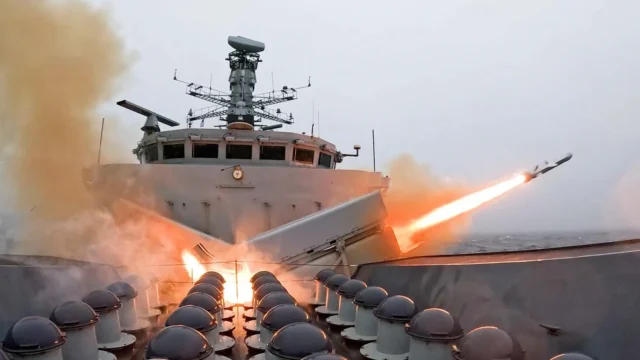


Mobilising real estate for UK defence resilience


Image courtesy Tritax
Back in 2005, The Economist reflected on what the world might look like in 2026, raising the possibility that the European Union could add “big new members, such as Turkey, Ukraine and maybe one day even Russia?”.[1]
It is an interesting snapshot of simpler times. Fast forward 20 years and the geopolitical situation is uncertain to say the least.
In June, the UK and its NATO allies agreed to commit 3.5% of GDP to ‘core’ defence spending by 2035, with an additional 1.5% allocated to broader security-related investments. Plans set out in the government’s 2025 Spending Review show that defence spending is expected to total £62.2 billion in 2025/26, increasing to £73.5 billion in 2028/29 [2] as it works towards this commitment.
Increased defence spending will necessitate investment in associated infrastructure and drive additional demand for industrial and logistics real estate. At the recent MAKE UK Defence Summit, the need to build domestic defence manufacturing resilience at pace was a constant refrain. While it is difficult at this early stage to say what this demand will look like with certainty – and the expected Defence Investment Plan may provide more clarity, the MoD’s Defence Industrial Strategy points to some core themes.
Composition of demand
First, we’re likely to see supercharged investment in small/medium sized enterprises (SMEs). While major primes such as BAE, Rolls Royce and Babcock will clearly be beneficiaries of additional defence spend, an emphasis on rapidly developing technology is likely to fuel the UK SME tech sector. Currently, only 4% of MoD spend is directly with SMEs, which is planned to double by 2028 and will test their adaptive logistics capacity.
Second, specialist regional clusters are in focus. Potential high-growth frontier industry clusters have been identified by government, some of which have been marked for imminent investment. Dispersed across the UK, these are focused on specific technologies or capabilities and will not only tap into existing specialisms but also seek to stimulate place-based, sometimes regenerative, growth.
Export demand is also likely to increase. In October, Minister for Defence Readiness and Industry Luke Pollard announced an agreement with President Erdoğan for Turkey to purchase 20 British-built Typhoon fighter jets. The deal, worth £8 billion, is the UK’s biggest fighter jet export contract since 2007.[3]
Collaborating to deliver
From a real estate perspective, this additional demand is a great opportunity and the market is already seeing new requirements for buildings in core logistics locations. Delivering the necessary step-change in critical infrastructure for UK defence will, however, drive more specialist requirements and, given the strategy of dispersed regional clusters, will include locations outside of traditional logistics heartlands. Meeting this demand requires a more strategic approach.
The Defence Industrial Strategy acknowledges logistics and warehousing in its redefined ‘UK defence industrial base’ and the need to engage with adjacent industries to improve defence readiness and avoid barriers to scaling. In practice, this means collaboration not only between the MoD, defence companies and third-party logistics operators (3PLs) but also with providers of logistics real estate. This starts with an understanding of timescales, process and financial incentive.
Timings and process
While some requirements will be relatively straightforward, a high-specification build-to-suit project might take several years to bring forward. Whether in logistics heartlands or in a specialist regional cluster, securing land and planning approval for the siting of, sometimes sensitive, defence capabilities is likely to take time and involve significant collaboration with local or Mayoral authorities and highly invested communities.
Government agencies and defence companies, therefore, need to start the process of engaging now. This means building relationships with established, well-capitalised real estate partners with a track-record of delivery and, ideally, a portfolio of both high-quality existing stock and land options.
These conversations need to be framed around the highly specific solutions required. They relate not only to supply-chain connectivity but also to proximity to multiskilled labour and companies with adjacent capabilities, utility and power resilience, 24/7 security, sustainability and the ability to accommodate advanced technologies and complex/precision manufacturing or logistics processes.
Financing
The challenge of delivering highly bespoke buildings, particularly in non-traditional geographies, should not be underestimated, as they bring additional complexity in terms of fulfilment and significantly increase risk for private capital.
Just as the Strategic Defence Review acknowledges the need to explore new funding models to make defence innovators a more attractive proposition for private capital and reduce the cost of finance for defence companies, so a similar approach may be necessary for the associated real estate requirements.
The UK government has signalled a new era for UK defence. The logistics real estate sector is poised to be part of it and has a strong track-record in innovation, helping its traditional clients to adapt to rapidly changing macro circumstances – from trade disruption to new technologies – and to meet specific strategic objectives. It is well equipped to deliver critical defence infrastructure but doing so in the timescales set, means those conversations need to start now.
[1] https://www.economist.com/news/2005/11/18/the-world-in-2026
[2] https://commonslibrary.parliament.uk/research-briefings/cbp-8175
[3] https://hansard.parliament.uk/Commons/2025-10-29/debates/65A33FDA-F396-48EE-BFB4-E893635CA1ED/details
Sign up for our newsletter and get our latest content in your inbox.
Similar Reads




Sign up for our newsletter. Select all sectors relevant to you.
Related