Northumbria University researchers awarded £4m to solve space radiation mystery
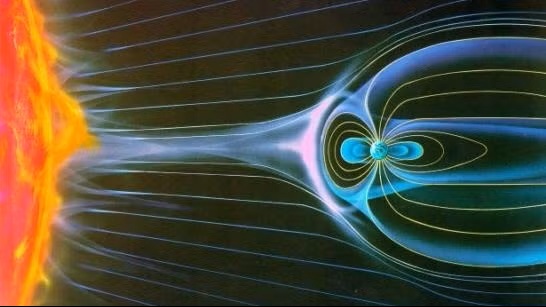
Above: Sketch of the interaction between the solar wind and a magnetised planet.
Copyright NASA
Radiation belts are areas of space surrounding the Earth where the planet's magnetic field captures and holds fast-moving particles. In these harsh environments, some particles reach nearly the speed of light.

The intensity and size of these belts can change dramatically over just hours or days in response to disturbances from the Sun. However, scientists currently cannot predict their behaviour – whether they will intensify or weaken, expand or shrink.
Led by Northumbria's Professor of Space Physics Clare Watt, the five-year project will combine extensive spacecraft data from international missions with advanced computer modelling. The team will determine what controls energy transfer through Earth's magnetosphere – the magnetic shield around our planet – and into the radiation belts.
The project has been selected by the Science and Technology Facilities Council (STFC) for one of its prestigious Large Awards, which aim to tackle big scientific questions that have the potential to produce world-leading research.
Speaking about the project, Professor Watt said: “Despite decades of research and sophisticated NASA missions that have sampled these harsh environments directly, the radiation belts have remained frustratingly unpredictable.
“This project will help us understand whether that's because we don't fully grasp the physics involved, or because parts of the system are inherently chaotic and sensitive to tiny changes in conditions.”
The research addresses two key questions: what controls how much energy from the solar wind reaches the radiation belts, and whether small changes in conditions can lead to dramatically different outcomes.
Understanding Earth's radiation belt environment is crucial for protecting satellites operating in these regions, which provide essential services including GPS navigation, telecommunications and weather forecasting.
Professor Watt explained: “Earth's radiation belts are the only place in the universe where we can directly sample such high-energy astrophysical environments. The insights from this project will be crucial for transforming scientific models into operational forecasting tools, helping us predict space weather conditions and protect vital satellite infrastructure.”
Working alongside Professor Watt is Professor Jonny Rae and Dr Sarah Bentley, also of Northumbria University, Dr Oliver Allanson of the University of Birmingham and Dr Ravindra Desai of the University of Warwick.
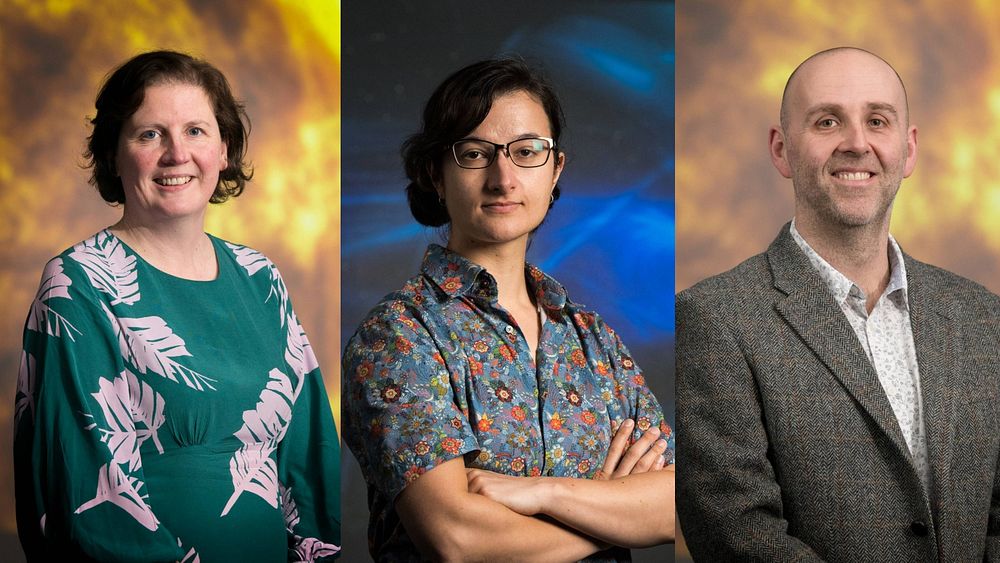
Above: (left to right) Professor Clare Watt, Dr Sarah Bentley and Professor Jonny Rae.
Courtesy Northumbria University
Dr Oliver Allanson said: “It is an eternal wonder that microscale interactions of subatomic particles that occur in one thousandth of a second can determine the global evolution of the near-Earth radiation environment over hundreds of thousands of kilometres, and with it the fate of key space assets.”
The project will produce recommendations for improving forecasting accuracy, including where to incorporate real-time data into models and how to effectively use ensemble modelling to provide probabilistic forecasts.
Northumbria University is home to an internationally renowned Solar and Space Physics research group with world-leading expertise in space weather research.
The University plays a key role in the UK's national SWIMMR (Space Weather Instrumentation, Measurement, Modelling and Risk) programme – a £20 million initiative supporting the Met Office's space weather forecasting capabilities.
Dr Andy Smith, a senior research fellow at Northumbria, has pioneered the use of artificial intelligence to predict space weather events, with his physics-inspired machine learning models now used operationally by the Met Office. His groundbreaking work earned him a prestigious Winton Award from the Royal Astronomical Society.
The University's space weather research directly informs national preparedness, with academics contributing to critical assessments of space weather risks to UK infrastructure, satellite safety, and power networks.
In 2023, Northumbria University announced the development of the new North East Space Skills and Technology Centre (NESST), expected to open later this year.
Described as a 'game-changer' for the UK space economy, NESST is the result of a £50 million investment with partners including the UK Space Agency and Lockheed Martin UK Space. The Centre will bring together industry and academia to collaborate on internationally significant space research and technological developments, creating over 350 jobs and injecting over £260 million into the North East economy over the next 30 years.