Roke launches Nav-Sync Armour

Image courtesy Roke
GNSS interference is now a routine feature of modern operations. Across Ukraine, the Baltics and the Middle East, ships, aircraft and critical infrastructure are regularly disrupted by low-cost, ground-based interference that degrades or denies navigation.
GNSS signals are inherently weak by the time they reach Earth, making them vulnerable whether used in Critical National Infrastructure (CNI) or Defence applications. By transmitting electromagnetic noise, jammers can overwhelm legitimate satellite signals, preventing receivers from maintaining an accurate position solution.

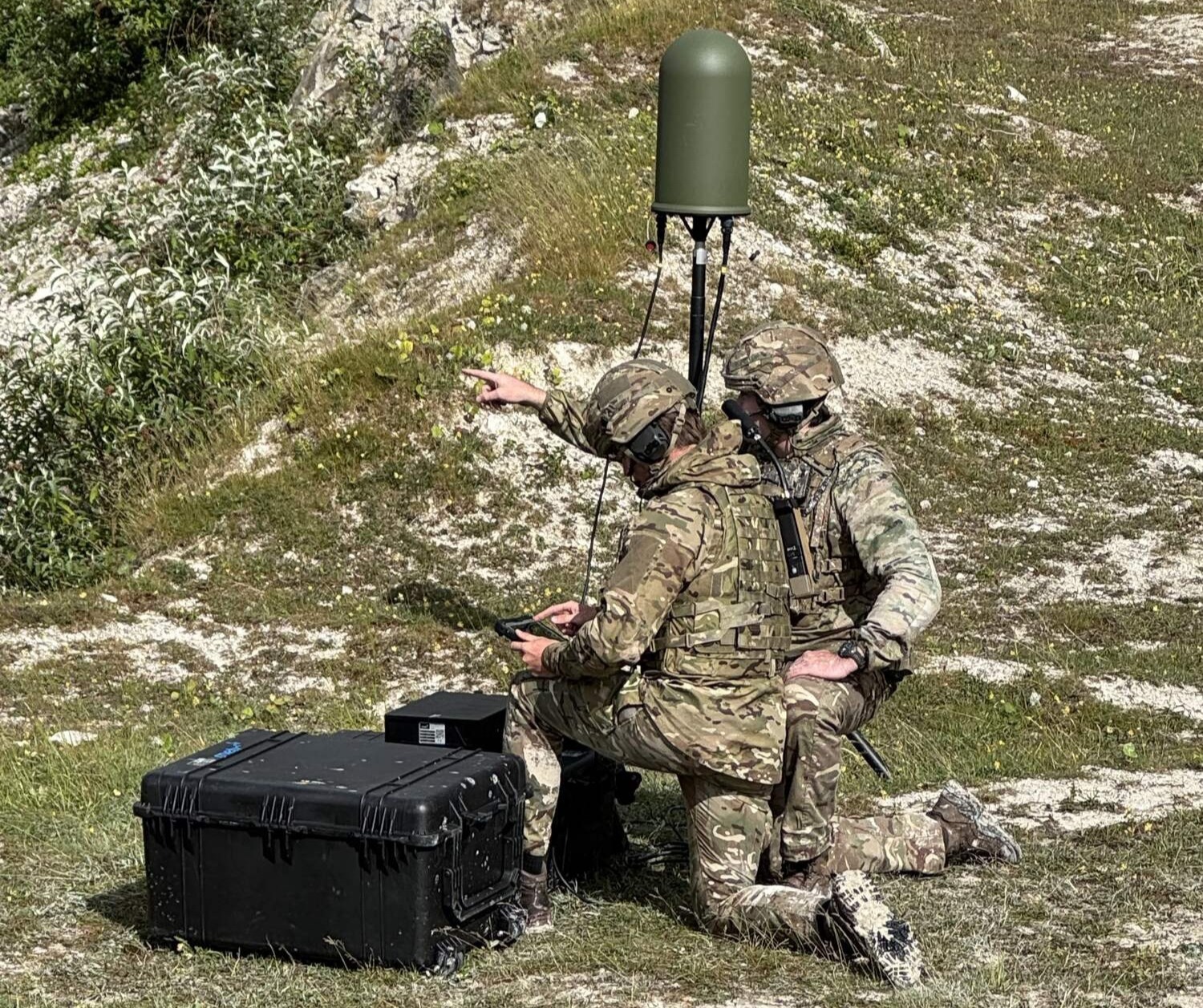
Launched at Eurosatory in Paris yesterday, Nav-Sync Armour is designed to counter this threat and support the growth of autonomous platforms. It is a multi-element CRPA that actively protects GNSS signals in contested environments.
Unlike conventional antennas, which receive signals uniformly from all directions, it uses multiple receiver channels and advanced digital processing to distinguish between genuine satellite signals and interference, meaning it suppresses jamming sources in real time while maintaining the integrity of authentic signals.
The system can mitigate multiple concurrent in-band jammers across L1 or L2 frequencies, delivering a stable and trusted GNSS output that enables continued operation under active interference.
Marc Overton, Managing Director at Roke said: “CRPAs have long been the gold standard for resilient navigation, but not always a cost-effective offering for some platforms. As a result, a large proportion of assets have been left either exposed to attack or reliant on solutions that struggle to perform in contested environments.
“For decades, effective GNSS protection has been concentrated on high-cost platforms, with many systems operating without meaningful resilience. Nav-Sync Armour addresses that imbalance by delivering the performance of high-end CRPA systems in a compact, low-SWaP solution that is affordable for all platforms.”
Mission success increasingly depends on autonomy. These air, maritime or ground platforms require the persistence and scale that modern operations demand, yet they are often the least protected. Nav-Sync Armour enables resilient navigation where it has previously been impractical or unaffordable.
In today’s battlespace, resilience is no longer about protecting a few high-value assets — it is about ensuring enough systems can continue to operate to deliver mission success.
Nav-Sync Armour shifts the balance back in favour of the platform, removing traditional barriers of cost, complexity and restriction to make high-performance protection available at the scale modern operations require.
Roke has been involved in CRPA technology for over four decades, having developed the world’s first anti-jam CRPA system in 1984. Its expertise has since been used to protect some of the world’s most advanced air platforms.
Nav-Sync Armour builds on this heritage, combining proven expertise with a modern digital architecture to deliver enhanced performance in a compact, low-SWaP solution. Designed as a direct replacement for existing GNSS antennas, it provides a straightforward route to upgrading resilience without significant platform redesign.
The system has been engineered for rapid integration with minimal impact on existing platform designs. Its compact form factor and low power consumption make it suitable for a wide range of installations, while its UK sovereign design ensures it is free from ITAR constraints, reducing supply chain friction and enabling broader adoption.
Roke has worked with other UK partners to create an onshore supply chain capable of manufacturing in the thousands.
It connects directly to existing GNSS receivers via standard RF interfaces, simplifying integration and retrofit.
Nav-Sync Armour forms part of Roke’s wider Resilient PNT portfolio, delivering layered approaches to maintain navigation resilience in GNSS-contested environments. The portfolio reflects a broader shift in defence capability, moving from selective protection of high-value assets to scalable protection across the force.