UK-led space tech to enhance William Herschel Telescope
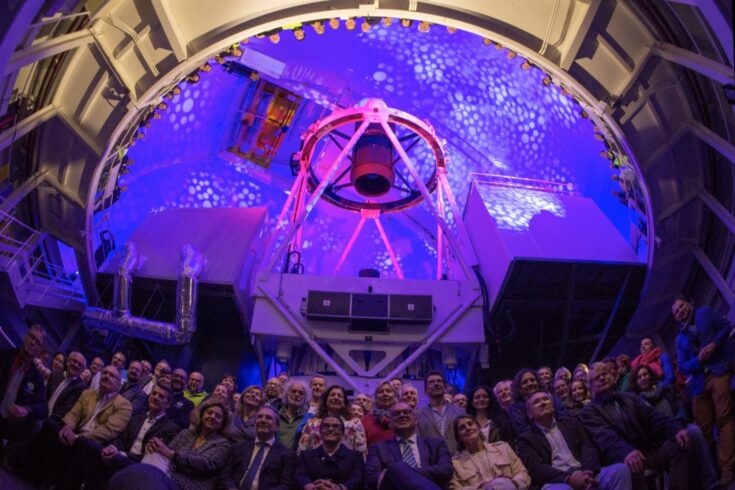
Image courtesy UKRI / STFC
A spectrograph is a tool that splits light received by a telescope like a prism into different colours that researchers can analyse to learn more about objects such as stars which the light has emitted from.
The William Herschel Telescope Enhanced Area Velocity Explorer (WEAVE) is a next-generation spectrograph led by the UK and co-funded by the Science and Technology Facilities Council (STFC) and developed in part by STFC RAL Space. This is set to vastly improve the William Herschel Telescope and answer big astronomical questions.

The William Herschel Telescope is located at the Observatorio del Roque de los Muchachos in La Palma on the Canary Islands.
One-of-a-kind tech
WEAVE is unique among multi-object spectrographs both in the sharpness of the images it produces and its ability to split light for as many as 960 celestial sources simultaneously.
Its high-resolution mode is five to 10 times greater than other available spectrographs, enabling more precise measurements of properties such as the abundance of chemical elements in cosmic light sources.
In the coming years, the Isaac Newton Group of Telescopes (ING), which is co-funded by STFC and includes the William Herschel Telescope, will make use of these advanced capabilities by assigning 70% of the time available on the telescope to the WEAVE survey.
The WEAVE survey is a set of eight major surveys organised by over 500 astronomers across Europe that will help answer questions such as:
- how our galaxy formed
- how the stars within the galaxy evolved
- how other galaxies were assembled
- what dark matter and dark energy are
Together, these surveys and other research programmes will require spectra of several million stars and galaxies, a goal only now obtainable thanks to WEAVE.
Professor Mark Thomson, STFC Executive Chair, who attended the inauguration event, said: "This is an important step forward for astronomy in Europe.
"With the inauguration of WEAVE, we are at the start of a new era of exciting new observations from the William Herschel Telescope, with the potential to yield breakthroughs in astronomy and cosmology.
"As one of the three main partners of the William Herschel Telescope, STFC is delighted to mark this occasion and acknowledge the outstanding work from the astronomers, engineers and the staff at the Isaac Newton Group of telescopes who have made this possible."
Launching the next phase
The inauguration ceremony was the largest ever gathering at the telescope and included:
- delegates from various funding agencies and research institutes, including STFC
- organisations involved in WEAVE’s design and construction
- the WEAVE science teams
The culmination of a decade of work, WEAVE was installed in May 2022 and obtained its first scientific data in December of the same year. During 2023, several of its observation modes have been fine-tuned and sufficient data has been obtained to verify its scientific capabilities.
WEAVE’s inauguration signifies the start of scientific exploitation, commencing with the WEAVE survey and scientific programmes using its large integral-field unit (LIFU) mode.