Viasat and partners complete Iris RPAS flight trial
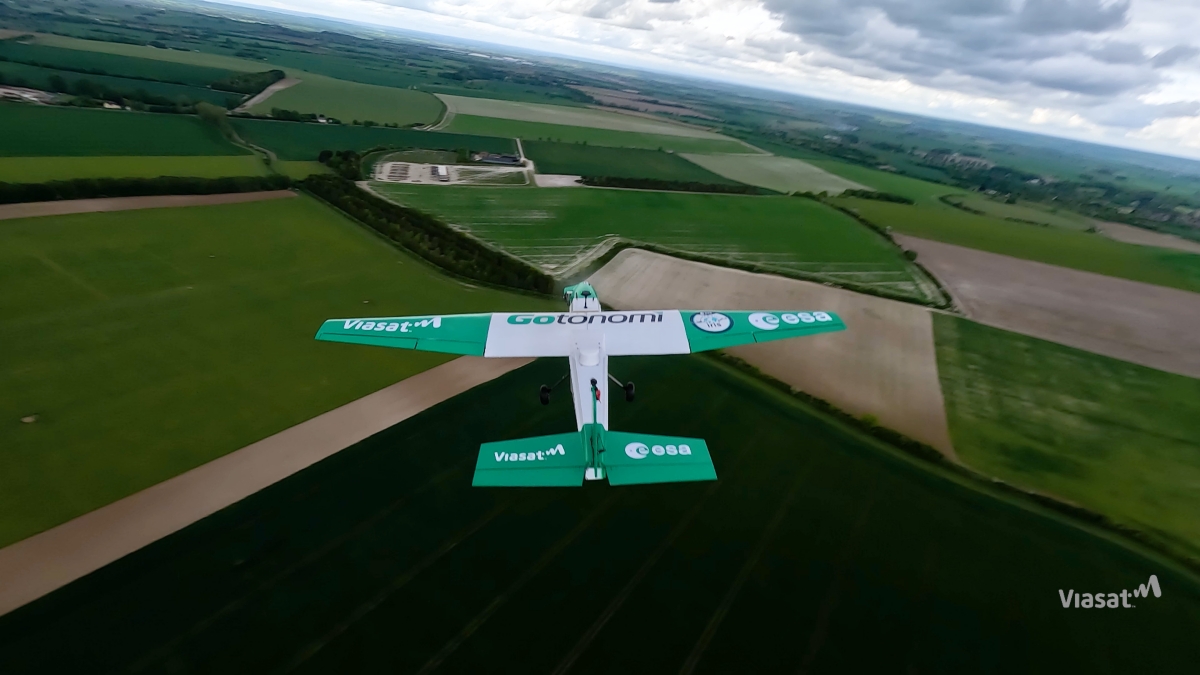
Image courtesy Viasat
The demo aims to understand how emerging connectivity technologies support Unmanned Aircraft System Traffic Management (UTM) interaction and controlled BVLOS operations in complex and remote environments.
The activity forms part of ESA’s wider Iris programme (Iris SATCOM Global), which primarily targets commercial aviation and is designed to build evidence around trusted communications for the safe integration of aircraft into shared, non segregated airspace. Within this context, RPAS represents a specific element contributing to the broader commercial aviation framework.
BVLOS operations are critical in remote or hard to access environments, where aircraft must often carry out precise manoeuvres beyond direct visual control. In these scenarios, safe operations depend on reliable interaction between the aircraft, the remote operator and wider airspace systems, rather than line of sight oversight alone.
This trial focused on observing how new connectivity technologies behave under real flight conditions and how they support the exchange of trusted information with airspace management systems. The objective was to better understand how uncrewed aircraft can be monitored, directed and adapted during flight, including how uncrewed aircraft can be monitored and managed during flight including under more demanding operational conditions.

By examining connectivity behaviour alongside UTM interaction, the trial reflects the practical realities of future BVLOS operations, where communications and airspace coordination must work together to maintain situational awareness, predictability and safety.
“UTM integration and resilient network capabilities are core pillars of the ESA Iris RPAS activities- not just operational add-ons,” said Joel Klooster, SVP Aircraft Operations and Safety at Viasat. “Through the Iris RPAS trial, we’re validating how advanced, multilink networks can support real-time interaction, airspace awareness, and continuity of command and control in live operating conditions. The results show an enhanced, interoperable network is foundational for safe, efficient, and scalable UAV operations within managed airspace.”
Viasat’s participation builds on its long standing collaboration with ESA and its focus on aviation safety. Working alongside TTP and Frequentis, the trial brings together complementary expertise across satellite connectivity, emerging network technologies and airspace integration, helping to build a clearer picture of how BVLOS operations can be safely supported as they move into more challenging environments.
This flight trial is one of several activities currently being delivered through the Iris RPAS programme, each exploring different operational scenarios, environments and system interactions. Together, these trials are contributing to a growing evidence base that supports collaboration between industry, regulators and airspace stakeholders as BVLOS operations continue to evolve.
Bernhard Kirschner, Solution Architect Integrated Lower Airspace Solutions at Frequentis AG, said: “At Frequentis AG, we focus on enabling the safe integration of uncrewed aircraft into controlled airspace. This Iris RPAS flight trial shows how robust connectivity supports the reliable exchange of safety critical information with UTM systems—an essential foundation for predictable and safe BVLOS operations.”
Martin Wallis, Aviation Programme Lead at TTP plc, said: “As BVLOS operations move into more complex and remote environments, trusted communications will be essential to maintaining safety, situational awareness and operational control. This Iris RPAS trial helps build real-world evidence around how connectivity technologies can support integration with UTM and airspace management systems. Drawing on our expertise in UAV satellite connectivity, terminal and antenna technologies, including our Gotonomi UAV satcom platform, TTP plc is pleased to support the wider effort to enable resilient, scalable and safety-led uncrewed aviation.”