UK Space Agency signs the Artemis Accords
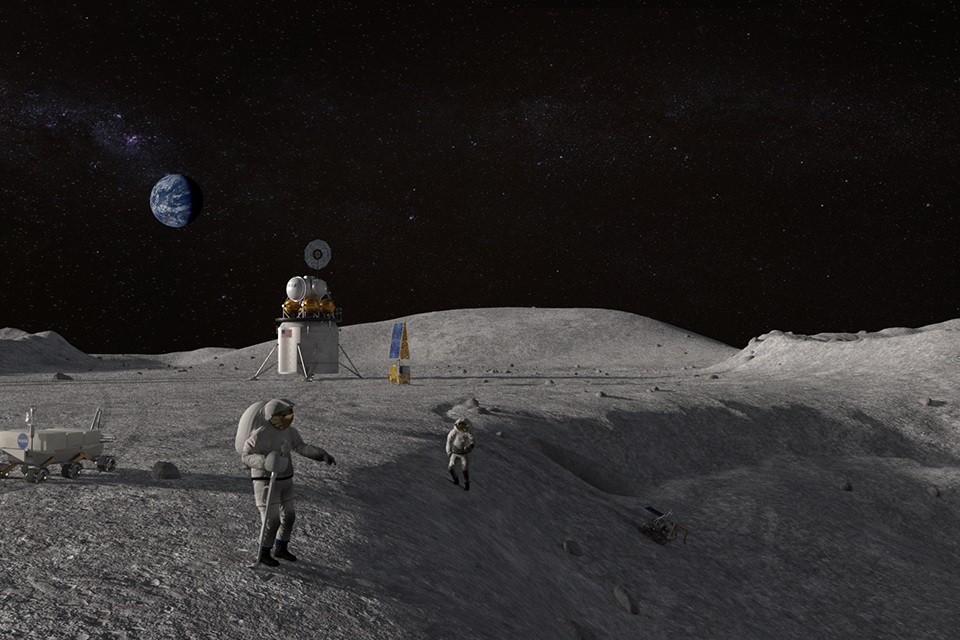
Above:
Artemis astronauts on surface of Moon.
Courtesy NASA
NASA’s Artemis programme aims to land the first woman and the next man on the Moon by 2024. Commercial and international partners will collaborate to achieve a sustainable presence on the lunar surface as a steppingstone to the first human mission to Mars.

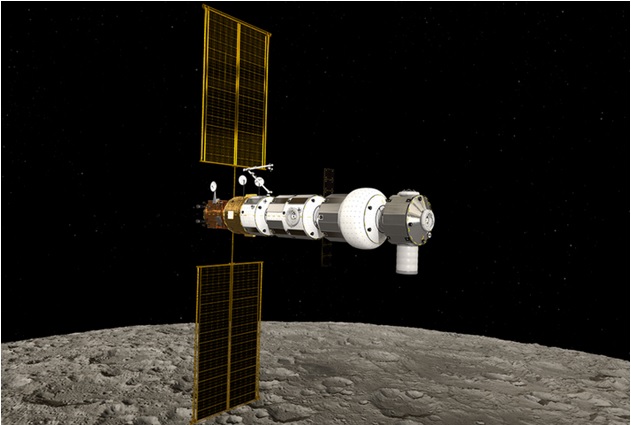
Above:
UK businesses will be involved in building key parts of the Lunar Gateway.
Image courtesy ESA
The UK will play a key role in this mission. Businesses across the UK will be involved in building the service module and habitation module of the Lunar Gateway, a new space station orbiting the moon, generating economic benefits and high-skilled jobs. The UK has already committed over £16 million for the first phase of the design of these elements.
Science Minister Amanda Solloway said: The prospect of the first woman landing on the Moon in the coming years will be a source of inspiration for thousands of young people across the UK who may be considering a career in space or science.
"Today’s historic agreement, backed by £16 million of UK funding, underlines our commitment to strengthening the UK’s role in the global space sector, building on our existing strengths in satellites, robotics and communications to grow our economy and improve life on Earth."
With numerous countries and companies conducting operations in space it is vital to establish a set of principles to govern the civil exploration and use of outer space.
The US worked with the UK, along with other spacefaring nations including Japan, Australia, Canada, Italy and the UAE, to develop the Artemis Accords, a set of principles to ensure a shared understanding of safe operations, use of space resources, minimising space debris and sharing scientific data.
James Cleverly, Minister for Defence and International Security at the Foreign, Commonwealth and Development Office, said:
"By signing the Artemis Accords, the UK is joining international partners to agree a common set of principles which will guide space exploration for years to come. This ground-breaking agreement will guide how states should operate in space, as envisaged in the Outer Space Treaty.
"The UK is at the forefront of international collaboration to explore and preserve outer space for future generations. We’re committed to keeping space – and the crucial space systems upon which our societies depend – safe and secure, by launching a landmark UN resolution to agree responsible behaviour for operating in space."
While NASA is leading the Artemis programme, international partnerships with countries including the UK will play a key role in achieving a safe and sustainable human presence on the Moon.
UK Space Agency CEO Graham Turnock, who signed the Artemis Accords during a virtual ceremony at the International Astronautical Congress (IAC), said: "Signing the Accords is a strong signal of our intent to take a leading global role in civil space. We hope to deepen our relationship with the US when it comes to space and enhance the UK’s global influence in the space sector.
"This exciting step could open up new opportunities for UK companies and scientists to be part of NASA missions to the Moon and Mars."
International cooperation on Artemis is intended not only to bolster space exploration but to enhance peaceful relationships between nations. At the core of the Artemis Accords is the requirement that all activities will be conducted for peaceful purposes, in line with the Outer Space Treaty.
Sustaining human life for long periods of time on space missions is a significant challenge and one that requires resources such as water, building materials and fuel. As transporting these resources into space is expensive, a key enabler of future missions will be the ability to extract and use resources from the Moon, asteroids or Mars. The UK has worked with international partners to ensure the Artemis Accords are clear that any such resource extraction in space should be carried out in a manner that complies with the Outer Space Treaty.