Lufthansa Technik and PTC collaborate on transition to sustainable aviation
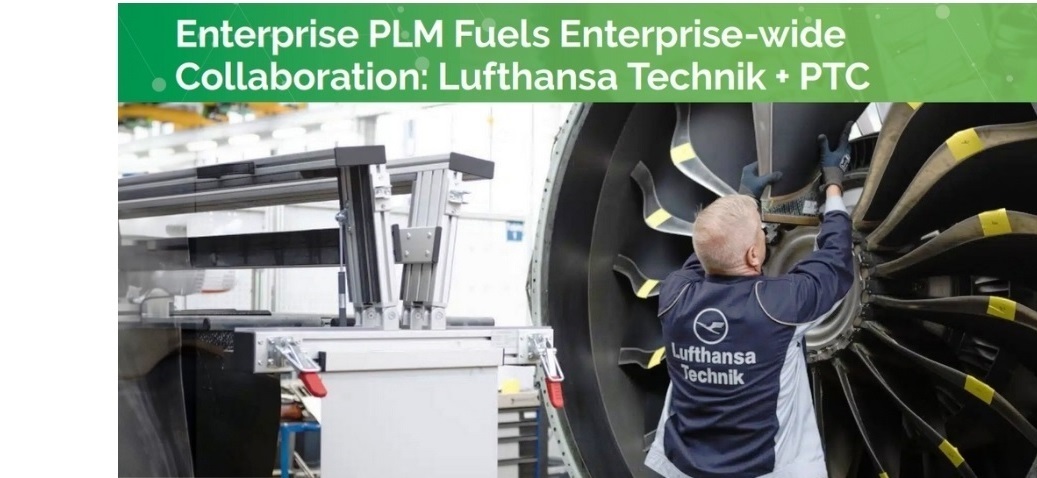
Image courtesy PTC
The global airline industry faces steep challenges moving into 2024 and beyond. International air travel has yet to fully bounce back from its pre-COVID levels, though domestic travel is rebounding more quickly. Supply chain disruptions, skilled labour shortages and demand for expensive sustainability and environmental measures continues to grow.
Nevertheless, the International Air Transport Association (IATA), is forecasting record 2024 operating profits for the industry of more than $49 billion. In 2023, almost four billion passengers took to the airways, nearly matching the record travel levels of 2019. With the most credible forecasts predicting healthy continuing growth in demand, airlines must modernise and expand their fleets aggressively. Last year, airlines ordered more than 3,000 new airliners – a historical record – from the industry’s two largest builders.
Keeping the industry aloft: MRO
The $104 billion (2024 projected, Oliver Wyman Inc.) maintenance, repair and overhaul (MRO) sector is vital in securing the airline industry’s ability to rise to these challenges and exploit the opportunities they represent. As the sector’s name suggests, MROs partner with airlines to ensure that every plane in every fleet is airworthy, safe and reliable.
The implications for airlines are in many cases amplified for MRO leaders, who need to balance the direct upstream requirements of their customers with the dynamics of a still-recovering downstream material and personnel supply chain. Managing the complexities inherent in this responsibility is an immense, high stakes undertaking. Only with the right business and technology partnerships – strong, trusted relationships and powerful, proven tools – can MROs measure up.
Excellence in motion: Lufthansa Technik plus PTC
Lufthansa Technik AG, headquartered in Hamburg, has been among the world’s foremost leaders in the MRO space since 1951 and is licensed internationally for maintenance, design and production. With 20,000 employees, 800 customers and more than 4,200 aircraft under contract worldwide, its scale and reach extend far beyond Deutsche Lufthansa AG itself, Germany’s renowned flag carrier and Europe’s largest airline.
In its collaboration with the major airlines, Lufthansa Technik currently provides technical aircraft services to a wide array of fleet workhorses and specialty aircraft. OEMs include Airbus, Boeing, Embraer, Bombardier and DeHavilland and Lufthansa Technik delivers solutions to virtually every major commercial airline. Complementing its comprehensive range of MRO services, the company also designs, manufactures and delivers innovative products that address sustainability goals, as well as providing advanced aircraft modification services.
Lufthansa Technik’s high-end cabin customisations include not only luxury levels of fit, finish and function for select clientele but also address special missions such as patient transport, scientific research and government. Germany’s equivalent of the United States’ ‘Air Force One’ presidential aircraft, known as ‘Regierungsflieger’ (currently the Airbus A350-900 Konrad Adenauer) is customised and maintained by Lufthansa Technik.
To meet the imperatives of the current market and continue to excel for its customers, Lufthansa Technik has defined an approach that is both proactive and adaptive. Technological innovation – and digitalisation in particular – is at the core of its strategy. To achieve the best available business outcomes through digital transformation, while safeguarding their commitment to state-of-the-art workmanship and the highest quality standards, Lufthansa Technik has partnered with PTC for product lifecycle management (PLM). The range and complexity of customer aircraft and the sheer number of products and services delivered are driving the need for comprehensive PLM across the company and its manufacturing, service and supply chains.
PTC’s Windchill PLM system, seamlessly integrated with its ThingWorx IIoT platform, were selected to deliver the data management backbone and IoT capabilities required. PTC’s Kepware, which facilitates connectivity between different industrial automation devices and application, is also part of Lufthansa Technik’s integrated solution.
Digitising the core
A top priority in today’s fluid and dynamic OEM market involves pure innovation – conceiving and commercialising new products and services. This enables growth of the company’s footprint within existing customers’ enterprises and generates opportunities with new customers. At the core of the Lufthansa Technik enterprise, however, the existing MRO business must also adapt and accelerate.
Overall, process refinement and redefinition through digital transformation is seen as central to the success of Lufthansa’s strategic engagement with PTC. Engineering a comprehensive and seamless ‘digital thread’ that consolidates all data related to specific products and the portfolio, is central to this vision.
A major programme within this broader initiative is entitled ‘Digitise the Core’, which Lufthansa Technik have characterised as “evolving the efficiency of our production systems through fully digital processes into the future". The scope of the initiative involves the orchestration and implementation of projects across the organisation and its four principal business units: Aircraft Component Services, Original Equipment and Special A/C Services, Engine Services and Aircraft Maintenance Services.
The programme’s success to date is evident in its momentum: the number of projects being executed has increased from 10-20 to more than 300 in just two to three years. It is notable in this context that this has been achieved while upgrading from a regulation-driven and document-based PDM system to a model-based PLM system. A guiding premise has been the creation of an authoritative source of truth using PTC Windchill, in which all data, including heterogenous data types from the various units, are centralised and made accessible to all stakeholders.
Lufthansa Technik is framing ‘Digitise the Core’ as a strategic initiative by which to rethink the production pipeline in a way that delivers maximum value to the business, including enterprise priorities like more standardisation of parts and processes. The programme is designed to foster efficiency through automation, increase transparency across departments and business units, fuel data-driven decision-making and to conceive and deliver new digitally enabled services.
Measuring success
To measure the programme’s ongoing business impact, refine it as needed and consolidate successes, the company is employing an Objective Key Result (OKR) approach. Major enterprise objectives are linked to business goals and each business goal subdivided according to business values like increased standardisation. Each quarter, measurable key results are specified and effective contribution to those values assessed and documented. Attention to these metrics over multiple quarters and years allows for continuous improvement and accelerates progress toward the vision of a fully ‘Digitised Core’.
Mission-critical ‘fields of action’
Within the programme, ‘fields of action’ are defined to organise the effort: discrete categories of activity that are common to all units of the business. Paperless execution, for example, is a field of action in which businesses across the enterprise are involved. Every field of action is addressed company-wide through simultaneous, coordinated activities in all business segments and in alignment with IT and the innovation-focused teams. To ensure the practical utility of the efforts, the programme is designed to address technology processes as well as common business cases.
Other fields of action further define the contours of the programme, as proven areas of focus for organising the required energies and resources within the enterprise.
Technical documentation is the field of action that addresses the entire lifecycle of a document, from its birth through its distribution, enrichment with Lufthansa Technik’s in-house IP, analysis and its application to the job at hand, as well as subsequent revisioning and updating.
Material supply chain as a field of action is especially germane right now, as the industry faces a shortage of aircraft parts worldwide. Lufthansa Technik is rethinking how to manage, protect and control the supply chains on which their business relies, always with an eye toward the goal of driving increased efficiency.
Shop floor is a field of action that comes into play for the many products Lufthansa Technik designs and manufactures itself, complementing the vast array of parts it obtains from OEMs. One example is the outfitting of custom interiors, for the line of business Lufthansa Technik refers to as ‘VIP Cabins’.
Requirements are defined in the design phase, which generates its own critical revenue stream. This then flows into material management and work management for production – what to do, who will do it and when. Thus, work instructions are associated directly with the manufacturing bill of materials (mBOM) and thereby reflect the original engineering bill of materials (eBOM).
Data convergence drives business unity
Dr Severin Todt, Lufthansa Technik’s Senior Director of IT Design, Completion and Manufacturing, said in a recent interview with PTC: “Regardless of the field of action, it’s really all about the data.
“How do we ensure an authoritative source of truth…We will always have different sources of data but they need to be accessed through a single layer, ensuring that we have one, authoritative source of truth.”
Achieving that level of data governance involves several critical requirements, all of which PTC’s Windchill and ThingWorx platforms are designed to accommodate within the overall Lufthansa Technik IT and industrial infrastructure. These include maintaining the right data structures, keeping those structures aligned, providing accessibility for the right parties in the appropriate format for each, how export control is implemented and how data is extracted.
Intelligence fueling action
As significant a topic as data, per se, is in the context of Lufthansa Technik’s digital transformation, it is still only a means to an end. Ultimately, the data must be productively applied, streamlining and automating existing processes and driving enterprise efficiency. Putting manufacturing data to immediate, practical use by generating actionable intelligence is the foundational purpose of PTC’s PLM platform and its complementary systems. The continuing success of the partnership between PTC and Lufthansa Technik demonstrates the positive impact of the ongoing collaboration.
PLM: inspiring the Digital Core
In his conversation with PTC, Dr Todt emphasised the importance of the PLM system to the overall success of the project: “It’s a fundamental role. It’s not only in maintenance but in meeting the engineering needs of our innovation teams… PLM is a central part, not only as a platform but as an inspiration for our processes, from engineering, into manufacturing and service… In the future, it will include the supply chain, which is currently addressed mainly by our ERP system. We’re aiming to integrate Windchill into our ERP (in a future phase).”
Implementing the PLM programme was Lufthansa Technik’s top priority within the broader core digitisation initiative addressed with PTC’s Windchill. The effort will enable consolidation of the overall PLM landscape, including harmonisation of CID tools as well as EBOM, MBOM and SBOM management. MultiCAD data management is also central to the initiative and Windchill will integrate a robust array of CAD tools that includes Solidworks, NX, 2D AutoCAD and Zuken for ECAD.
IIoT: operational tech meets information tech
Dr Todt explained that complementing and amplifying the impact of Windchill, the ThingWorx/Kepware deployment: “… has really helped us map an efficient way to tightly integrate our operational technology into the backend IT systems.
"Kepware was really the best product (to do that) and in combination with ThingWorx, we now have a new channel for acquiring information from the shop floor, as well as for controlling and sending data and instructions to the equipment – the tools and machines themselves – on the shop floor.”
According to Dr Todt, the ThingWorx platform, synced with Kepware, is “giving us fast capabilities to deliver value to customers, in an agile way”.
Aligning on a common vision for PLM
Lufthansa Technik’s size, global reach and business diversity mean that no company-wide undertaking will be without its challenges. The principal issue confronting the PLM aspect of ‘Digitising the Core’ has been aligning the strategies of different businesses across the enterprise.
While the company is well on the way to delivering a comprehensive roadmap for the big picture ‘digital target’, different groups have different mindsets toward PLM. Tailored or specialised PLM programmes for various groups are under consideration where appropriate, such as for the aforementioned VIP teams and tool and equipment teams, who have more modest needs relative to PLM.
Balancing priorities for long-term gains
Lufthansa Technik continues to work diligently with PTC to meet the need for an integrated, congruent solution that addresses two discrete priorities. The initiative must first deliver measurable value for business units with very specific and not-always-complementary needs. It must also consolidate the PLM environment in a way that maximises value delivered to the enterprise at large, while minimising frictions that impair collaboration within the company and among its partners.
Teaming up to win
Of course, there is more to the story than great technology deployed effectively. As Dr Todt put it: “It’s not only about the technology but the support from PTC experts that is really helping us succeed on this journey.”
The collaboration between the professionals of Lufthansa Technik and PTC’s PLM and IIoT experts is meeting these needs with measurable impact, resulting in significant efficiencies and setting new standards of excellence for Lufthansa’s Technik’s storied brand.
To learn more click here
Sign up for our newsletter and get our latest content in your inbox.
Similar Reads

Sign up for our newsletter. Select all sectors relevant to you.
Related