NASA confirms 2024 warmest year on record

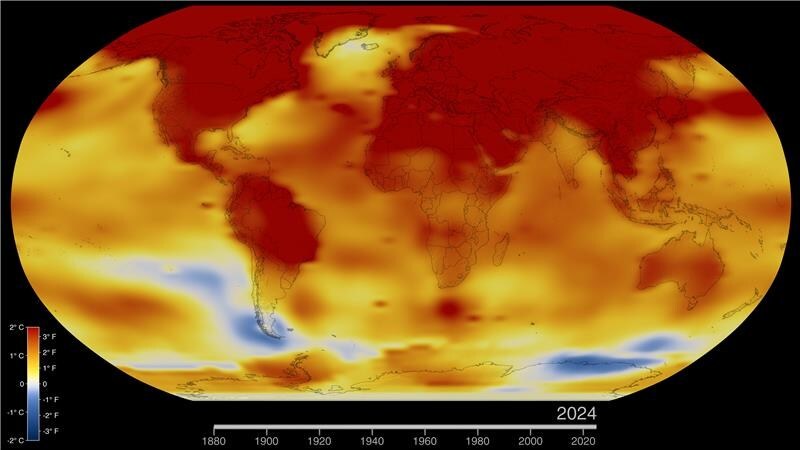
Above: Last year was Earth’s warmest year since modern record-keeping began around 1880 and the past 10 consecutive years have been the warmest 10 on record.
Courtesy NASA / Grace Weikert
Global temperatures in 2024 were 2.30 degrees Fahrenheit ( 1.28 degrees Celsius) above the agency’s 20th-century baseline (1951-1980), which tops the record set in 2023. The new record comes after 15 consecutive months (June 2023 through August 2024) of monthly temperature records — an unprecedented heat streak.
"Once again, the temperature record has been shattered — 2024 was the hottest year since record keeping began in 1880," said NASA Administrator Bill Nelson. "Between record breaking temperatures and wildfires currently threatening our centres and workforce in California, it has never been more important to understand our changing planet."
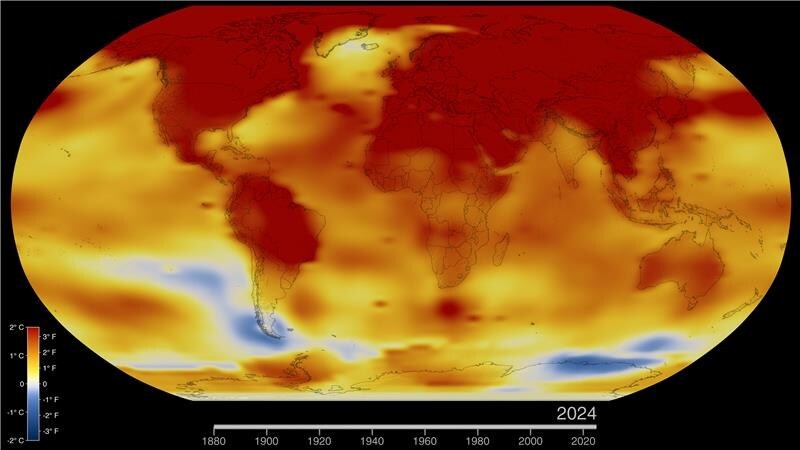
Above: This map of Earth in 2024 shows global surface temperature anomalies, or how much warmer or cooler each region of the planet was compared to the average from 1951 to 1980. Normal temperatures are shown in white, higher-than-normal temperatures in red and orange and lower-than-normal temperatures in blue. An animated version of this map shows global temperature anomalies changing over time, dating back to 1880.
Courtesy NASA’s Scientific Visualization Studio
NASA scientists further estimate Earth in 2024 was about 2.65 degrees Fahrenheit (1.47 degrees Celsius) warmer than the mid-19th century average (1850-1900). For more than half of 2024, average temperatures were more than 1.5 degrees Celsius above the baseline and the annual average, with mathematical uncertainties, may have exceeded the level for the first time.
"The Paris Agreement on climate change sets forth efforts to remain below 1.5 degrees Celsius over the long term. To put that in perspective, temperatures during the warm periods on Earth three million years ago — when sea levels were dozens of feet higher than today — were only around three degrees Celsius warmer than pre-industrial levels," said Gavin Schmidt, director of NASA’s Goddard Institute for Space Studies (GISS) in New York. "We are halfway to Pliocene-level warmth in just 150 years."
Scientists have concluded the warming trend of recent decades is driven by heat-trapping carbon dioxide, methane and other greenhouse gases. In 2022 and 2023, Earth saw record increases in carbon dioxide emissions from fossil fuels, according to a recent international analysis. The concentration of carbon dioxide in the atmosphere has increased from pre-industrial levels in the 18th century of approximately 278 parts per million to about 420 parts per million today.
NASA and other federal agencies regularly collect data on greenhouse gas concentrations and emissions. These data are available at the US Greenhouse Gas Center, a multiagency effort that consolidates information from observations and models, with a goal of providing decisionmakers with one location for data and analysis.

Above: This data visualisation, which is updated monthly, shows monthly global temperature anomalies on Earth’s surface and how those temperatures deviate from the average from 1951 to 1980.
Courtesy NASA’s Scientific Visualization Studio
Exceptional heat trends
The temperatures of individual years can be influenced by natural climate fluctuations such as El Niño and La Niña, which alternately warm and cool the tropical Pacific Ocean. The strong El Niño that began in fall 2023 helped nudge global temperatures above previous records.
The heat surge that began in 2023 continued to exceed expectations in 2024, Schmidt said, even though El Niño abated. Researchers are working to identify contributing factors, including possible climate impacts of the January 2022 Tonga volcanic eruption and reductions in pollution, which may change cloud cover and how solar energy is reflected back into space.
"Not every year is going to break records but the long-term trend is clear," Schmidt said. "We’re already seeing the impact in extreme rainfall, heat waves and increased flood risk, which are going to keep getting worse as long as emissions continue."
Seeing changes locally
NASA assembles its temperature record using surface air temperature data collected from tens of thousands of meteorological stations, as well as sea surface temperature data acquired by ship- and buoy-based instruments. This data is analysed using methods that account for the varied spacing of temperature stations around the globe and for urban heating effects that could skew the calculations.
A new assessment published earlier this year by scientists at the Colorado School of Mines, National Science Foundation, the National Atmospheric and Oceanic Administration (NOAA) and NASA, further increases confidence in the agency’s global and regional temperature data.
"When changes happen in the climate, you see it first in the global mean, then you see it at the continental scale and then at the regional scale. Now, we’re seeing it at the local level," Schmidt said. "The changes occurring in people’s everyday weather experiences have become abundantly clear."
Independent analyses by NOAA, Berkeley Earth, the Hadley Centre (part of the United Kingdom’s weather forecasting Met Office) and Copernicus Climate Services in Europe, have also concluded that the global surface temperatures for 2024 were the highest since modern record-keeping began. These scientists use much of the same temperature data in their analyses but use different methodologies and models. Each shows the same ongoing warming trend.
NASA’s full dataset of global surface temperatures, as well as details of how NASA scientists conducted the analysis, are publicly available from GISS, a NASA laboratory managed by the agency’s Goddard Space Flight Center in Greenbelt, Maryland.
For more information on NASA’s Earth Science Division and its programmes: www.nasa.gov/earth
Sign up for our newsletter and get our latest content in your inbox.
Similar Reads





Sign up for our newsletter. Select all sectors relevant to you.
Related