

Brace for turbulence as the Met Office predicts the strongest El Niño in living memory


Airlines operating in the North Atlantic could encounter increased turbulence this winter as an exceptionally strong El Niño alters atmospheric circulation and the jet streams used by commercial aircraft.
The Met Office says the 2026 El Niño is developing into the largest in living memory and probably the strongest since the 19th century.
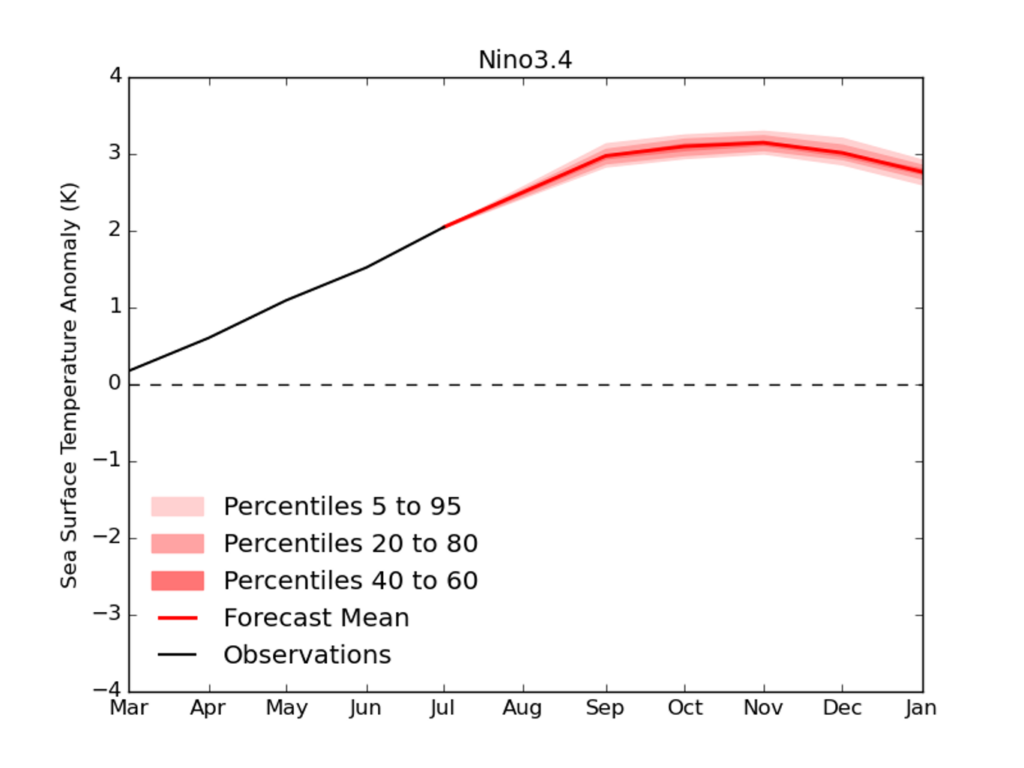
Its GloSea long-range forecasting system indicates sea-surface temperature anomalies in the Niño 3.4 region that could exceed 3°C in the coming months.
Professor Adam Scaife, Head of Long Range Forecasting at the Met Office, described the event as “unprecedented”.
“I have never seen an El Niño signal this intense in our forecasts,” he said.
A typical El Niño produces warming of between 1°C and 2°C in the equatorial Pacific, according to Scaife, with 2°C already representing a particularly large event.
“If the forecast is accurate – and other forecast systems show similar extreme values – then 2026 will far exceed our recent experience of El Niño and its worldwide climate influences,” he added.
The event is expected to strengthen towards a winter peak. The Met Office says it could increase the probability of wetter and stormier conditions across northwest Europe during autumn and early winter.
For aviation, however, the potential effects extend beyond weather disruption.
El Niño can change the conditions that produce turbulence
El Niño is the warm phase of the El Niño-Southern Oscillation (ENSO). Changes in tropical Pacific sea-surface temperatures alter atmospheric circulation. The effects extend into the mid-latitude jet streams.
Changes in the position and strength of jet streams can affect clear-air turbulence (CAT), which is a safety concern for aviation.
CAT generally occurs outside convective cloud. It is associated with vertical wind shear around upper-level jet streams. Unlike convective turbulence, CAT can occur without obvious visual warning. The result can be aircraft encountering sudden and severe turbulence, leaving cabin crew and passengers no time to prepare.
Research by Professor Paul Williams and Rachel Cheyne at the University of Reading examined whether ENSO could influence CAT using atmospheric reanalysis data covering strong El Niño and La Niña events since 1979.
Their research, presented to the European Geosciences Union, found strong links between ENSO and vertical wind shear across several key aviation regions, including the North Atlantic.
Over the US and Mexico, vertical wind shear increased from about 4 metres per second per 100 hPa during strong La Niña conditions to around 6 metres per second during strong El Niño conditions — an increase of approximately 50%.
Researchers also identified appreciable changes over the North Atlantic, South America, East Asia, Southeast Asia, Australia and Africa.
The researchers concluded that ENSO forecasts could potentially support seasonal CAT forecasts up to 12 months in advance.
North Atlantic turbulence has already increased
The El Niño event accompanies a longer-term increase in North Atlantic CAT.
A peer-reviewed study published in Geophysical Research Letters analysed atmospheric data between 1979 and 2020 using 21 turbulence diagnostics.
Researchers from the University of Reading and Met Office found consequential increases in CAT at aircraft cruising altitudes.
At an average point over the North Atlantic, the annual duration of light-or-greater CAT increased 17%, from 466.5 hours in 1979 to 546.8 hours in 2020.
Moderate-or-greater CAT increased 37%, from 70 hours to 96.1 hours annually.
Severe-or-greater CAT increased 55%, from 17.7 hours to 27.4 hours annually.

The University of Reading said the results provided evidence that aircraft are already encountering a more turbulent atmosphere as the climate warms.
The long-term trend is attributed to climate change rather than El Niño. However, both can affect upper-level winds and vertical wind shear.
Why the North Atlantic matters to aviation
The North Atlantic combines one of the world’s busiest long-haul aviation corridors with a powerful and variable jet stream.
Airlines exploit these winds to reduce eastbound journey times while attempting to minimise their headwind penalty westbound.
Changes in jet stream position and strength can therefore affect flight time, fuel burn and turbulence exposure.
A 2025 study published in Atmospheric Chemistry and Physics analysed 30 years of commercial flight data and found that both ENSO and the North Atlantic Oscillation produced statistically significant changes in transatlantic flight duration.
ENSO was associated with differences of up to 82 minutes on individual one-way flights and an average round-trip difference of about 4.8 minutes.
For airlines, avoiding forecast CAT can also generate additional operational costs.
Research by the University of Reading into North Atlantic turbulence avoidance found that fuel costs can vary with atmospheric circulation. Under some conditions, avoiding moderate-or-greater CAT produced relatively small penalties. During a strong positive North Atlantic Oscillation regime, however, round-trip fuel consumption could increase by as much as 8%.
What the record El Niño means for aviation
An exceptionally strong El Niño does not mean every North Atlantic flight will encounter severe CAT.
Multiple interacting systems, including ENSO and the North Atlantic Oscillation, influence atmospheric conditions over the region. But the scale of the developing event is pronounced.
The Met Office expects an El Niño outside modern experience. Research indicates that ENSO can alter the wind shear associated with CAT. Peer-reviewed observations show North Atlantic clear-air turbulence has already increased substantially over the past four decades.
For airlines, that makes the evolution of the North Atlantic jet stream and associated turbulence fields an important operational factor to watch as the 2026 El Niño approaches its winter peak.
Sign up for our newsletter and get our latest content in your inbox.
Similar Reads




Sign up for our newsletter. Select all sectors relevant to you.
Related