Airbus launches UK ZEDC
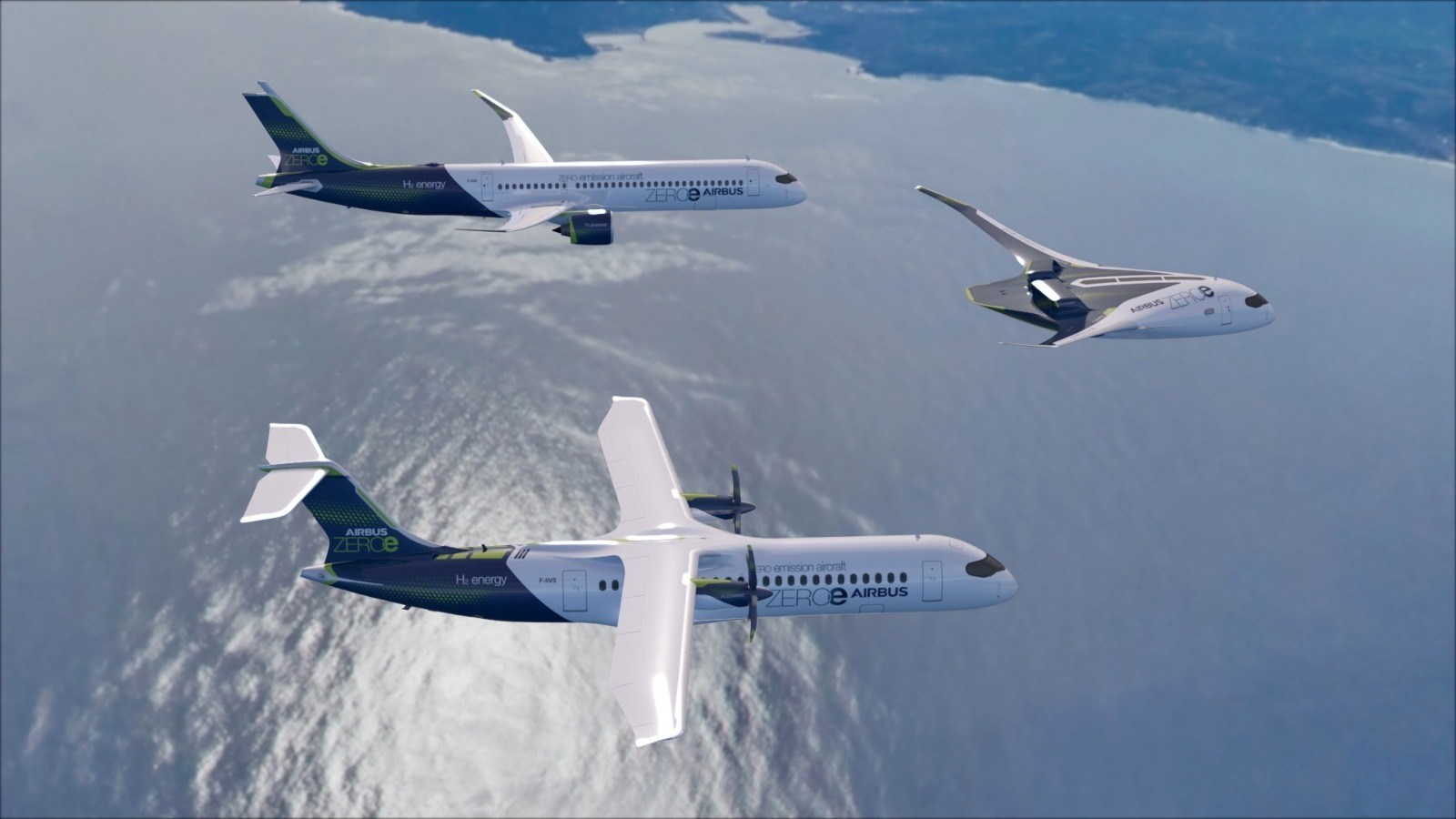
Above:
Airbus ZEROe - Formation Flight.
Copyright Airbus
A priority for the UK ZEDC will be the development of a cost-competitive cryogenic fuel system required for the successful entry-into-service of Airbus’ ZEROe passenger aircraft by 2035 and to accelerate UK skills and know-how on hydrogen-propulsion technologies.

The UK ZEDC will benefit from the recent commitment by the UK Government to guarantee £685 million of funding to the Aerospace Technology Institute (ATI) over the next three years to support the development of zero-carbon and ultra-low-emission aircraft technologies.
“Establishing the ZEDC in the UK expands Airbus’ in-house industrial capabilities to design, develop, test and manufacture cryogenic hydrogen storage tanks and related systems for the ZEROe project across Airbus’ four home countries. This, coupled with our partnership with ATI, will allow us to leverage our respective expertise to realise the potential of hydrogen technology to support the decarbonisation of the aviation industry,” said Sabine Klauke, Airbus Chief Technical Officer.
Technology development at the new UK ZEDC in Filton, has already started and will cover the full product and industrial capabilities from components up to whole system and cryogenic testing. End-to-end fuel systems development, a speciality of Airbus in the UK, is one of the most complex technologies crucial to the performance of a future hydrogen aircraft.
The ZEDC complements Airbus’ existing Research and Technology footprint in the UK, as well as the work on cryogenic liquid hydrogen tanks being done at Airbus’ existing ZEDCs in Madrid, Spain and Stade, Germany (composite structure technologies) and in Nantes, France and Bremen, Germany (metallic structural technologies). All Airbus ZEDCs are expected to be fully operational and ready for ground testing with the first fully functional cryogenic hydrogen tank during 2023, and with flight testing starting in 2026.
With this new facility, Airbus reaffirms its long-term commitment to remain a major player in Britain’s world-leading aerospace ecosystem, working with the Jet Zero Council to driveforward research in the sector, supporting green jobs and helping the UK meet its ambitious net zero targets.
The launch of the UK ZEDC follows the opening of the £40 million AIRTeC research and testing facility in Filton in June 2021, jointly funded by the ATI and Airbus, to deliver the next generation of aircraft wing, landing-gear systems and fuel system designs.
Harry Boneham, Aerospace Analyst at GlobalData, said: “Airbus is pushing ahead with the development of hydrogen technology, pursuing its self-imposed 2035 deadline for the fielding of the first zero-emission passenger aircraft. GlobalData notes that hydrogen aircraft are a feasible reality by 2040*, so if Airbus can meet its deadline, it would be a remarkable achievement and cement the company as the leader of a future green aviation market.
“Airbus’ decision to open a new ZEDC in Bristol can also be seen as a success for the UK government, which in recent years has sought to stimulate the development of a green aerospace industrial base in the UK. In March 2022, the government announced a £685 million fund for the Aerospace Technology Institute. This follows a £200 million fund that was provided in 2020.
“It was the former of these two funds that attracted Airbus to the UK. The firm already has facilities in Madrid, Stade, Nantes, and Bremen. However, with these additional funds, it makes sense for the company to increase its UK footprint, creating jobs and bringing the company one step closer towards its 2035 deadline.”