BA strides towards sustainable jet fuel from waste

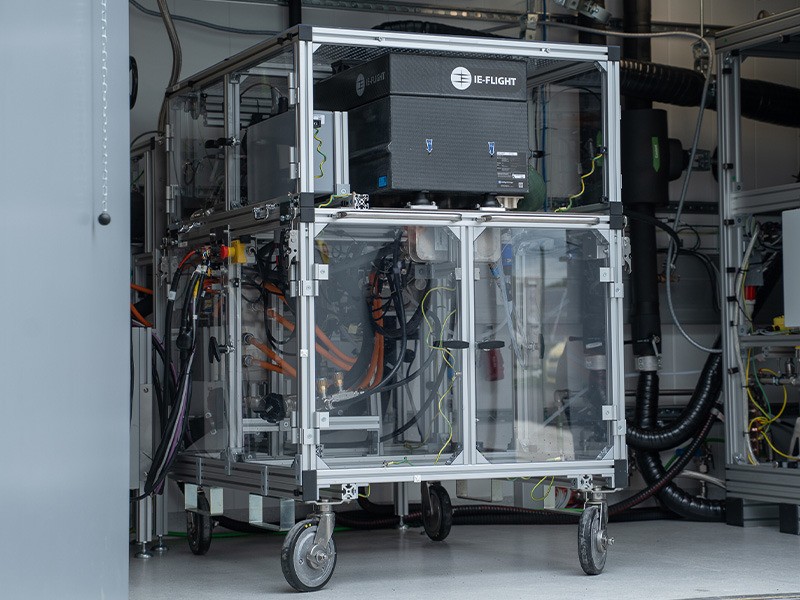
Above:
Velocys' Fischer-Tropsch reactor.
Courtesy British Airways
Altalto Immingham Limited, a subsidiary of renewable fuels company Velocys and a collaboration with British Airways and Shell, has submitted a planning application to develop the site in Immingham, North East Lincolnshire, close to the Humber Estuary.

The proposed state-of-the-art plant would take over half-a-million tonnes each year of non-recyclable everyday household and commercial solid waste destined for landfill or incineration such as meal packaging, nappies and takeaway coffee cups and convert it into cleaner burning sustainable aviation fuel.
The technology, built by Velocys, will reduce greenhouse gas emissions by 70 per cent for every tonne of sustainable jet fuel that replaces a tonne of conventional fossil fuel – equivalent to taking up to 40,000 cars per year off the road.
British Airways intends to purchase jet fuel produced at the plant for use in its aircraft. This is an important step in the reduction of the airline’s carbon emissions towards the industry targets of carbon neutral growth from 2020 and a 50% reduction by 2050 from 2005 levels.
The fuel will also improve air quality with up to 90% reduction in soot from aircraft engine exhausts and almost 100% reduction in sulphur oxides; and the technology offers a lower emissions route to process UK waste than incineration or landfill.
The development is also anticipated to bring hundreds of millions of pounds of investment, hundreds of jobs during construction and approximately 130 permanent jobs to the region.
Alex Cruz, British Airways Chairman and CEO, said: “The submission of the planning application marks a major milestone in this project and we are delighted with the progress being made. Sustainable fuels can be a game changer for aviation which will help power our aircraft for years to come. This development is an important step in the reduction of our carbon emissions and meeting the industry targets of carbon neutral growth from 2020, and a 50% in CO2 reduction by 2050 from 2005 levels. It also brings the UK another step closer to becoming a global leader in sustainable aviation fuels.”
Jonathon Counsell, Head of Sustainability at International Airlines Group (IAG), British Airways’ parent company, said: “This is a fantastic step forward for the project. We strongly welcomed the inclusion of sustainable aviation fuels into the renewable transport fuels policy framework and call on Government to continue to provide support given the significant near-term opportunities offered by these fuels.
“Specifically, we strongly believe a dedicated Office for Sustainable Aviation Fuels (OSAF) will provide the essential cross-government co-ordination necessary to progress the development and commercial deployment of sustainable aviation fuel and would welcome Government support in setting this up at the earliest opportunity.”
Henrik Wareborn, CEO at Velocys, said: “Velocys has a solution to decarbonise aviation fuel by converting an unwanted feedstock – household and commercial solid waste – to create a highly valuable product: sustainable transport fuels.
“This will cut greenhouse gas emissions from aviation, as well as improving air quality and helping to tackle our waste problem. This is a vital step towards the ultimate goal of living in a net zero carbon world by the middle of the century.”
British Airways’ collaboration with Velocys was first announced in September 2017 and is part of the airline’s plans to develop long-term, sustainable fuel options and find solutions to help reduce aviation emissions, which contribute two per cent of CO2 emissions globally.
As part of its centenary celebrations, British Airways, in collaboration with Cranfield University, challenged academics from across the UK to develop a sustainable alternative fuel that could power a commercial aircraft on a long-haul flight, carrying up to 300 customers with zero net emissions.
University College of London students were crowned as the winners of its BA 2119: Future of Fuels challenge. The team received £25,000 to develop their idea further and will present at the IATA Alternative Fuels Symposium in New Orleans in November.
British Airways has been in the vanguard of the development of the waste to fuels pathway since 2010 and led the conversation with UK Government to get waste-based fuels including in the RTFO (Renewable Transport Fuels Obligation) in the UK which was achieved in 2018.
IAG was the first airline group worldwide to set its own carbon emissions targets and a key participant in securing the adoption of CORSIA. British Airways was the first airline to offer a carbon offset scheme 15 years ago and continues to offer a facility for its customers to support low carbon projects in the UK and around the world.
Altalto Immingham Limited is a subsidiary of Velocys and a collaboration with project co-investors British Airways and Shell.
Velocys is a British sustainable fuels technology company. Originally a spin-out from Oxford University, in 2008 the company acquired a US company based on complementary technology developed at the Pacific Northwest National Laboratory. Over 15 years Velocys has developed proprietary Fischer-Tropsch technology that enables the production of drop-in transport fuels from the embedded carbon-sources in a variety of waste materials. Having demonstrated its technology at commercial scale, Velocys is currently developing projects in Natchez, Mississippi, USA and Immingham, UK to produce fuels that significantly reduce both greenhouse gas emissions and key exhaust pollutants for aviation and road transport.
Velocys is leading the development of the Altalto Immingham project and has assembled all the technology components into a standardised integrated design. Velocys also supplies the central processing unit: micro-Channel Fischer-Tropsch reactors with the proprietary Velocys Actocat catalyst. This is the part of the process that turns a gas mixture of carbon and hydrogen into the liquid hydrocarbons required to create the sustainable fuels.
The process enables the production of aviation and road fuels with 70% less net greenhouse gas emissions compared to conventional fuel.
Subject to planning and funding decisions, the plant is due to begin construction in 2021 and to start producing commercial volumes of Sustainable Aviation Fuel in 2024.