Advancing UK Aerospace, Defence, Security & Space Solutions Worldwide

Aerospace

CAA approves MLLR airspace change
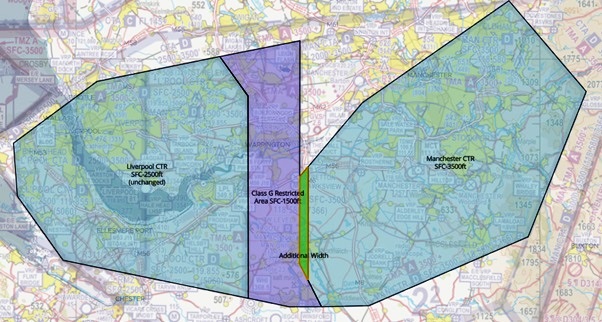
The UK Civil Aviation Authority (CAA) has approved an amendment to the airspace currently known as the Manchester Low-Level Route (MLLR).

Above: Chart depicting the new North West Transit Corridor with the additional width identified in green.
Courtesy CAA

The MLLR will be reclassified and replaced by a Class G airspace Restricted Area to be known as EGR323 North West Transit Corridor.

The new North West Transit Corridor will continue to provide crucial north-south routing for aircraft, enabling them to navigate efficiently between Manchester and Liverpool Airports’ adjoining Class D airspaces.

Advertisement
ODU RT

The changes, which aim to reduce the risk of mid-air collisions and improve airspace management, will take effect from 20 February 2025. This coincides with the expiration of the current exemption in this airspace, Official Record Series 4 (ORS4) No.1596.

Jon Round, Head of Airspace, Air Traffic Management and Aerodromes at the UK Civil Aviation Authority said: “This is a significant step in enhancing both safety and accessibility for airspace users in the North West.

"By simplifying the structure of this critical corridor and reducing the risk of mid-air collisions, we’re ensuring that pilots can continue to benefit from efficient transit between Manchester and Liverpool Airports without compromising on safety.

"This amendment is part of our ongoing commitment to modernising the UK’s airspace and improving air traffic management for everyone.”

The amendment includes:

Advertisement
Security & Policing Rectangle
  • Reclassifying the current Class D MLLR airspace to Class G uncontrolled airspace.
  • Implementing a Restricted Area within the reclassified airspace that will limit the speed and weight of the aircraft, as well as having visibility and QNH setting restrictions.
  • A maximum altitude within the Class G airspace of 1500ft – 200ft higher than the previous MLLR permitted.
  • Creating Class G airspace 0.65 nautical miles wider to the east than today’s MLLR boundary.

The regulator’s decision to reclassify this portion of airspace follows input from the general aviation community, air navigation service providers and local airports as part of its function to review airspace classification.


Advertisement
ECS leaderboard banner
Wales to be UK launchpad for advanced autonomous tech

Aerospace Defence Security

Wales to be UK launchpad for advanced autonomous tech

20 February 2026

Thousands of skilled workers in Wales will be involved in the design, testing and manufacture of advanced autonomous technologies and unmanned systems, as a landmark £50 million Defence Growth Deal positions the nation at the forefront of Britain’s defence future.

NPAS increases aircraft available for deployment

Aerospace Security

NPAS increases aircraft available for deployment

19 February 2026

In January this year, the National Police Air Service (NPAS) was able to increase the number of aircraft that were available for operational deployment.

Alloyed secures ATI Programme funding to develop ABD-1000AM

Aerospace

Alloyed secures ATI Programme funding to develop ABD-1000AM

19 February 2026

Developer and manufacturer of advanced metallic components, Alloyed Ltd, has secured funding from the ATI Programme for an ambitious £1 million project to accelerate the development of ABD-1000AM, a next-generation nickel-based superalloy designed for additive manufacturing.

Birmingham Airport publishes new sustainability strategy

Aerospace

Birmingham Airport publishes new sustainability strategy

19 February 2026

Birmingham Airport (BHX) has published its new sustainability strategy for 2026 to 2030, outlining the next strategic steps on its journey to becoming a more sustainable and socially responsible business.

Advertisement
PTC rectangle
UK hydrogen airport trial sets out roadmap for further studies

Aerospace

UK hydrogen airport trial sets out roadmap for further studies

18 February 2026

A new report into the UK’s first airside trial of multiple hydrogen-powered ground support equipment (GSE) has confirmed that hydrogen can be safely and effectively integrated into airport ground operations, whilst setting out a series of essential next steps needed to accelerate hydrogen adoption and decarbonisation across the aviation sector.

Kent collaborates on Pre-FEED study for Eq.flight SAF demo plant

Aerospace

Kent collaborates on Pre-FEED study for Eq.flight SAF demo plant

18 February 2026

Integrated energy services partner, Kent, has collaborated with Equilibrion during a successful bid for funding from the UK Department for Transport’s Advanced Fuels Fund (AFF) and with that funding for Equilibrion and its partners, Kent is delivering the Pre-Front-End Engineering Design (Pre-FEED) for Eq.flight, an advanced power-to-liquids ...

Advertisement
ODU RT
Advertisement
ECS leaderboard banner