Cirium reveals global 2021 flights burnt 40% less fuel
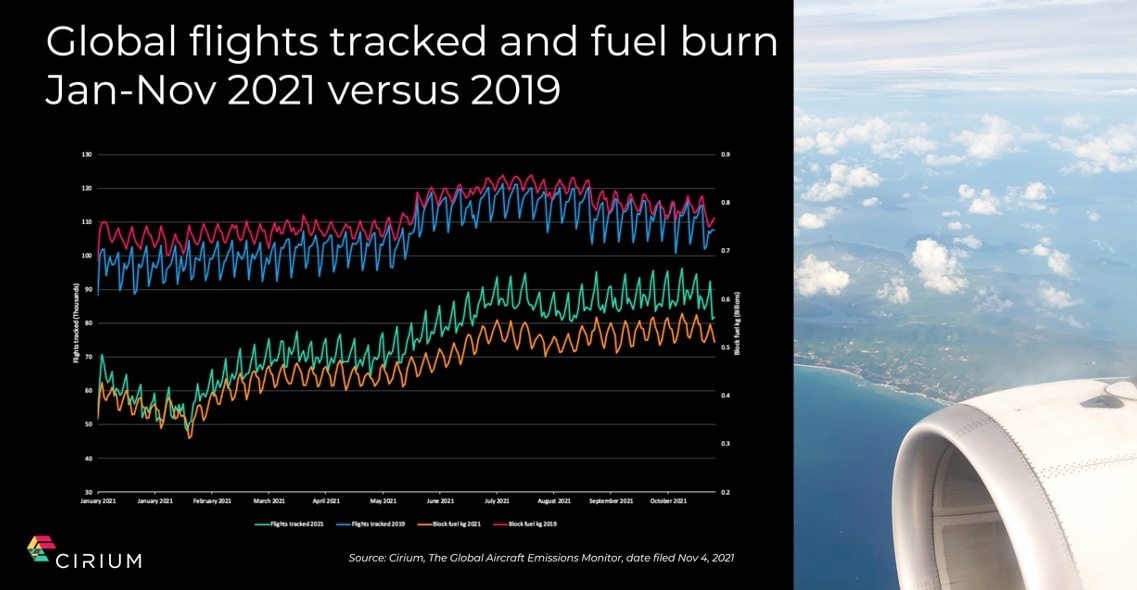
Image courtesy Cirium
New insights from Cirium show that airlines have burnt 40% less fuel from flights in 2021 year-to-date compared to the same period in 2019.
The reduction in flight-produced carbon emissions is attributed to the drop in flights worldwide because of the dramatic impact that COVID-19 had on air travel.
Flights tracked year-to-date are 29% down versus 2019.

The fuel burn has increased as domestic and international flights have started to return but not as much as expected compared to 2019 - before the pandemic. Airlines have been flying their aircraft far fewer hours and prioritising the most efficient.
Jeremy Bowen, Cirium CEO, said: “To achieve the aggressive targets for aviation to reach net zero emissions by 2050, a thorough understanding is needed of all elements of an aircraft used for flights and the exact flight operations.
“Cirium’s Global Aircraft Emissions Monitor boasts data of the highest quality and validity.
“The need for greater sustainability is clear and Cirium is committed to supporting the industry’s decision-making based on accurate carbon emissions tracking.”
The uniqueness of the Monitor derives from the data, which is obtained from the widest and deepest data warehouse in the aviation industry. No other independent source can provide calculations based on the same blended data sets.
The Monitor’s custom data calculations are based on hundreds of flight and aircraft variables for maximum accuracy.
These variables include actual flight and taxi times, cabin configuration, aircraft operating empty weight, assumed cargo tonnage, aircraft/engine type, winglet equipage, aircraft age and more.
Tests conducted on the Global Aircraft Emissions Monitor have validated its accuracy to within 1%.
The Global Aircraft Emissions Monitor includes customised options for CO2 emissions and fuel consumption. It applies complete profiles of actual flights and aircraft, which are fused with block fuel burn models.
While aviation has reduced its emissions overall this year, travel is recovering, with Cirium forecasts projecting for global recovery to 2019 levels potentially by 2023.
Cirium’s Fleet Forecast also predicts that based on the flight capacity of the increasing fleet to be in service by 2039, fuel burn may reach 485 million tons.
This equates to 1,530 million tons of CO2 emissions, excluding any initiatives for Sustainable Aviation Fuels (SAF) or offsetting.
Carbon emissions and fuel consumption from flights are increasingly becoming the centre focus for all airlines, airports, aviation finance, aircraft manufacturers, air traffic management, government and fuel providers.
The comprehensiveness of the Cirium Global Aircraft Emissions Monitor will enable organisations to track emissions as a measure of efficiency. It will also enable a greater understanding of the aspects of total cost of ownership, the profile of a current operator, climate impact, benchmark the competition and create fuel demand models.