Dark matter debate narrows

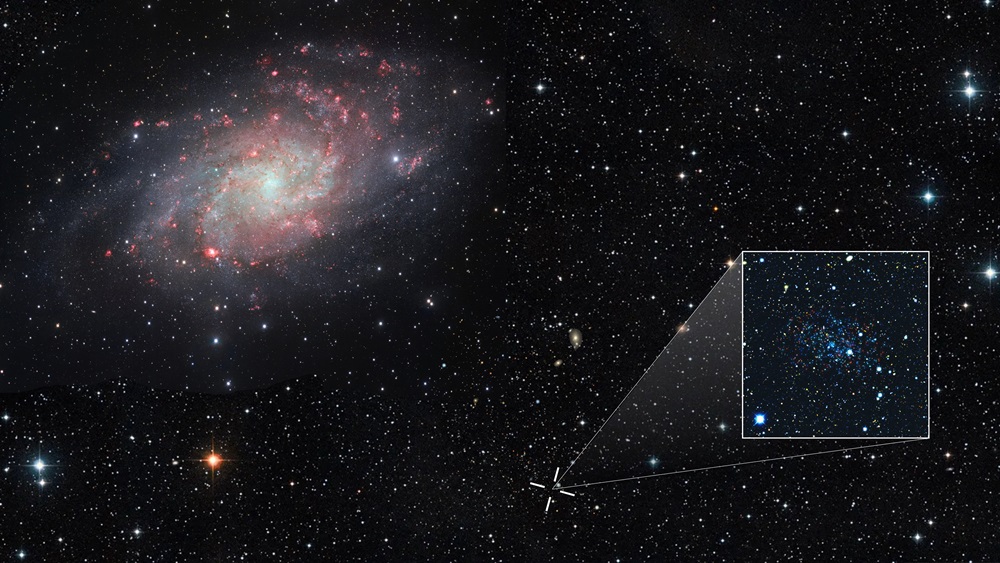
Above: ‘In spiral galaxies like M33 (left), the link between visible matter and gravitational acceleration is well established. Faint dwarf galaxies such as Eridanus II (right) show lower accelerations. The study reveals that their gravitational field cannot be explained by their visible matter alone and reinforces the need for dark matter’.
Credit: M33 – ESO/VST, Eridanus II – V. Belokurov & S. Koposov. Background – DECam Legacy Survey & ESO/Digitized Sky Survey 2 (Davide De Martin)
Led by the Leibniz Institute for Astrophysics Potsdam (AIP) in collaboration with the University of Surrey, the University of Bath, Nanjing University in China, the University of Porto in Portugal, Leiden University in the Netherlands, and Lund University in Sweden, the study analysed stellar velocity data from 12 of the smallest and faintest galaxies in the Universe to put rival theories to the test. Among them is Modified Newtonian Dynamics (MOND) – an alternative theory first proposed in the 1980s that suggests the laws of gravity change at very low accelerations and, therefore, at very large distance scales, removing the need for dark matter altogether.
The authors found that the galaxies’ internal gravitational fields cannot be explained by visible matter alone and that MOND predictions fail to reproduce the observed behaviour. They then compared their results with theoretical models that assume instead that these galaxies are surrounded by a massive halo of dark matter. Run on the UK’s DiRAC National Supercomputer facility, these dark matter models gave a much better match to the data.
Mariana Júlio, a PhD student at the Leibniz Institute for Astrophysics Potsdam (AIP), and lead author of the study, said: “The smallest dwarf galaxies have long been in tension with MOND predictions but the discrepancy could plausibly be explained by measurement uncertainties, or by adapting the MOND theory.
“For the first time, we were able to resolve the gravitational acceleration of the faintest galaxies at different radii, revealing in detail their internal dynamics. Both the observations and our EDGE simulations show that their gravitational field cannot be determined by their visible matter alone, contradicting modified gravity predictions. This finding reinforces the need for dark matter and brings us closer to understanding its nature.”
The research, published in Astronomy & Astrophysics, also challenges a long-standing assumption about how galaxies behave. Astronomers have long believed there is a simple link between the amount of visible matter in a galaxy and the strength of the gravitational pull it produces – known as the ‘radial acceleration relation’.
While this relationship still holds for larger systems, the new study shows that it starts to break down in the smallest galaxies.
In some cases, the same amount of visible matter can produce different gravitational accelerations, suggesting that another unseen factor – most likely dark matter – is influencing their behaviour.
Professor Justin Read from the University of Surrey, a co-author of the study, said: “New data and modelling techniques are allowing us to map out the gravitational field on smaller scales than ever before and this is giving us new insights into the strange, apparently invisible, substance that makes up most of the mass of the Universe.
“Our results demonstrate that there is not enough information based only on what we can see to determine the gravitational field strength in the smallest galaxies. This result can be explained if these galaxies are surrounded by an invisible halo of dark matter, as the dark matter encodes the ‘missing information’. But MOND theories – at least those proposed so far – require the gravitational field to be determined only by what we see. That just doesn’t seem to work.”
While the findings do not reveal what dark matter is made of, they do narrow the space for alternative explanations. Future observations of even fainter and more distant galaxies will help to hone-in on what dark matter really is.
The full paper can be found here: https://arxiv.org/abs/2510.06905
Sign up for our newsletter and get our latest content in your inbox.
Similar Reads





Sign up for our newsletter. Select all sectors relevant to you.
Related