Dorset and Devon & Cornwall police achieve third party drone camera certification
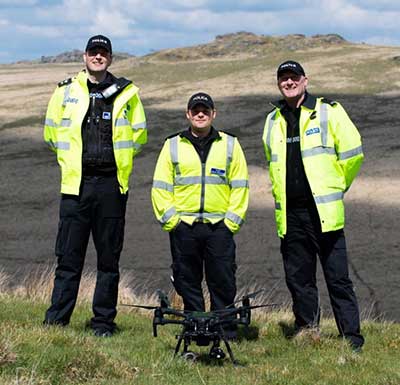
Above:
Three of the Devon & Cornwall drone team standing in front of their drone.
Courtesy Devon & Cornwall Police
Unmanned aerial vehicles (drones) are often fitted with surveillance cameras and therefore if a relevant authority such as a police force are using them they must comply with the surveillance camera code of practice.

Dorset and Devon & Cornwall police started using drones about two years ago and are the first forces to have their drone use certified by the Surveillance Camera Commissioner through his third party certification scheme.
After the successful training of two pilots an official six month operational trial was commissioned to fully scrutinise how drones could be used within the police for both planned and spontaneous incidents. This proved a great success, being able to deploy a drone at a fraction of the cost of a helicopter and on occasions where the helicopter was unavailable or too expensive to deploy.
Martyn Underhill, Dorset Police and Crime Commissioner, said: "I’ve seen first-hand how deploying drones at a road crash can reduce the impact on the public especially in rural Dorset on the A35. Drones can capture 3D imagery and information from the scene in minutes rather than hours and roads can be reopened much quicker. They are also invaluable in helping with searches for missing people. I am convinced policing can take huge steps forward with this approach.
"Deploying a drone costs a fraction of the cost of a helicopter and they can also be used on occasions in which the helicopter is unavailable."

Following the guiding principles
Dorset, and Devon and Cornwall police followed the 12 guiding principles in the code – for example ensuring that they made every effort to involve the public and wider community, inform them that they were considering the use of drones and how they might be used. Following the guiding principles put them in a good position to apply for the Surveillance Camera Commissioner’s third party certification scheme.
Ricky Fidler, Dorset Police Drone Lead, said: "Applying for certification seemed an obvious next step for drones as this was another way to ensure that the processes we had in place were suitable and transparent.
"We found the whole process remarkably simple, most of the documentation that was required by the Surveillance Camera Commissioner we had already completed – a Privacy Impact Assessment and so on. We are familiar with these documents within the police service as we use them in other areas of business."
Legitimate systems and processes
There are two steps to certification. The first step, desktop certification, is aimed at organisations that are working hard to achieve full compliance with the code but are aware that they may need more time to become fully compliant. The second step, full certification, is for organisations that are close to or fully compliant with the code. Dorset and Devon and Cornwall have achieved step one.
Fidler added: "We would absolutely recommend other forces and organisations to apply for certification. It’s a real confidence boost to have someone responsible for the public’s interest checking that our systems and processes are legitimate and human rights compliant. We will definitely apply for full certification within the 12 month period."
Third party certification is a great way to demonstrate compliance with the code to those you are using surveillance cameras to protect. Particularly if you are using new technologies that people many not be familiar with.
Police and Crime Commissioner Underhill added: "I am delighted to hear that Dorset Police has been granted certification from the Surveillance Commissioner’s Office for the use of drones. Policing needs to be at the forefront of technology and quick to embrace innovation. Whether it is helping search for a missing person, recording evidence for use in a criminal investigation or giving police officers a unique view of a particular situation, the potential drones have for helping forces is huge."
Visit the Commissioner’s certification page to find out how you can have your scheme certified against the surveillance camera code of practice.