Advancing UK Aerospace, Defence, Security & Space Solutions Worldwide
  • Home
  • /
  • Aerospace
  • /
  • EasyJet partners with GKN Aerospace to accelerate adoption of hydrogen in aviation

Aerospace

EasyJet partners with GKN Aerospace to accelerate adoption of hydrogen in aviation
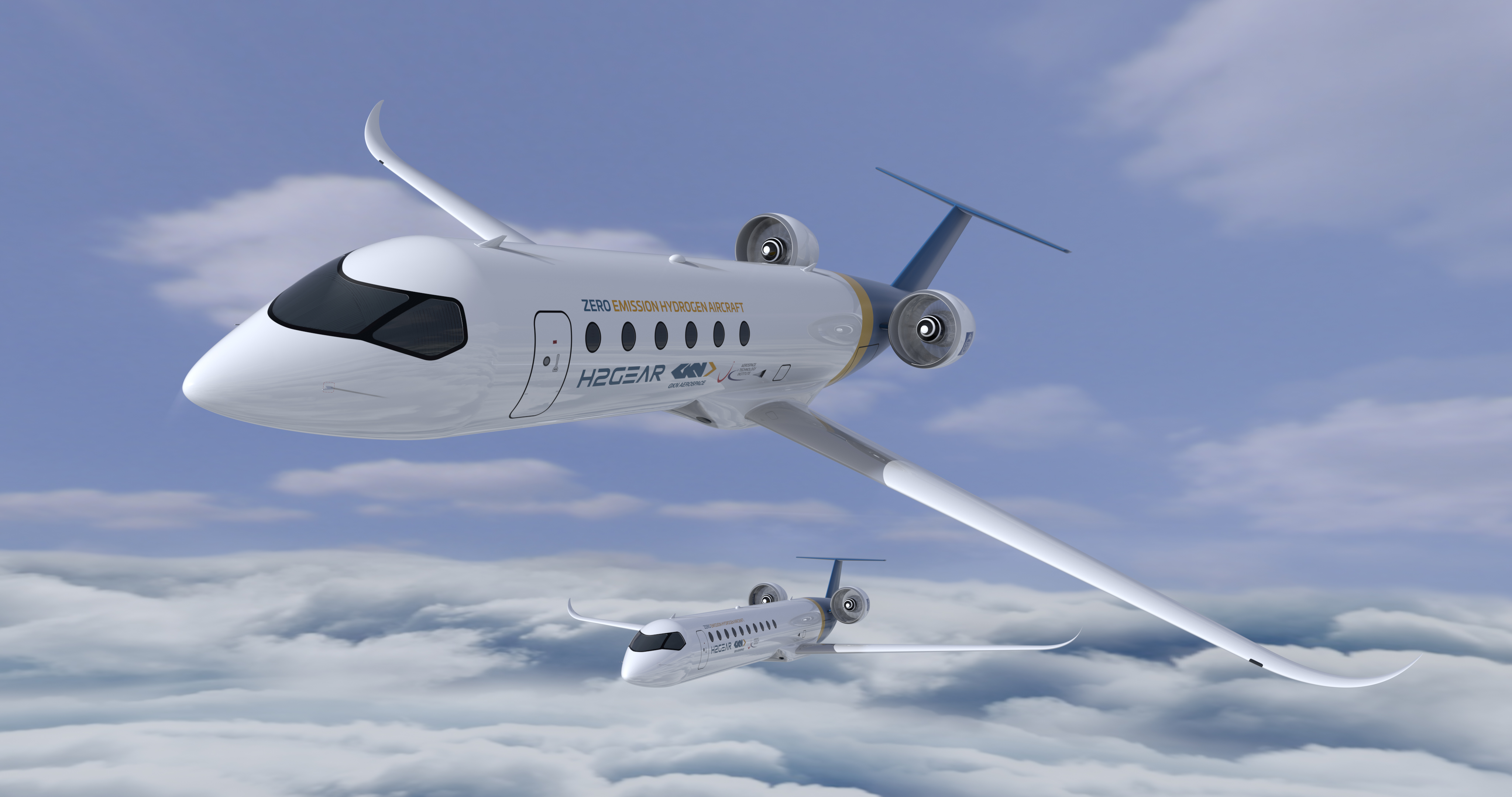
EasyJet has announced it is working with GKN Aerospace to work toward reducing carbon emissions in aviation through the adoption of zero carbon emission technologies.

Image courtesy easyJet / GKN Aerospace

The airline will support the development of GKN Aerospace’s Hydrogen Combustion (H2JET) and Hydrogen Fuel Cell (H2GEAR) technology, including exploring the options for flight demonstration, as part of the airline’s ambition to de-carbonise aviation. Among others, easyJet will provide insights into operational requirements and economics.

Advertisement
ODU RT

H2GEAR is a GKN Aerospace led ground-breaking UK collaboration programme aiming to develop a liquid hydrogen propulsion system for sub-regional aircraft that could be scaled up to larger aircraft. Liquid hydrogen is being converted to electricity within a fuel cell system. This electricity efficiently powers the aircraft, eliminating carbon emissions and creating a new generation of clean air travel.
The H2GEAR programme is supported by £27M of ATI funding, matched by GKN Aerospace and its industrial partners.

H2JET is a Swedish collaborative two-year programme led by GKN Aerospace to push development of key subsystems for gas turbine-based hydrogen propulsion of medium range civil aircraft.
 
David Morgan, Director of Flight Operations, easyJet, said: “At easyJet, we are committed to working towards a future with zero carbon emission flying. We know that technology is a key driver to achieve our decarbonisation targets, with hydrogen propulsion a frontrunner for short-haul airlines like easyJet. Cross-industry partnerships are key to developing these promising new technologies and we look forward to collaborating with GKN Aerospace to support bringing this technology to maturity as early as possible.”
 
Max Brown, VP Technology, GKN Aerospace, said: “At GKN Aerospace sustainability is at the heart of our business. Hydrogen-powered aircraft offer a clear route to keep the world connected, with dramatically cleaner skies. The UK is at the forefront of this technology. We look forward to work with easyJet and our partners, to develop and industrialise the breakthrough technology to fly aircraft with zero CO2 emissions.”


Advertisement
ODU RT


Advertisement
FIA2026 animated banner
May

Aerospace

May's air passenger demand down whilst air cargo demand rises

30 June 2026

International Air Transport Association (IATA) data for May 2026 global passenger demand revealed that air passenger demand fell by 2.2% and air cardo rose by 6.0%, compared to May 2025 levels.

SAS orders 18 A330neo aircraft

Aerospace

SAS orders 18 A330neo aircraft

30 June 2026

Scandinavian carrier SAS has placed a firm order with Airbus for 18 A330-900 aircraft powered by Rolls-Royce Trent 7000 engines, as part of its ongoing fleet renewal strategy.

London City Airport appoints Jonathan Rayner as COO

Aerospace

London City Airport appoints Jonathan Rayner as COO

30 June 2026

London City Airport has today announced the appointment of Jonathan Rayner as its new Chief Commercial Officer (COO) and a member of the Executive Committee.

ADS sees aircraft deliveries up 45%

Aerospace

ADS sees aircraft deliveries up 45%

30 June 2026

ADS has reported that commercial aircraft orders and deliveries have surged during May 2026, with aircraft deliveries seeing a 45% increase compared to May 2025.

Advertisement
ODU RT
CAA warns of risks posed by incorrectly packed batteries

Aerospace Security

CAA warns of risks posed by incorrectly packed batteries

26 June 2026

Ahead of the big summer getaway where over 60 million people are expected to be flying, the UK Civil Aviation Authority (CAA) is telling all passengers to 'pack right for a safe flight' by taking their batteries in the cabin with them.

University of Bristol study looks at reducing vertical air taxi noise

Aerospace

University of Bristol study looks at reducing vertical air taxi noise

25 June 2026

The University of Bristol has published a study in Applied Acoustics this week, showing how landing pad design could reduce noise for vertical air taxis.

Advertisement
ODU RT
Advertisement
General Atomics LB