ESA’s Euclid launched
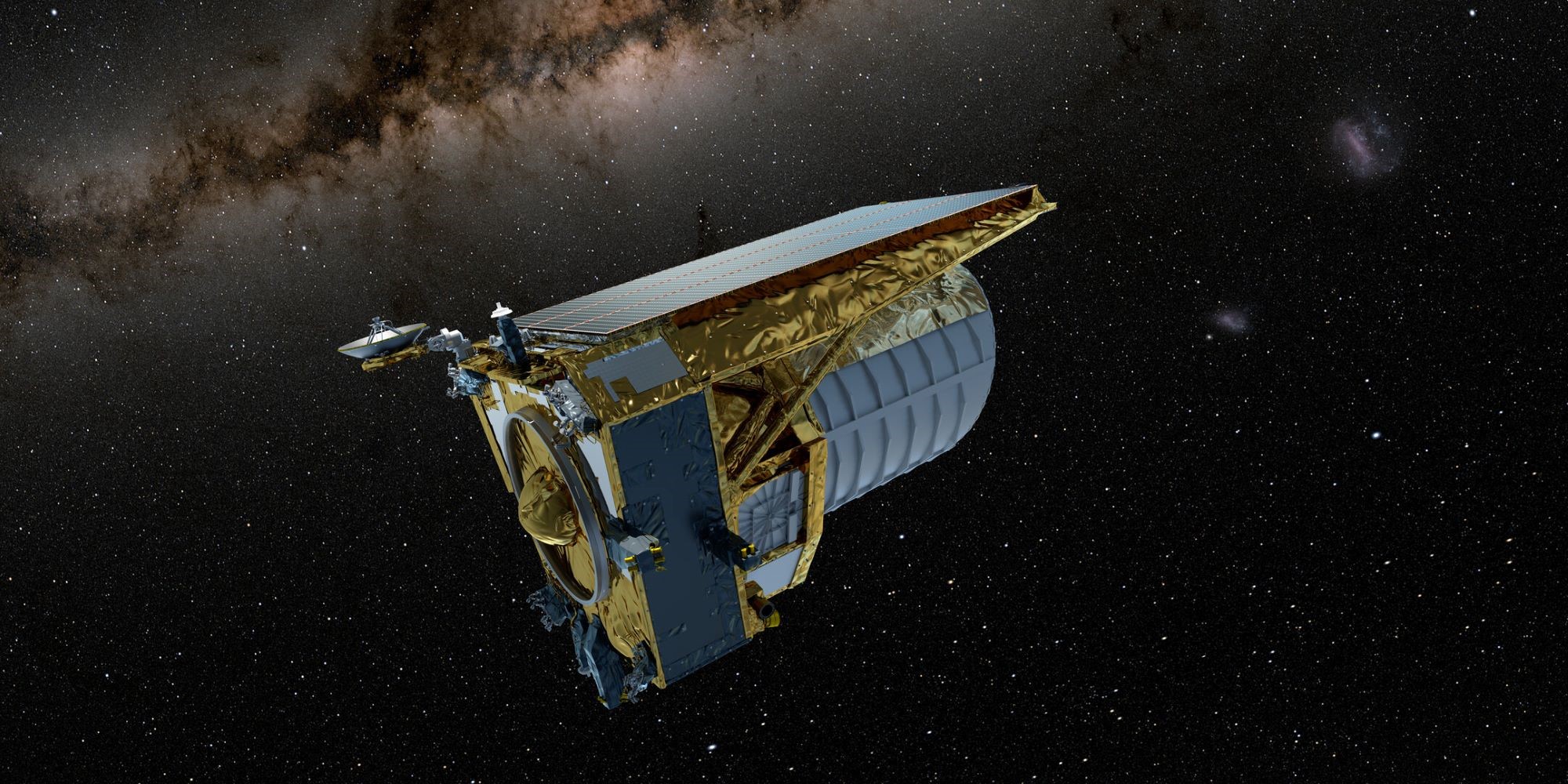
Above:
Euclid looking into the Universe.
Copyright ESA
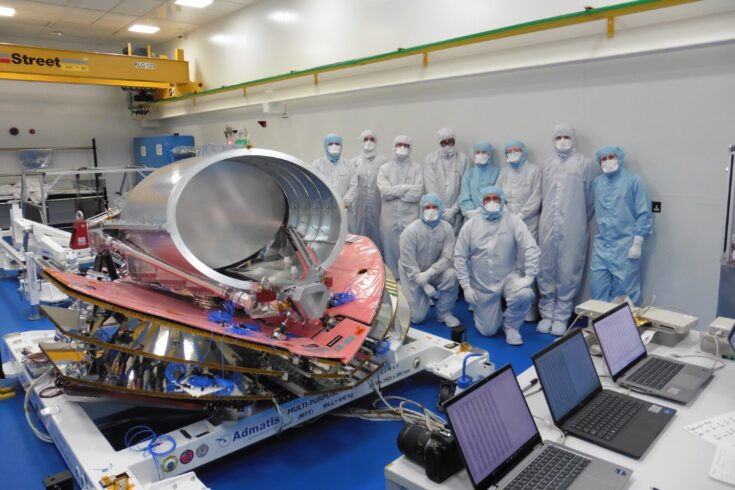
A high-precision 1.2m diameter telescope and payload module designed and built by Airbus will enable Euclid to explore the composition and evolution of the Universe including the role of dark matter and dark energy.
Built by Thales Alenia Space for ESA, Euclid will collect high-resolution images in visible and infrared wavelengths. Within six years of observation, covering more than one third of the entire sky, Euclid will measure the shapes of and distances to, more than one billion galaxies.

Jean-Marc Nasr, Head of Space Systems at Airbus said: “Euclid is another world-inspiring space mission that will aid humanity’s understanding of the structure and evolution of the Universe. This is the largest telescope with the highest optical performance ever designed and integrated by Airbus and testament to the skills and expertise of our space instruments team.”
Euclid will create a map of the large-scale structure of the Universe and will explore how the Universe has expanded and how structure has formed over cosmic history, revealing more about the role of gravity and dark energy.
Euclid will also examine the effects of “weak lensing”, an effect that distorts the shapes of distant galaxy images due to the presence of dark matter between the Earth and those galaxies. In this way it will map out the distribution of dark matter across the Universe with unprecedented accuracy.
The full silicon carbide (SiC) telescope will have to operate in extremely cold conditions of 100 Kelvin (-170°C), it builds on Airbus’ world-leading expertise in silicon carbide technology for space, already proven in orbit on ESA’s Herschel and Gaia missions.
Euclid is a 'Medium Class' mission in ESA’s Cosmic Vision programme. Thales Alenia Space was the industrial prime contractor for the satellite and Airbus was responsible for the payload module, of which the telescope is the main instrument.
Euclid will reach its operational orbit around Lagrange 2 four weeks after launch when testing will begin, with full operations expected to start after three months.
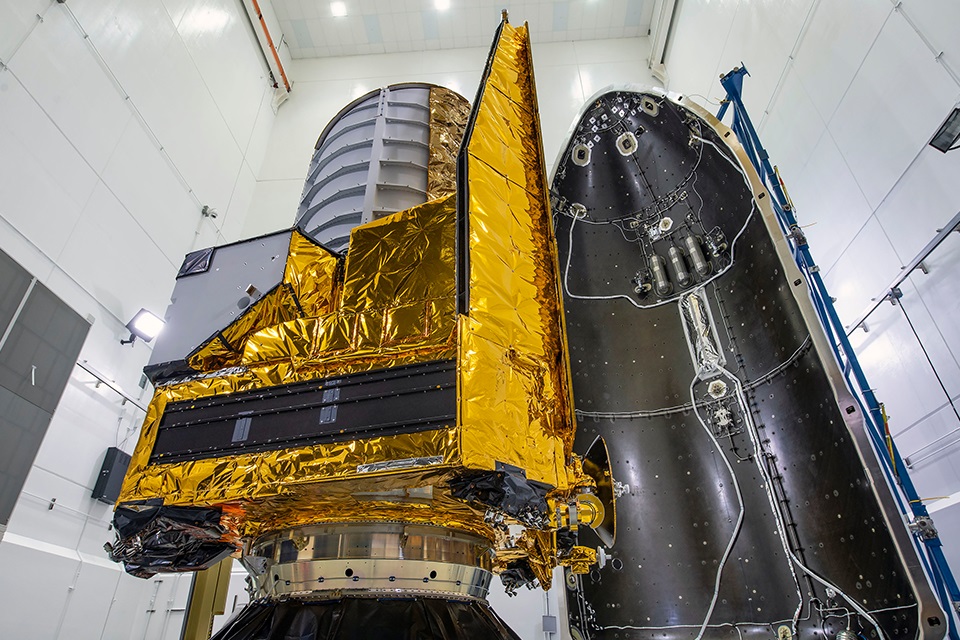
Above:
The Euclid spacecraft being loaded into the SpaceX Falcon 9 fairing ahead of launch, on 27th June 2023.
Courtesy SpaceX.
Led by the European Space Agency (ESA) and a consortium of 2,000 scientists across 16 countries, Euclid will spend six years venturing through space with two scientific instruments: a UK-built visible imager (VIS) that will become one of the largest cameras ever sent into space and a near infrared spectrometer and photometer, developed in France.
UK Secretary of State for Science and Technology Chloe Smith said: "The launch of the Euclid mission is a truly significant moment. Backed by £37 million in UK funding and supported by our remarkable scientific talent and expertise, the mission will launch one of the largest cameras ever into space to look out across our universe.
"The mission will gain unparalleled insight into the mysteries of how the Universe was formed, delivering ground-breaking discoveries that will redefine what we know about space."
Dr Paul Bate, Chief Executive of the UK Space Agency, said: "Watching the launch of Euclid, I feel inspired by the years of hard work from thousands of people that go into space science missions and the fundamental importance of discovery – how we set out to understand and explore the Universe.
"The UK Space Agency’s £37 million investment in Euclid has supported world-class science on this journey, from the development of the ground segment to the build of the crucial visible imager instrument, which will help humanity begin to uncover the mysteries of dark matter and dark energy."
The UK Space Agency’s funding goes back to 2010, up to 2024, and is divided between teams at University College London, The Open University, University of Cambridge, University of Edinburgh, University of Oxford, University of Portsmouth and Durham University.
All these institutions have contributed to the development and implementation of the Euclid UK Science Ground Segment (UKSGS), which runs the Euclid data analysis. Led by the University of Edinburgh, which hosts Euclid’s UK Science Data Centre (SDC-UK), the UKSGS will process hundreds of petabytes of data over the next six years to produce maps of the galaxies and dark matter of the Universe.
The wider Euclid Consortium includes experts from 300 organisations across 13 European countries, the US, Canada and Japan.
The Science and Technology Facilities Council (STFC) also contributed to design and development work on Euclid instrumentation and provided funding to UK astronomy teams who will analyse the data returned from the mission, including studies on the physics responsible for the observed accelerated expansion of the Universe.
Executive Chair at STFC Professor Mark Thomson said: "Euclid will answer some of the biggest and most profound questions we have about the Universe and dark energy. Congratulations to everyone involved in the design, construction and launch of Euclid – we are opening a new window on the cosmos.
"This is a fantastic example of close collaboration between scientists, engineers, technicians and astronomers across Europe working together to tackle some of the biggest questions in science."
Research funded by the UK Space Agency
University College London (MSSL and P&A) – Design, build and testing of Euclid’s VIS optical camera (£20.5 million)
UCL researchers have led on designing, building and testing the VIS optical camera, one of Euclid’s two instruments, working with teams at Open University as well as in France, Italy and Switzerland. The core electronics for the instrument, including its complex array of 36 CCDs (that convert photons into electrons), were built at UCL’s Mullard Space Science Laboratory. The camera, one of the largest ever sent into space, will take high resolution, panoramic images of a large swathe of the Universe, going back 10 billion years and covering a third of the night sky.
Professor Benjamin Joachimi (UCL Physics & Astronomy) is also playing a key role in the ground-based part of the mission (the ground segment), converting Euclid’s raw data into statistical summaries that can be compared to our current theoretical models of the universe.
Professor Mark Cropper, leader of the VIS camera team at UCL Mullard Space Science Laboratory, said: "The VIS instrument will image a large swathe of the distant Universe with almost the fine resolution of the Hubble Space Telescope, observing more of the Universe in one day than Hubble did in 25 years. The data will allow us to infer the distribution of dark matter across the Universe more precisely than ever before. The galaxies being imaged are up to 10 billion years old so we will also see how dark matter has evolved over most of the Universe’s history. The Universe on this scale has not yet been seen in this level of detail."
Professor Tom Kitching, one of four science coordinators for Euclid, said: "The puzzles we hope to address are fundamental. Are our models of the Universe correct? What is dark energy? Is it vacuum energy – the energy of virtual particles popping in and out of existence in empty space? Is it a new particle field that we didn’t expect? Or it may be Einstein’s theory of gravity that is wrong. Whatever the answer, a revolution in physics is almost guaranteed.
University of Edinburgh (£8.9 million)
Edinburgh has been involved in the design and build of Euclid from its earliest days - leading the Euclid gravitational lensing data analysis, the UK Data Science Analysis and host to the UK’s Euclid Science Data Centre which will process hundreds of petabytes of data throughout the mission.
Professor Andy Taylor, leader of the gravitational lensing analysis for Euclid, the UK’s Euclid Science Data Analysis and SDC-UK, said: "This is a very exciting time for astronomy and cosmology in particular. Euclid is designed to answer some of the biggest questions we have about the Universe. It has been a lot of hard work by many scientists to get here but the results could change how we understand nature."
Professor Alkistis Pourtsidou, leader of Euclid’s nonlinear modelling team said: "Euclid is going to provide a very large and very detailed 3D map of the Universe, across the sky and along time. This map is a remarkable achievement combining state-of-the-art science and engineering. We want to extract the maximum amount of information from it and use it to figure out how nature works at the most fundamental level."
Dr Alex Hall, deputy leader of the gravitational lensing science working group, said: "With the launch of Euclid begins an astronomical observing campaign that is amongst the most ambitious ever attempted. By imaging over a billion galaxies, Euclid will allow us to make a map of dark matter with unprecedented precision that will answer fundamental questions about our Universe. The next few years are going to be very exciting and it is a privilege to be part of this incredible project.
University of Oxford – Developing lensing signal measurement and correction for the effects of telescope and detectors on the data (£2.1 million)
Oxford’s Department of Physics has played a significant role in the lensing data analysis. As well as contributing to the development of the method used to measure the lensing signal, the team have specialised in correcting for the effects that the telescope and imaging detectors have on the data. No telescope system is perfect – there is always some blurring and distortion of the images – and Oxford’s role has been not only to build the software models but also to devise ways of calibrating those models using dedicated in-orbit data from Euclid. These are crucial steps that allow the lensing measurements to be used to explore the dark side of our Universe.
Professor Lance Miller, leader of the work at the University of Oxford, said: "This is an incredibly exciting time. This space mission is the result of years of work and for us here in Oxford, that work continues as we put the finishing touches to the software that will be analysing some of the first Euclid data sent back to Earth, from August onwards. I have been working on Euclid since its inception, so to have reached this major milestone today is extraordinary. It is fantastic to be part of a mission that could play a fundamental role in our understanding of the Universe."
University of Portsmouth – Writing code for data analysis (£1.8 million)
The University of Portsmouth’s team, led by Ernest Rutherford Fellow, Dr Seshadri Nadathur, has been working with the wider European team, writing code that will help analyse data from the spacecraft.
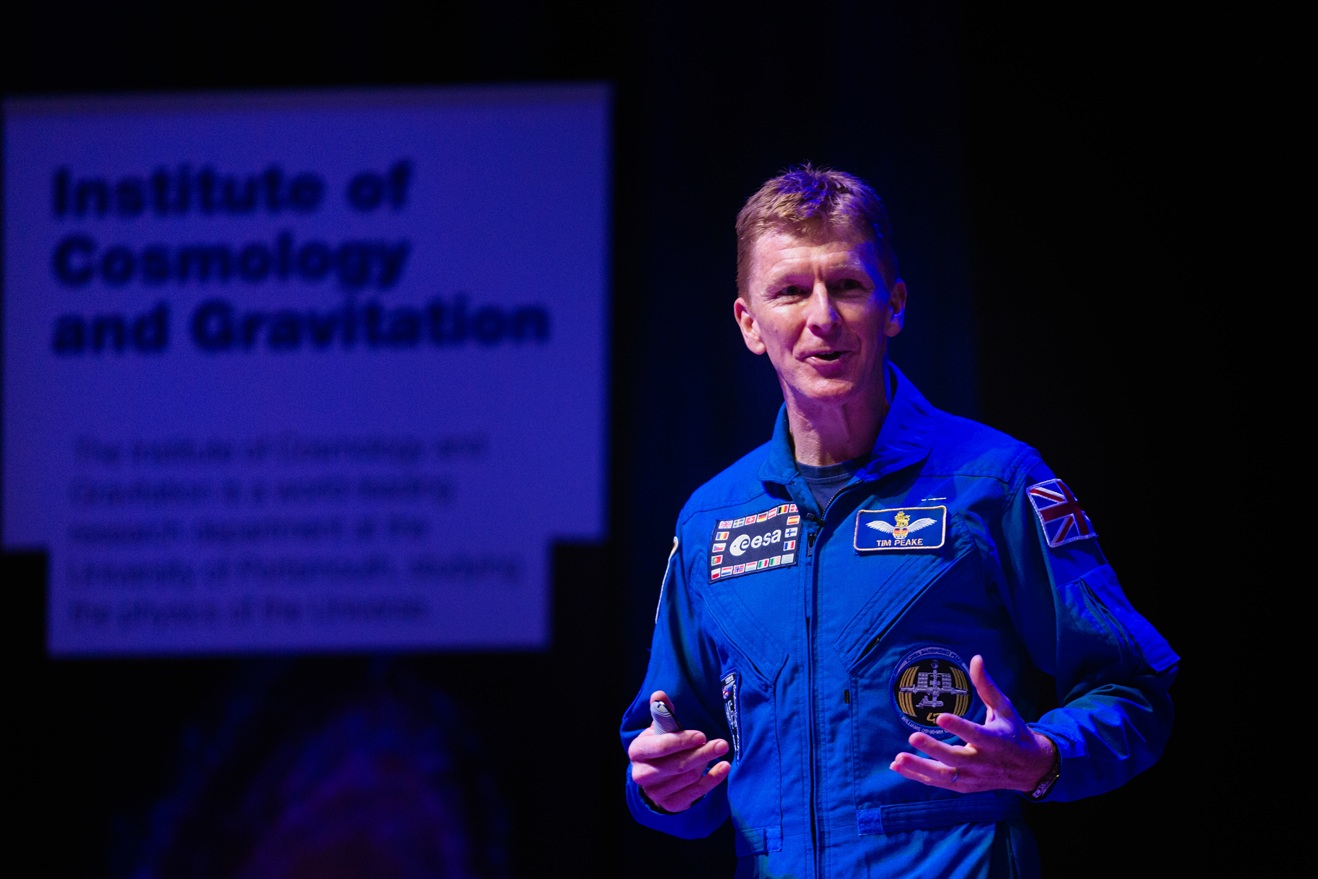
Dr Seshadri Nadathur, from Portsmouth’s Institute of Cosmology and Gravitation, said: "Galaxies are not randomly scattered around the sky – instead there are patterns in their positions that are relics of correlations created at the time of the Big Bang, shaped over billions of years by the interplay of gravity pulling galaxies together and the expansion of the Universe driving them apart. By measuring and understanding these patterns in the maps Euclid will provide, we will learn about the mysterious force of dark energy that seems to be driving the Universe to expand ever faster.
"The team at Portsmouth has been busy developing and testing software that builds the maps and allows them to correct for any spurious patterns in the galaxy positions that arise purely due to variations in the performance of the telescope and instruments, so that we can isolate the true cosmological patterns we are interested in."
Durham University – Building Euclid tolerance to radiation and supercomputer mock data (£1.3 million)
Professor Richard Massey, of Durham University’s Centre for Extragalactic Astronomy/Institute for Computational Cosmology, is a founder of the Euclid mission and has been developing its design and science goals for 20 years.
Work from a team of international researchers has included making Euclid’s camera more tolerant to the high radiation environment in which it will need to survive above the Earth’s atmosphere, learning from our experience with the Hubble Space Telescope. As well as leading on Euclid’s radiation monitoring and mitigation strategy, Durham has used supercomputer simulation capabilities to create mock data to train Euclid’s analysis software, which will be compared against the spacecraft’s real observations.
Professor Richard Massey said: "When exploring any wild new frontier, the first step is to map the land. Euclid will make the largest ever map (with a tiny ‘you are here’ at the centre) and will show the invisible Universe.
"By revealing where dark matter and dark energy hide, we hope to take the second step - to discover what they are and trigger a gold rush of new science about how they behave.
"Euclid is like the Hubble Space Telescope but with a wide-angle view. It will let astronomers stand back and see the sweeping vista of the Universe - but with the same high-resolution detail.
"Exploring and mapping new frontiers is the most human thing possible. Helping shape our next look into the dark has been a privilege.
"It has taken 20 years to make Euclid’s technology possible, engineer its details and navigate the politics of competing against other proposed missions that would all discover amazing things. That rocket carries the sense of exploration and lifetimes’ work of thousands of scientists and engineers."
The Open University – Developing and testing VIS detectors (£1.2 million)
The Open University’s Centre for Electronic Imaging (CEI) has been involved in developing the detectors for the VIS instrument and testing how they will perform in the harsh radiation environment in space. The team will continue to monitor the detectors during the mission, to help mitigate the effects of the damage caused by high energy particles outside the Earth’s protective atmosphere, allowing Euclid to return the best possible science for the mission lifetime.
Dr Jesper Skottfelt, CEI Fellow at The Open University, said: "After 15 years of CEI involvement in the Euclid mission, it is exciting to see the spacecraft being launched. Our study of the VIS detectors has led to the development of new techniques to correct the effects of radiation damage which will enhance science return for this and future space missions. We look forward to seeing the progress Euclid will deliver towards answering some of the most fundamental questions we have about our Universe."
University of Cambridge – Developing astrometric calibration pipeline for Euclid image data (£870,000)
The University of Cambridge’s Institute of Astronomy (IoA) team has been involved in Euclid since 2010, supporting development of the astrometric calibration pipeline for the optical image data from Euclid, ensuring that the positions of the billions of sources to be imaged by Euclid can be determined to exquisite accuracy.
Nicholas Walton, leader of the IoA Euclid team and a Director of Research at the University of Cambridge, said: "Dark energy and dark matter fundamentally govern the formation and evolution of our Universe. The Euclid mission will finally uncover the mysteries of how these ‘dark’ forces have shaped the cosmos that we see today, from life here on Earth, to our Sun, our Milky Way, our nearby galaxy neighbours and the wider Universe beyond."
Serco - which has offices in the UK and across Europe - has also been a major contributor to the Euclid mission. There are Serco teams working for the European Space Astronomy Centre (ESAC, Spain), who have contributed to the development phase of the mission and will continue to support during the Performance and Validation phase (sciences operations) and at the European Space Operations Centre (ESOC, Germany), where Serco provides the Network Operation Centre services, responsible for the monitoring and control of the ground segment, the operational scheduling, as well as the maintenance and operations of the IT systems and control room infrastructure used to run ESA missions. Serco teams at ESA-ESTEC have also provided Logistics Service Support, expertly managing the shipment of the spacecraft from the Netherlands to Cape Canaveral in Florida, USA.
Commenting on the launch Roberto Mulatti, Space Managing Director in Europe said: “We are proud to be playing our part in the EUCLID mission. We extend our heartfelt appreciation to our Serco colleagues for their hard work, impact and dedication in supporting this prestigious customer's mission.”
Gaetan Desclee, Serco Europe Managing Director said: “It is an honour to support the European Space Agency in their unique exploration mission. Serco’s wide space services allow us to provide support throughout the entire mission supply chain. We are committed to continue delivering exceptional services to better support our customers in the field.”