IATA reports passenger demand improving in July

Image courtesy IATA
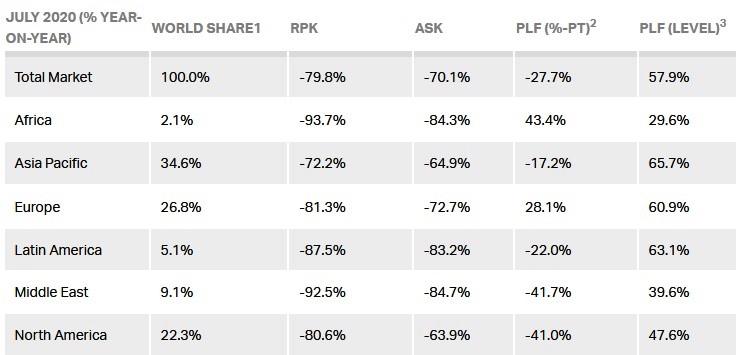
This was somewhat better than the 86.6% year-over-year decline recorded in June, primarily driven by domestic markets, most notably Russia and China. Market reopening in the Schengen Area helped to boost international demand in Europe but other international markets showed little change from June. Capacity was 70.1% below 2019 levels and load factor sagged to a record low for July, at 57.9%.

“The crisis in demand continued with little respite in July. With essentially four in five air travelers staying home, the industry remains largely paralyzed. Governments reopening and then closing borders or removing and then re-imposing quarantines does not give many consumers confidence to make travel plans, nor airlines to rebuild schedules,” said Alexandre de Juniac (above), IATA’s Director General and CEO.
International Passenger Markets
July international passenger demand collapsed 91.9% compared to July 2019, a slight improvement over the 96.8% decline recorded in June. Capacity plummeted 85.2%, and load factor sank 38.9 percentage points to 46.4%.
European carriers’ July demand toppled 87.1% compared to last year, improved from a 96.7% drop in June, year-over-year, reflecting relaxation of travel restrictions in the Schengen Area. Capacity dropped 79.2% and load factor fell by 33.8 percentage points to 55.1%.
Asia-Pacific airlines’ July traffic dived 96.5% compared to the year-ago period, virtually unchanged from a 97.1% drop in June, and the steepest contraction among regions. Capacity fell 91.7% and load factor shrank 47.3 percentage points to 35.3%.
Middle Eastern airlines posted a 93.3% traffic decline for July, compared with a 96.1% demand drop in June. Capacity tumbled 85.6%, and load factor sank 43.4 percentage points to 38.0%.
North American carriers saw a 94.5% traffic decline in July, a slight uptick from a 97.1% decline in June. Capacity fell 86.1%, and load factor dropped 53.0 percentage points to 35.0%, second lowest among regions.
Latin American airlines experienced a 95.0% demand drop in July, compared to the same month last year, versus a 96.6% drop in June. Capacity fell 92.6% and load factor sank 27.1 percentage points to 58.4%, highest among the regions.
African airlines’ traffic dropped 94.6% in July, somewhat improved from a 97.8% contraction in June. Capacity contracted 84.6%, and load factor fell 47.1 percentage points to 25.4%, which was the lowest among regions.
Domestic Passenger Markets
Domestic traffic fell 57.5% in July. This was an improvement compared to a 68% decline in June. Domestic capacity fell 42.2% and load factor dropped 22.9 percentage points to 63.3%.
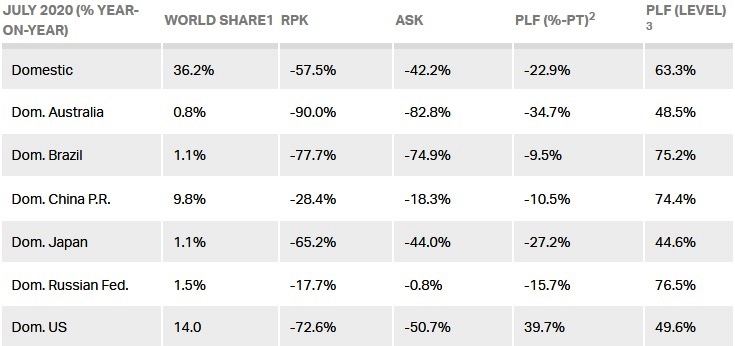
China’s carriers’ traffic was down 28.4% compared to July 2019. Recovery had slowed modestly in June amid new virus outbreaks but resumed its pace from mid-July.
Russian airlines’ domestic traffic was down 17.7% in July, dramatically improved compared with 58% decline in June. Demand has been supported by low domestic fares and a boom in domestic tourism.