General Atomics

IFS identifies £1bn a year yet to be funded in UK defence investment plans

The Institute for Fiscal Studies has identified a £1 billion annual funding gap in the UK's Defence Investment Plan ahead of the Autumn Budget.

Exiting a Land Rover Defender Wolf, members of the 3rd Battalion, Parachute Regiment, British Army, demonstrate a vehicle checkpoint security for the Marines of 2nd Battalion, 6th Marines, at landing strip Viper, in support of Operation IRAQI FREEDOM.
Photo: Ministry of Defence

New analysis highlights outstanding funding decisions for the UK’s Defence Investment Plan ahead of the Autumn Budget.

The UK government has yet to identify funding for around £1 billion a year of its planned increase in defence spending, according to new analysis from the Institute for Fiscal Studies (IFS).

In its Green Budget 2026, published on 12 October, the IFS found that the government’s Defence Investment Plan increased planned expenditure by an average of £3 billion annually compared with previous commitments.

However, around £1 billion a year of that increase remains unfunded.

The IFS said this represents “money that the new Chancellor will have to find at the next Budget, whether from tax, borrowing or other spending, if he sticks to existing plans”.
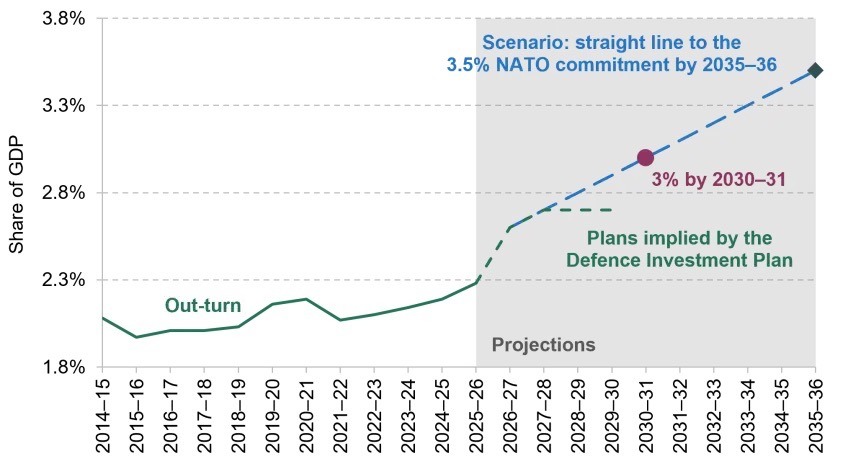
Note: Defence spending here refers to NATO-qualifying defence spending, a broader measure than Ministry of Defence funding alone. DIP plans are rounded to one decimal place, in line with the wording in the DIP funding plan document. Scenario shows a linear path of defence spending to 3% of national income by 2030–31 and to 3.5% of national income by 2035–36.


Source: Authors’ calculations using NATO figures, Defence Investment Plan funding explainer (https://www.gov.uk/government/publications/the-defence-investment-plan/the-defence-investment-plan-funding-explainer) and Office for Budget Responsibility’s Economic and fiscal outlook March 2026.
Note: Defence spending here refers to NATO-qualifying defence spending, a broader measure than Ministry of Defence funding alone. DIP plans are rounded to one decimal place, in line with the wording in the DIP funding plan document. Scenario shows a linear path of defence spending to 3% of national income by 2030–31 and to 3.5% of national income by 2035–36.

Source: Authors’ calculations using NATO figures, Defence Investment Plan funding explainer (https://www.gov.uk/government/publications/the-defence-investment-plan/the-defence-investment-plan-funding-explainer) and Office for Budget Responsibility’s Economic and fiscal outlook March 2026.

Graph: IFS

The institute also highlighted “domestic and international political pressure to move further and faster on defence spending”.

How much of the Defence Investment Plan is funded?

The government’s Defence Investment Plan, published in June, sets out almost £298 billion in Ministry of Defence expenditure between 2026–27 and 2029–30.

The plan includes £15 billion in additional investment over four years to support priorities identified in the 2025 Strategic Defence Review.

According to the government’s funding breakdown, £10.3 billion of the additional spending has an identified funding source, leaving £4.7 billion to be addressed at the Autumn Budget.

The government intends to fund much of the increase by reallocating capital spending from other departments, including reductions to transport and energy budgets.

UK defence spending commitments

Under existing plans, NATO-qualifying UK defence spending is due to reach 2.7% of gross domestic product (GDP) in 2027–28 and remain at that level until 2029–30.

The government has also committed to increasing core defence spending to 3% of GDP in the next Parliament, subject to future funding decisions.

The UK is among NATO allies that have agreed to spend 3.5% of GDP on core defence by 2035.

The IFS estimates that meeting the 2035 commitment would require approximately £25 billion in additional annual spending, in today’s prices, compared with current plans.

In its June assessment, IFS Senior Research Economist Max Warner said: “Defence spending will likely remain one of the biggest fiscal pressures facing the UK in the medium term.”

Warner also questioned how the government would meet its longer-term commitments, given the difficulty of identifying funding for the more modest increases announced in June.

The IFS’s latest analysis notes that reaching 3.5% by 2035 would require defence spending to increase substantially faster in the next Parliament if the government maintains its existing plans through 2029–30.

The institute also noted that other NATO members have increased defence spending as a share of national income more rapidly than the UK.

Autumn Budget funding decision

The outstanding defence funding requirement comes as the Treasury faces wider pressures on public spending.

In a parliamentary response on 15 September, the government confirmed that the remaining £4.7 billion for the Defence Investment Plan would be addressed at the Autumn Budget.

The Chancellor must now determine how to meet that commitment through taxation, borrowing or changes to other spending plans if the government maintains its existing defence investment programme.

Related

NCC to lead business support for Greater South West robotics hub
GSWRAH
NCC to lead business support for Greater South West robotics hub
The UK's National Composites Centre (NCC) is to going to help businesses across the Greater South West navigate the challenges and opportunities of robotics and automation through a new £9.8 million regional programme.
Aerospace Defence

12 Oct 2026

Edgewing opens engineering hub in Italy with UK site to follow
The GCAP fighter jet
Edgewing opens engineering hub in Italy with UK site to follow
The first of three engineering hubs designed to support the development of the future GCAP fighter has opening, with similar sites in the UK and Japan coming soon.
Aerospace Defence

9 Oct 2026

Marshall Aerospace begins new chapter as Aurelius acquisition completes
Marshall Aerospace C-130s
Marshall Aerospace begins new chapter as Aurelius acquisition completes
The completion of AURELIUS' acquisition of Marshall Aerospace marks a new chapter in the company's illustrious history, which spans more than a century of engineering excellence, innovation and service.
NCC to lead business support for Greater South West robotics hub
GSWRAH
NCC to lead business support for Greater South West robotics hub
The UK's National Composites Centre (NCC) is to going to help businesses across the Greater South West navigate the challenges and opportunities of robotics and automation through a new £9.8 million regional programme.
Aerospace Defence

12 Oct 2026

RAF Marham runway repairs strengthen its operational resilience
RAF F-35B 207 sqdrn
RAF Marham runway repairs strengthen its operational resilience
The resilience of RAF Marham’s airfield infrastructure has been reinforced following the completion of vital runway repairs, whilst maintaining support for Lightning Force operations.
Defence Member News

11 Oct 2026

Sentinel Photonics brings multiple laser detection sensors into one hub
Sentinel Photonics' LASARD MAX Connect
Sentinel Photonics brings multiple laser detection sensors into one hub
With one single hub that joins up laser detection sensors, operators can now see, share and act on laser threats across a wide area in real time.
UK and Germany back SaxaVord in new European space launch deal
SaxaVord Spaceport, Shetland
UK and Germany back SaxaVord in new European space launch deal
The UK and Germany have agreed to deepen space launch cooperation, with Scotland's SaxaVord Spaceport securing European access to orbit.
Aerospace Defence Space

9 Oct 2026

Excelerate Technology to build UK CNI robotic security solution
Satellite in Earth orbit
Excelerate Technology to build UK CNI robotic security solution
In a project co-funded by the European Space Agency Business Applications and Space Solutions (ESA BASS) and supported by the UK Space Agency, Excelerate Technology will build and demonstrate how space-enabled assets can provide innovative safety and security solutions, including protection of Critical National Infrastructure (CNI) at a site in the UK.
World Space Week: How British technology will help ESA return to the Moon
ESA Argonaut
World Space Week: How British technology will help ESA return to the Moon
As Europe prepares to return to the Moon, British-developed LEIA LiDAR technology will help ESA's Argonaut lander autonomously identify safe touchdown zones on the lunar surface.
Space

5 Oct 2026

Sentinel Photonics brings multiple laser detection sensors into one hub
Sentinel Photonics' LASARD MAX Connect
Sentinel Photonics brings multiple laser detection sensors into one hub
With one single hub that joins up laser detection sensors, operators can now see, share and act on laser threats across a wide area in real time.
Big cargo drones complete first BVLOS delivery to North Sea wind farm
Skyports and Ørsted North Sea wind farm cargo drone trial
Big cargo drones complete first BVLOS delivery to North Sea wind farm
Skyports and Ørsted conducted a complex North Sea cargo drone trial, illustrating how heavy loads can safely and efficiently be delivered offshore beyond visual line of sight (BVLOS).
Aerospace Security

9 Oct 2026

UK Government and UKRI invest £54m to prevent future disease outbreaks
Poultry facility
UK Government and UKRI invest £54m to prevent future disease outbreaks
The UK Government and UKRI are investing £54 million in biosecurity research to tackle antimicrobial resistance, improve disease outbreak preparedness, develop next-generation vaccines and strengthen protection against emerging biological threats.
Security

8 Oct 2026