Innovate UK funded project to bring high-value 3D printing to UK manufacturing
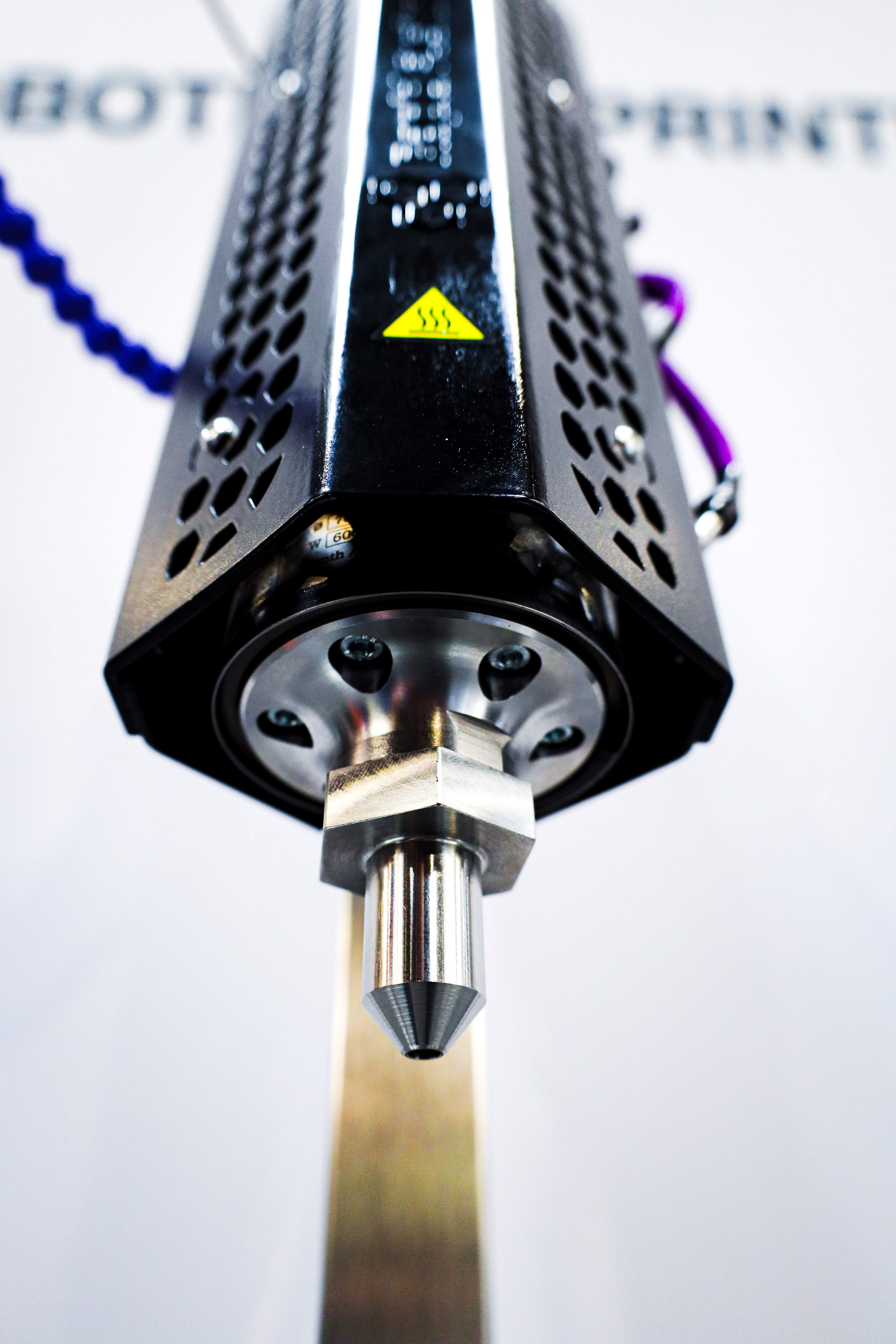
Above:
Rapid Fusion Pellet Extruder.
Courtesy NMIS / Evo-3D
The Evo One ‘large format additive manufacturing’ (LFAM) project – which involves 3D printing experts Evo-3D, the National Manufacturing Institute Scotland (NMIS) operated by the University of Strathclyde and part of the High Value Manufacturing Catapult (HVMC), Rolls-Royce, materials supplier Filamentive, software developer AI Build and energy technology company Baker Hughes – are developing a 3D printer system that could make UK manufacturers more competitive than their international peers. The initiative has received £1.1 million in funding from Innovate UK, the UK’s innovation agency.

LFAM is a commercial 3D printing technique that creates large volume polymer components, used in a variety of industries including aerospace, automotive, energy, and marine. While countries like the USA, Germany, and China have embraced this approach, there are currently no manufacturers of large format 3D printers in the UK and the country only accounts for around 5% of the global additive manufacturing market[1], which the UK government aims to increase to 8% by 2025.
Access to the right technologies will be a crucial part of achieving that aim, but existing LFAM systems have their limitations. These include slow build times, being unsuitable for high-value or high-integrity parts, operational complexity, use of unsustainable materials, and being unaffordable to small and medium-sized companies.
The new product being developed through Evo One LFAM will address the challenges associated with these systems and cater to the specific needs of the UK Market. The system’s design team is aiming to make it 60% more reliable, achieve a 50% increase in productivity, reduce training and maintenance costs by 30%, and cut material waste by 80%, among a range of other improvements.
On the project’s completion, Evo-3D will launch a spin-out business to commercialise the system, called RapidFusion, creating the UK’s first original equipment manufacturer (OEM) in LFAM. Its development would also create the foundation on which a new supply chain can be built, re-shore critical manufacturing capabilities, and help more UK manufacturers take advantage of the opportunities presented by Industry 4.0 – the fourth industrial revolution.
Jake Hand, director of marketing and development at Evo-3D, said: “The UK is behind other major economies when it comes to LFAM. What we are aiming to do through the development of this system is democratise high-value, environmentally responsible manufacturing in the UK through a system that will bring the latest technology and capabilities to large and small businesses.
“We saw during the pandemic how easily supply chains can crumble. That’s why it’s potentially more important than it ever has been to develop as much capacity and capability in the UK as we can, not to mention the economic and carbon reduction opportunities associated with having a thriving manufacturing sector at the vanguard of the latest available green technologies.”
The NMIS team will support the project across a number of its specialisms, including material analysis, design and the additive manufacturing process. It will also look at the validation and verification of the system and high-value materials being used. Rolls-Royce and Baker Hughes will test the system once it is ready, while AI Build will help with the development of the slicing technology.
Stephen Fitzpatrick, director – digital factory at NMIS, added: “We have a huge opportunity in the UK to be a leader in large format additive manufacturing. Putting the right technology in as many manufacturers’ hands as we can is a great base to build on, and having a UK-based OEM is the first step in that direction.
“With the right tools at our disposal, we can encourage more manufacturers of all sizes to embrace the latest manufacturing techniques and technologies, paving the way for a more sustainable and globally competitive sector. Our team, with specialisms ranging from digital process management to forging and forming, is supporting businesses across Scotland and the UK to innovate and transform what they do.”