

National Police Workforce and Wellbeing Survey results published


Over 55,000 people working in policing across England and Wales have shared what it is really like to do the job and the new findings released today make clear the pressure on the workforce has not eased.
With a record 55,602 responses – equivalent to one in five of the entire workforce – from Police Officers, Police Community Support Officers, staff, specials and volunteers from every rank and role, across 33 of the 43 regional territorial police forces across England and Wales, the survey provides the most comprehensive picture of wellbeing in policing to date.
How respondents feel about the pressures of the job
More than half of respondents (56%) regularly feel physically exhausted, 45% regularly feel burnt out and nearly two thirds (63%) regularly work beyond their contracted hours – rising to 72% among officers. The most commonly cited cause is consistent and clear: not enough people or cover to meet demand and with the load falling heaviest on frontline and operational roles.
Almost half of respondents (47%) plan to stay in policing for at least three years, above all, because they enjoy the role. However, three in 10 people say they may leave their force, or policing altogether, within a year – citing work-life balance, pay and benefits, or issues with leadership.
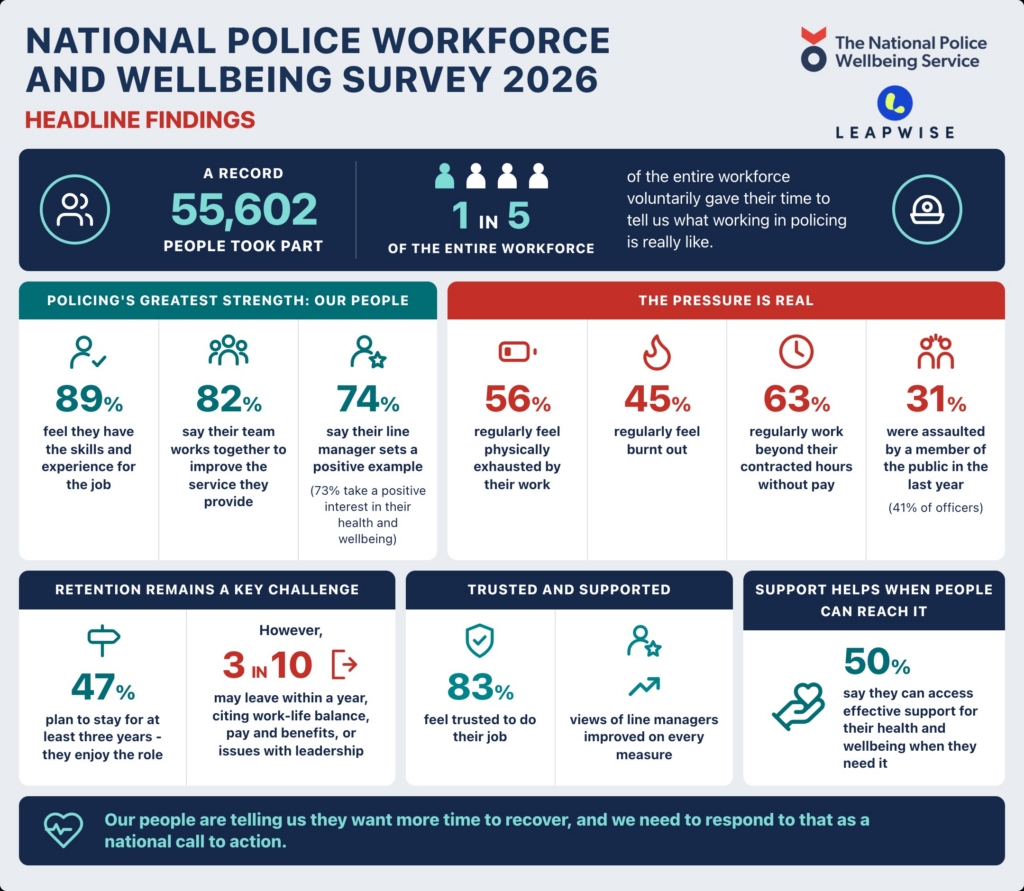
Yet the survey also reflects a workforce that believes in the job. Almost nine in 10 (89%) say they have the skills and experience to do it and a similar amount (82%) say their team works together to improve the service they provide.
How the service might address wellbeing challenges
Andy Rhodes, Service Director of the National Police Wellbeing Service, said: “First of all, as always, I want to thank every single person who took the time to complete the survey.
“Working in policing can be tough as it is but if our officers and staff are telling us they are exhausted and burnt out, we need to listen and act now.
“Our people are telling us they want more time to recover, and we are treating that as a national call to action. Releasing the pressure on the workforce requires a national solution and the findings of this survey will feed directly into the national wellbeing standards work with the Chief Medical Officer for Policing and into all our workstreams, including those around trauma, fatigue and early intervention.
“It is what the workforce has told us in these surveys in recent years that has led to the increased investment in police wellbeing and the introduction of mandatory wellbeing standards – so that good support no longer depends on where someone works or what role they serve in.
“The results show that change is needed now, more than ever. Wellbeing is a legal and moral duty of care, not a nice-to-have – it’s operational, not optional – and it’s our commitment as the National Police Wellbeing Service to help forces meet it.”
Building resilience and sustainable systems as part of reform
Chief Constable Jason Hogg, NPCC Workforce Coordination Committee Chair said: “Policing’s greatest strength remains its people. The findings of the National Police Workforce and Wellbeing Survey provide an important and honest reflection of the realities facing our workforce today so that we can make meaningful changes to help improve wellbeing across the service.
“Whilst it is encouraging that officers and staff continue to feel trusted, capable and supported, we cannot ignore the significant pressures they face around workload, fatigue, burnout and work-life balance. These are challenges that affect both the wellbeing of our people and our ability to deliver the best possible service to the public.

“The police reform programme set out by Government recognises that a modern and effective police service depends on a healthy, skilled and supported workforce. This year’s findings will be used to develop the mandatory wellbeing standards that will give greater consistency in the police wellbeing provision delivered as part of police reform.
“As we work together to build a more capable, consistent and sustainable policing system, we must ensure that improving workforce wellbeing sits alongside investment in leadership, technology, neighbourhood policing and professional standards. Looking after our people is fundamental to policing success and to maintaining public confidence now and in the future.”
Commitment to serving the public and protecting the community
Chief Constable Sir Andy Marsh, CEO of the College of Policing, said: “Behind every statistic in this survey is an officer or member of staff doing a difficult, demanding and often extraordinary job. These findings show a workforce still deeply committed to public service, proud of its professionalism and determined to do the best for the communities it serves.
“What they are asking for is not sympathy but action. They want the right conditions to do their jobs well, protect their wellbeing and keep serving the public effectively.
“These important Oscar Kilo survey results give chiefs, forces and national partners a clear direction of travel. From mandated wellbeing standards and psychological health checks, crisis care and practical wellbeing tools, we are building support around the issues officers and staff say matter most. This report is not the end of the conversation, it is a roadmap for action.”
Findings inform future planning
Tanvi Bhaktal from Leapwise Advisory said: “The latest survey shows that improvement is possible. In some forces, people feel better led, less exhausted and more positive about the future since last year. Yet, overall, there are still some big challenges for the service, with frontline officers and staff feeling more burned out than in any other sector we have data for and demotivated by cases of perceived unfairness and discrimination.
“The survey findings will continue to inform the work around Police Reform and the strengthening of the Police Covenant. Three national deep dives will follow this autumn – on wellbeing and workload, leadership and change and wellbeing support.
Government funding to underpin wellbeing support commitments
At the beginning of July this year, the Government announced significant new investment to strengthen police wellbeing support across England and Wales.
The funding will support delivery of the wellbeing commitments set out in the Police Reform White Paper, with Oscar Kilo, the National Police Wellbeing Service (NPWS), leading delivery of key national measures for officers and staff.
The announcement also reinforces the move towards mandatory national wellbeing standards for policing developed by the NPWS and the Chief Medical Officer for Policing, helping end different levels in police wellbeing support, making sure officers and staff can expect a more consistent level of support wherever they serve.
Andy Rhodes said: “This Police Reform funding gives us the opportunity to strengthen support across England and Wales. Through the National Police Wellbeing Service, it will help expand access to psychological health checks, trauma tracking, ResetU and the Mental Health Crisis Line, giving officers and staff more ways to understand their wellbeing, manage the demands of the job and get the right help earlier.”
Reset U is a private digital wellbeing app designed specifically for people working in policing, for sleep, fatigue and recovery, built for the reality of shift work and operational policing. Currently available in several forces, its usage is personal and private and will continue to be rolled out across other forces.
To download a PDF of the full national insights report, click here.
Sign up for our newsletter and get our latest content in your inbox.
Similar Reads



Sign up for our newsletter. Select all sectors relevant to you.
Related