NATS report charts further environmental progress
Air traffic controllers at NATS helped enable more than 30,000 tonnes of CO2 savings during the past financial year through the greater use of direct aircraft routings, smoother climbs and descents and the more efficient use of airspace.

Image courtesy NATS
It means that NATS has enabled fuel and CO2 savings of an average 7% per flight since 2008, when it became the first ATC provider in the world to introduce an environmental programme.
The figures have been revealed as part of NATS’ Responsible Business Report for 2019/20, published today. The report – being released later than usual due to the impact of COVID – charts the business’s on-going efforts to reduce the impact of flying on the environment, as well its charitable and social responsibility programmes.

Ian Jopson, NATS Head of Sustainable Operations, said: “Over the year we made further progress improving the environmental efficiency of our operation and are part of a commitment by the UK aviation industry, through Sustainable Aviation, to be carbon net zero by 2050. However, it’s clear from the hardening of public opinion that much more demonstrable action is expected of us going forward. We need to rise to that challenge.”
Earlier this year, research commissioned by NATS as part of its annual Aviation Index revealed strengthening public demand for action on climate change, alongside a growing concern that this might only be possible at the expense of passenger choice and value.
The Responsible Business report sets out its intention to take advantage of the current historically low traffic levels currently being experienced due to the COVID crisis to make meaningful and far reaching changes to its operations, in line with the Government’s ambition to 'build back better'.
Juliet Kennedy, NATS Operations Director, said: “This is a once-in-a-generation opportunity. The pressures of our very high traffic levels normally constrain our ability to try out new things, but we have the chance to do that now. We’re looking at how to make the most of the opportunity opened up by uniquely low traffic levels to investigate efficiency improvements and try out different procedures safely. We are fully committed to building back better”.
Elsewhere, the report marks NATS efforts to switch to renewable sources of energy. It now purchases 93% of its electricity from renewable sources and low carbon gas for 100% of its needs, helping reduce its carbon footprint by over 90% as a result.
Valuable work to help improve diversify and inclusion at NATS is also recognised. In the past financial year it established a new multicultural employee network called GlobeAll, while support is on-going for its existing groups; The Women’s Network, Young Professionals Network and NATS’ LGBT+ network, SkyPride.
Jopson concluded: “There is a lot to be proud of in this report, but clearly the impact of COVID is a huge challenge for us and the industry. Protecting the wellbeing of our employees while maintaining a safe and efficient service and planning for recovery and a better future is now our priority.”
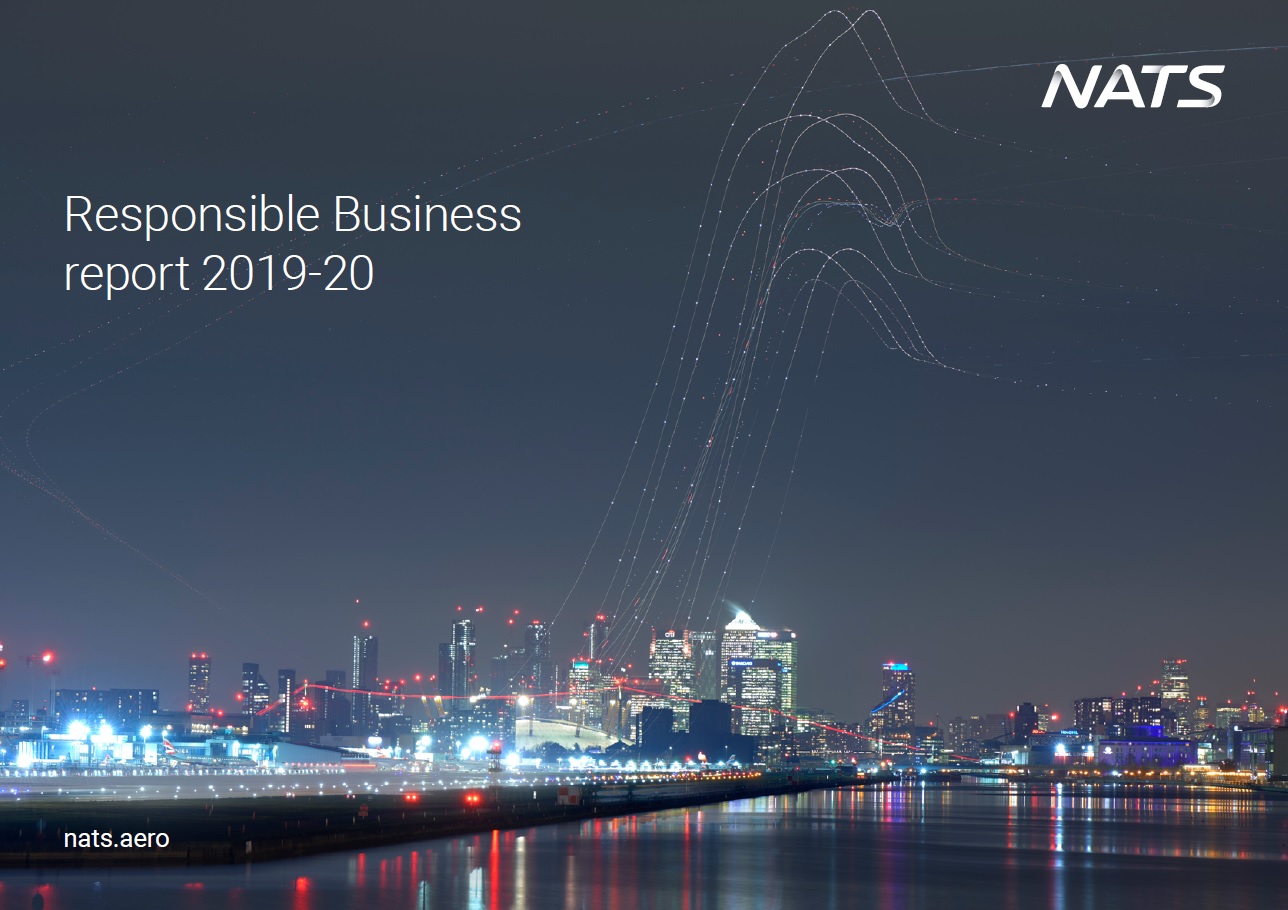
Click here to read the full report:
www.nats.aero/environment/responsible-business-report-2020