RAF wins Guinness World Record for first flight powered by synthetic fuel
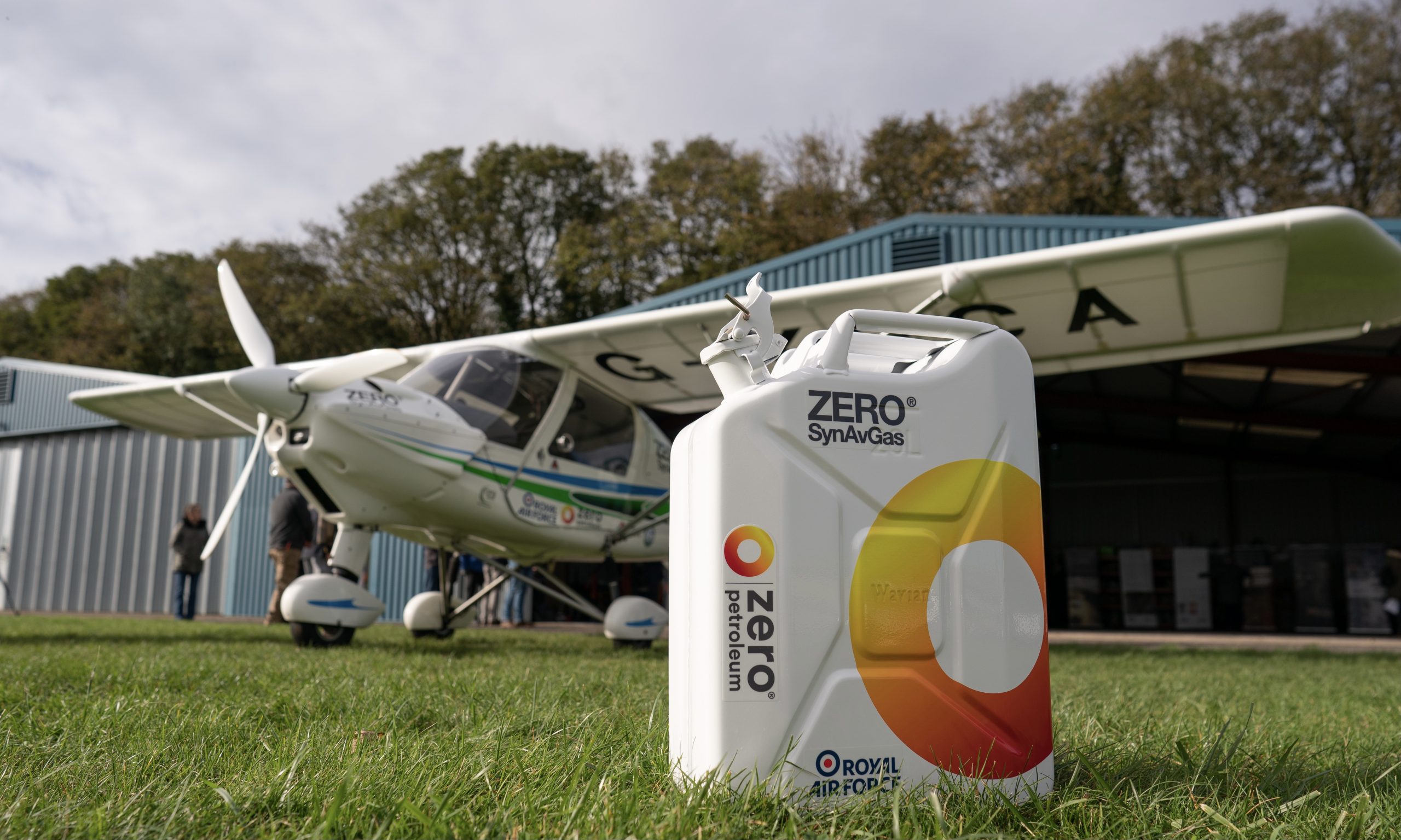
Image courtesy Zero Petroleum
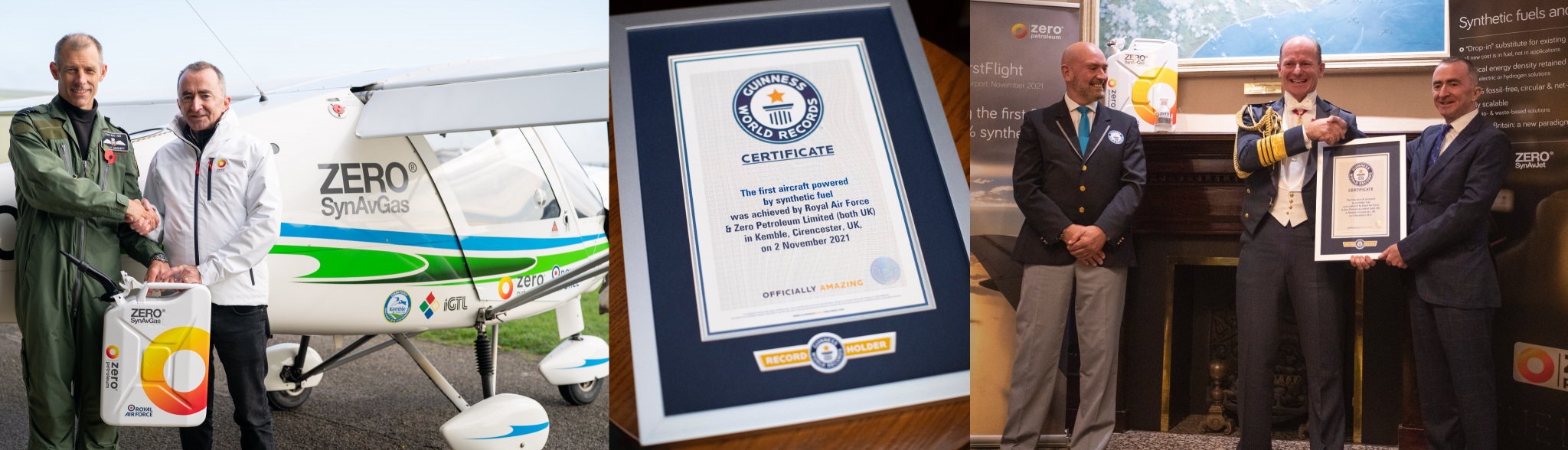
In a world-first, an Ikarus C42 microlight aircraft flown by Group Captain Peter Hackett, completed a short flight powered by synthetic gasoline at Cotswold Airport earlier this month on 2nd November 2021.
Zero Petroleum’s synthetic UL91 fuel is manufactured by extracting hydrogen from water and carbon from atmospheric carbon dioxide. Using energy generated from renewable sources like wind or solar, these are combined to create the synthetic fuel.

This innovation is part of the RAF’s Project MARTIN and has the potential to save 80-90% of carbon per flight, supporting the RAF’s vision that synthetic fuels will have a major role in powering the fast jets of the future.
Minister for Defence Procurement, Jeremy Quin said: "This is a world first ‘innovation’. It shows the determination of UK Armed Forces to drive forward creative ideas on Net Zero alongside meeting operational commitments.
"Whilst green technologies like electric and hydrogen power generation are viable for many RAF platforms, high-performance aircraft require a liquid fuel alternative, like the UL91, to maintain operational capabilities."
This is the first innovation of many, with a range of research and development activities underway to consider the viability of synthetic fuels without compromising aircraft performance.
Air Chief Marshal Sir Mike Wigston KCB CBE ADC Chief of the Air Staff said: "Climate change is a transnational challenge which threatens global resilience and our shared security and prosperity. I am determined to tackle this head on and have set the Royal Air Force the ambitious goal to be Net Zero by 2040. The way we power our aircraft will be a big part of achieving that goal, and this exciting project to make aviation fuel from air and water shows how it might be done.
"I am delighted at the award of this world record and to see the Royal Air Force yet again at the leading edge of innovation and technology."
Prior to the ground-breaking flight, the synthetic fuel was tested extensively with CFS Aero. The engine performed as if it were running fossil fuel but ran at a lower temperature. This means using synthetic fuel could also increase engine lifespan as well as a significant carbon saving.
Paddy Lowe, CEO Zero Petroleum said: "This unique project with the Royal Air Force demonstrates the validity of our synthetic fuel and the potential it has to eliminate fossil CO2 emissions from a number of difficult but critical sectors, including transport which currently accounts for 23% of the global total.
"We are particularly proud of the fact that our high-grade aviation gasoline ZERO® SynAvGas was developed in just five months and ran successfully in the aircraft as a whole-blend without any modification whatsoever to the aircraft or the engine. The engine manufacturer Rotax’s measurements and the test pilot’s observations showed no difference in power or general performance compared to standard fossil fuel."
"Synthetic fuel allows the world to rethink its relationship with petroleum which can now be man-made in significant volumes within a carbon neutral process. This revolution will power the Energy Transition by creating a fully circular fuel supply, at scale. This is the start of a new era of perpetual energy, fossil-free.
"I want to thank the Royal Air Force for setting and supporting this challenge and to thank the incredible team at Zero Petroleum and at our technology partner IGTL Technology who delivered the fuel for the flight today. I could not be more excited as I believe we have together made a significant mark in the history of powered aviation which started with the Wright brothers just 118 years ago.”

This revolutionary breakthrough underscores the MoD’s solution-based approach to addressing climate change issues whilst remaining agile in a world of evolving threats. It supports ambitions laid out in the Defence Command Paper and is backed by the £24 billion defence settlement, including a £6.6 billion R&D investment.
Working towards the Government’s Net Zero by 2050 goal, the RAF plans for their first Net Zero airbase by 2025 and goal of a Net Zero force by 2040.
Zero Petroleum’s synthetic fuel is made by the extraction of hydrogen from water, using energy generated from renewable sources and combining the hydrogen with carbon dioxide, captured from the atmosphere, to create 'drop-in' fuels which entirely substitute current fossil-based aviation fuels. The process uses Direct FT, an advanced proprietary variant of Fischer-Tropsch technology which, as a fully industrial process, is reliable, secure and fully scalable without the land-use and biodiversity challenges of biofuels.
Zero Petroleum was founded by Formula One engineering legend Paddy Lowe and Professor Nilay Shah OBE, Head of Chemical Engineering at Imperial College London. Paddy was previously Technical Director at McLaren, Executive Director at Mercedes and Chief Technical Officer at Williams, contributing to a total of 158 race wins and 12 World Championships and recognised by Honorary Fellowship of Sidney Sussex College, Cambridge. Nilay is one of the most prominent and influential chemical engineering authorities in the world and last year received an OBE for services to the decarbonisation of the UK economy. Both Paddy and Nilay are Fellows of the Royal Academy of Engineering.
Zero Petroleum completed a seed financing round including an investment from Formula One World Champion and Sky broadcaster, Damon Hill OBE. Zero Petroleum also received a grant from the UK’s leading innovation agency Innovate UK for fuel synthesis technology development.
Zero Petroleum’s vision is to become the world leader in synthetic fuels technology and production. These innovative fuels can replace fossil fuels without the need to adapt distribution infrastructure or engine design. They are crucial for sectors in which electrification is not currently an option, including aviation, agriculture and a wide range of high-performance vehicles.
The project to complete this flight, named Project MARTIN, started in June 2021. Zero Petroleum and its technology partner IGTL Technology combined efforts to design and build a production plant in record time in Peterhead, UK. The plant was then positioned at Billia Croo, Orkney, UK for fuel manufacturing operations during September and October 2021.