Advancing UK Aerospace, Defence, Security & Space Solutions Worldwide

Aerospace

Shell accelerates SAF blending at RTHA
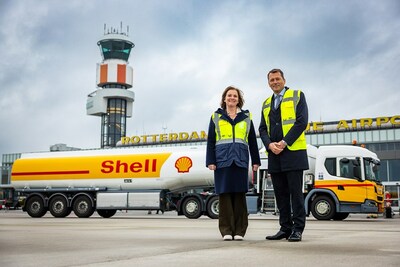
Shell and Rotterdam The Hague Airport (RTHA) have signed a long-term agreement to blend sustainable aviation fuel on all aircraft fuelled at the airport, starting in 2024.

Above: (left to right) Wilma van Dijk, CEO, RTHA and Jan Toschka, President of Shell Aviation.
Courtesy Shell

On top of the European blending mandate of 6%, the airport will accelerate its efforts by setting itself a minimum target of 8% to meet the more ambitious goal of the Dutch aviation sector of 14% by 2030. Using sustainable aviation fuel (SAF) is among the few measures currently available to reduce emissions from international aviation.
 
"Sustainable fuel is essential for the future of aviation", said RTHA's CEO Wilma van Dijk. "This long-term agreement makes it possible for Shell to invest in production facilities while allowing airlines to gradually adapt to a new reality."

Advertisement
Security & Policing Rectangle

"It's fantastic to support Rotterdam The Hague Airport on decarbonising flights through the use of SAF," added Jan Toschka, President of Shell Aviation. "It is particularly encouraging to see an airport committing to long-term SAF agreements, for volumes above the levels required under EU mandates. This type of ambition helps play an important role in providing strong, stable demand that is necessary for scaling up the supply and use of SAF."

Benefits of SAF
The added part sustainable fuel can lead to a CO₂ reduction of on average 80% across the chain. Besides this, sustainable fuel leads to a reduction of soot and ultrafine particle emissions, which at higher percentages of blending, improves air quality.

Shell is building an 820,000-tonnes-a-year biofuels facility at the Shell Energy and Chemicals Park Rotterdam, which will produce SAF and renewable diesel made from waste.

Phasing in SAF
For the moment, SAF is still much more costly than fossil kerosene. For this reason and because large-scale production of SAF has yet to take off, it is important to phase in additional blending requirements. RTHA has chosen to sign a long-term agreement with Shell in order to offer transparency on the growth path and cost for the users at the airport.

More blending necessary to meet targets
As a result of the European blending mandate, the aviation sector must blend in 2% SAF across the board by 2025. The target for 2030 is 6%. However, this is not enough to meet the Dutch aviation sector's more ambitious target of 14% SAF by 2030, as set out in the Sustainable Aviation Agreement.

Advertisement
ODU RT

RTHA therefore wants to speed things up by raising the target for 2024 by an additional two percentage points. This will be followed by incremental yearly increases of at least one percentage point until 2030, making for a total additional increase of minimal eight percentage points by 2030, on top of the statutory 6%. Thanks to this extra blending push, the 14% SAF target will be met at Rotterdam The Hague Airport.




Advertisement
ECS leaderboard banner
NPAS increases aircraft available for deployment

Aerospace Security

NPAS increases aircraft available for deployment

19 February 2026

In January this year, the National Police Air Service (NPAS) was able to increase the number of aircraft that were available for operational deployment.

Alloyed secures ATI Programme funding to develop ABD-1000AM

Aerospace

Alloyed secures ATI Programme funding to develop ABD-1000AM

19 February 2026

Developer and manufacturer of advanced metallic components, Alloyed Ltd, has secured funding from the ATI Programme for an ambitious £1 million project to accelerate the development of ABD-1000AM, a next-generation nickel-based superalloy designed for additive manufacturing.

Birmingham Airport publishes new sustainability strategy

Aerospace

Birmingham Airport publishes new sustainability strategy

19 February 2026

Birmingham Airport (BHX) has published its new sustainability strategy for 2026 to 2030, outlining the next strategic steps on its journey to becoming a more sustainable and socially responsible business.

UK hydrogen airport trial sets out roadmap for further studies

Aerospace

UK hydrogen airport trial sets out roadmap for further studies

18 February 2026

A new report into the UK’s first airside trial of multiple hydrogen-powered ground support equipment (GSE) has confirmed that hydrogen can be safely and effectively integrated into airport ground operations, whilst setting out a series of essential next steps needed to accelerate hydrogen adoption and decarbonisation across the aviation sector.

Advertisement
PTC rectangle
Kent collaborates on Pre-FEED study for Eq.flight SAF demo plant

Aerospace

Kent collaborates on Pre-FEED study for Eq.flight SAF demo plant

18 February 2026

Integrated energy services partner, Kent, has collaborated with Equilibrion during a successful bid for funding from the UK Department for Transport’s Advanced Fuels Fund (AFF) and with that funding for Equilibrion and its partners, Kent is delivering the Pre-Front-End Engineering Design (Pre-FEED) for Eq.flight, an advanced power-to-liquids ...

TEKEVER launches UAS Training School at West Wales Airport

Aerospace

TEKEVER launches UAS Training School at West Wales Airport

18 February 2026

Today, provider of AI-centred uncrewed aerial systems, TEKEVER, has announced the official opening of its new Training School at West Wales Airport.

Advertisement
PTC rectangle
Advertisement
ECS leaderboard banner