

SonoChem System wins UK Space Agency’s Aqualunar Challenge


Above: SonoChem System by Naicker Scientific.
Credit: Max Alexander
The Aqualunar Challenge is a £1.2 million international prize funded by the UK Space Agency’s International Bilateral Fund and delivered by Challenge Works – part of Nesta. It aims to drive the development of innovative technologies that make human habitation on the Moon viable by purifying water buried beneath the lunar surface.
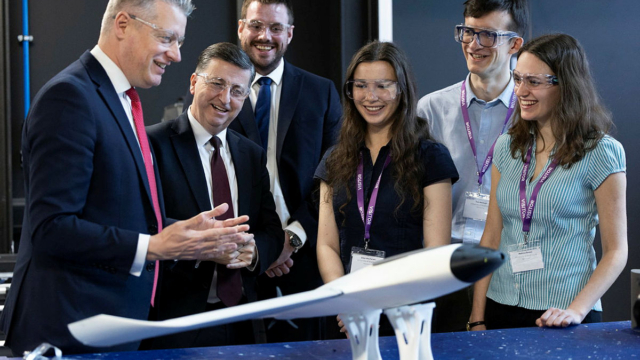
The SonoChem System by Gloucestershire-based Naicker Scientific, led by Lolan Naicker, was named the winner by UK Space Agency’s Meganne Christian at a ceremony in Canada House in London’s Trafalgar Square, where the team was awarded the £150,000 first prize.
Meganne Christian, European Member of the Astronaut Reserve, Commercial Exploration at the UK Space Agency and chair of the Aqualunar Challenge judging panel, said: "NASA has set the goal of establishing a permanent crewed base on the Moon by the end of the decade. The Artemis programme, as it is known, is supported by the UK Space Agency through its membership of the European Space Agency.
"Astronauts will need a reliable supply of water for drinking and growing food, as well as oxygen for air and hydrogen for fuel. 5.6% of the soil (known as ‘regolith’) around the Moon’s south pole is estimated to be water frozen as ice. If it can be successfully extracted, separated from the soil and purified, it makes a crewed base viable."
The SonoChem System employs Naicker Scientific’s groundbreaking core technology to purify water derived from lunar ice. Harnessing powerful sound waves, it spontaneously forms millions of tiny bubbles in contaminated water. The extreme temperature and pressure created within each micro bubble generates free radicals (unstable atoms which are highly chemically reactive) which effectively removes contaminants.
Lolan Naicker, Technical Director, Naicker Scientific explained: "Imagine digging up the soil in your back garden in the middle of winter and trying to extract frozen water to drink. Now imagine doing it in an environment that is -200°C, a nearly perfect vacuum, under low gravity, and with very little electrical power. That’s what we will have to overcome on the Moon.
"If we can make the SonoChem System work there, we can make it work anywhere, whether that’s on Mars’ glaciers, or here on Earth in regions where accessing clean water is still a challenge."
UK Science Minister, Lord Vallance said: "The Aqualunar Challenge was set up to overcome one of the most significant obstacles to humans surviving on the Moon or other planets – the availability of clean drinking water. By teaming up with our Canadian partners and harnessing the wealth of talent and creativity found across the UK, the challenge has uncovered a range of new ideas, including Naicker Scientific’s SonoChem system.
"Many of these ideas could not only fuel future space exploration, but also help improve lives and solve water shortages here on Earth – mitigating the impacts of climate change as we work towards a net zero future, a key ambition in our Plan for Change."
Naicker Scientific was awarded the £150,000 first prize, with two runners up winning £100,000 and £50,000 respectively:
First runner up: FRANK – Filtered Regolith Aqua Neutralisation Kit – developed by father and sons team RedSpace Ltd, Aldershot. A three-stage approach designed to deliver a continuous flow of drinking-grade water in a lunar environment first heats the regolith sample in a sealed chamber to separate off volatile gases and leave a liquid of water, methanol and regolith fragments. The liquid is passed through a membrane to remove solid particles. The remaining liquid is distilled to separate the methanol from the water.

Above: FRANK – Filtered Regolith Aqua Neutralisation Kit – by RedSpace Ltd.
Credit: Max Alexander
Second runner up: AquaLunarPure: Supercritical Water Purification on the Moon – developed by Queen Mary University of London. A reactor melts lunar ice to separate the dust and rock particles, then heats it to more than 373°C at 220 bars of pressure to turn it into “supercritical water” – not a solid, a liquid or a gas but a fourth state that appears like a thick vapour – in which oxidation will remove all the contaminants in one step.

Above: AquaLunarPure by Queen Mary University of London.
Credit: Max Alexander
Ten finalist teams were each awarded £30,000 seed funding in July 2024 to develop their technologies in pursuit of the prize and provided with a comprehensive package of non-financial support, including expert mentoring and access to testing facilities.
The Aqualunar Challenge is delivered by Challenge Works – part of the UK’s innovation agency for social good, Nesta – and the UK Space Agency, in collaboration with the Canadian Space Agency (CSA) and Impact Canada, with half the prize being awarded to UK-led teams, and half being awarded to Canadian-led teams.
Holly Jamieson, Executive Director, Challenge Works said: "Challenge prizes are open innovation competitions that level the playing field for innovators whether they are well-established in a sector or coming to it for the first time – rewarding ideas rather than reputations. The Aqualunar Challenge successfully attracted new entrants to work in the space sector – a sector that already generates £19 billion of income a year in the UK, but where there is great potential for growth.
"Competing teams have reported back that participating in the prize has helped them secure investment and open up commercial conversations to grow their businesses. There may only be one first prize, but the Aqualunar Challenge has produced many winners."
To find out more about the Aqualunar Challenge in the UK and learn more about all ten competing teams, visit aqualunarchallenge.org.uk
Sign up for our newsletter and get our latest content in your inbox.
Similar Reads

Sign up for our newsletter. Select all sectors relevant to you.
Related