Jet Zero Taskforce’s first annual report launched at SSWS
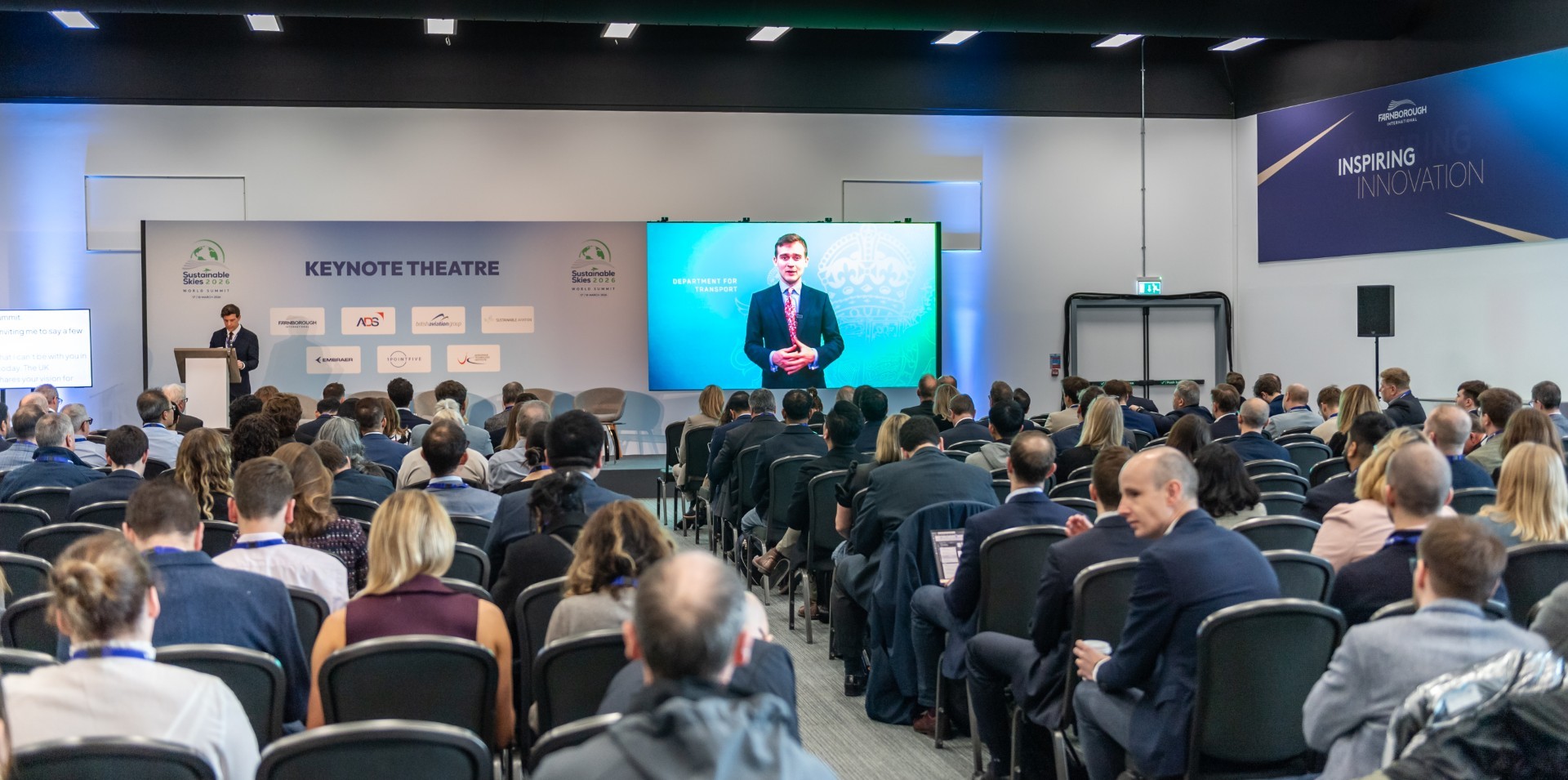
Above: Keir Mather MP, addressing the Sustainable Skies World Summit yesterday via video and launching the Jet Zero Taskforce’s first annual report.
Courtesy FIL
The Jet Zero Taskforce: 2025 annual report highlights the major milestones achieved in 2025 through close collaboration between the government, industry and academia, marking a shift from planning to delivery in the UK’s net-zero aviation strategy.

Speaking at the summit, Keir Mather MP said the Government shares the industry’s ambition for 'truly sustainable skies': “The progress we are making is encouraging but we must be clear eyed that there is still a long way to go on this journey and there are real challenges ahead but there are enormous opportunities too.
“The green transition is not only about protecting our planet but also about strengthening our economy and our resilience. In an uncertain world, energy security has never been more important and that is why we must keep building momentum, boosting the production and deployment of SAF, backing technological renovation, improving efficiency and building robust carbon markets.”
Central to progress is the introduction of the UK’s Sustainable Aviation Fuel (SAF) Mandate in January 2025, which requires fuel suppliers to blend SAF starting at 2% and rising to 10% by 2030. The policy is expected to cut emissions while supporting a domestic SAF industry. The Government has also advanced a Revenue Certainty Mechanism to unlock private investment and awarded £63 million through the Advanced Fuels Fund.
Industry has responded with increased SAF supply, new production facilities and partnerships such as Project Speedbird, alongside financial incentives from airlines and airports to accelerate uptake.
Advances in zero-emission flight have also been made, including expansion of the Hydrogen Challenge programme and nearly £240 million in joint funding for next-generation aerospace technologies. Operational improvements, including the creation of a UK Airspace Design Service and more efficient aircraft spacing, are already delivering emissions reductions and improved performance.
The report also highlights progress on long-term solutions, including frameworks for greenhouse gas removals (GGRs) and carbon capture, alongside new research and trials to tackle non-CO₂ impacts such as contrails.
Complementing the report, Sustainable Aviation announced a £2 million 'Advanced Market Signal' initiative to help scale the GGR market, with members committing to purchase carbon removal credits. The sector estimates it will require 20–30 million tonnes of removals annually by 2050.
Sustainable Aviation also outlined steps to address non-CO₂ emissions, including improved real-time data, targeted SAF use, smarter flight paths and closer scientific collaboration.
Duncan McCourt, Chief Executive of Sustainable Aviation, said: “The UK aviation industry is working hard to address its climate impact.
“Scaling Greenhouse Gas Removals is essential for hard-to-abate sectors, and this Advanced Market Signal is the aviation industry acting now to help stimulate the growth of the GGR sector.
“We have also made clear today that the aviation industry supports action to address the non-CO₂ impact of aviation. By accelerating research, trials and collaboration, we can deliver practical solutions that reduce aviation’s full climate impact.”
Following the publication of the government’s Jet Zero Taskforce 2025 Annual Report, Karen Dee, Chief Executive of AirportsUK, the trade body for UK airports, said: “We welcome this report and the role it plays in illustrating the measures the aviation sector is taking to ensure it can meet its decarbonisation targets and therefore be able to continue growing sustainably.
“It is vitally important that the good work that was done in 2025 is built upon in 2026 and that government continues to ensure the right frameworks are in place to support programmes like airspace modernisation and the development of a domestic SAF industry.
“The UK continues to lead the world in our efforts to decarbonise aviation and stands to benefit in the form of new jobs, new investment, energy security and other aspects, so we must not let up now.”
Taking place 17th-18th March 2026, Sustainable Skies World Summit convenes the global aviation community and provides a platform for collaboration, innovation and concrete action toward achieving the industry's NetZero goals.
Registration is still open and the event is free to attend: https://sustainableskies.co.uk
For more information on the Jet Zero Taskforce report, visit: https://www.gov.uk/government/publications/jet-zero-taskforce-2025-annual-report
For more information on the Sustainable Aviation, visit: https://www.sustainableaviation.co.uk